Grade 12 Physical Sciences · Chemical Change · Paper 2 (Chemistry)
Rates of Reaction Grade 12
Real Rates of Reaction past paper questions and answers from 2024 to 2025, with each memo split into the ticks examiners give. Try one, mark yourself, and see exactly which skill cost you marks.
- past paper questions
- 176 past paper questions
- skills
- 10 skills
- videos
- 10 videos
Try a Rates of Reaction exam question
No sign-up. Takes 3 minutes.
Question 5.1 · November 2025 · Paper 2 · National (DBE) · 2 marks
Work it out on paper first. Then mark yourself with the official memo, one tick at a time.
Rates of Reaction skills
Each skill is one thing a memo gives a tick for. Tap one for its own questions, notes and videos.
- Define rate and energy termsGive the exact meaning of words like exothermic, endothermic, activation energy, activated complex, reaction rate and catalyst.22 past paper questions · 3 videos
- Interpret the energy change of reactionsDecide if a reaction is exothermic or endothermic from ΔH or an energy graph, and calculate ΔH or activation energy (burning releases heat, so ΔH < 0).52 past paper questions · 3 videos
- Explain rate using collision theoryExplain how temperature, concentration, surface area or a catalyst changes reaction rate using particle collisions (powder reacts faster than lumps).28 past paper questions · 4 videos
- Calculate reaction rateCalculate reaction rate as change in amount over change in time (20 cm³ of gas made in 10 s is 2 cm³/s).17 past paper questions · 3 videos
- Interpret reaction rate graphsRead reaction rate graphs to see when a reaction is fastest or stops, or sketch the curve for new conditions such as a higher temperature.18 past paper questions · 3 videos
- Sketch a Maxwell-Boltzmann curveSketch or read the curve of how many particles have each kinetic energy, and show how it shifts at a higher temperature.17 past paper questions · 3 videos
- Identify variables in an investigationName the independent, dependent and controlled variables in an experiment (in a test of temperature on reaction rate, temperature is independent).50 past paper questions · 3 videos
- Write investigative question or conclusionWrite an investigative question, hypothesis or conclusion that links two variables (How does the length of a wire affect its resistance?).38 past paper questions · 3 videos
- Describe and evaluate an experimentName apparatus, describe or explain steps of a method, and give safety precautions (repeat readings and work out an average).18 past paper questions · 3 videos
- Read a graph of resultsRead values from a graph or table of results, or calculate a gradient (finding resistance from the gradient of a V-I graph).38 past paper questions · 3 videos
More Rates of Reaction Grade 12 questions and answers
Try each one on paper before you open the memo.
4. Question 4.2.1 · November 2025 · Paper 1 · National (DBE) · 3 marks
Cricketers at an academy conduct an experiment to determine the relationship between the contact time and the final momentum of a ball for a constant average net force.
A cricket ball of mass g is thrown horizontally with a certain initial velocity and is struck by a bat so that the ball moves in the opposite direction, as shown in the diagram below. The average net force acting on the ball is horizontal.
The experiment is repeated using the same ball. The average net force and the initial velocity of the ball are kept constant. The contact time between the bat and the ball is changed EACH time. The results obtained are shown in the sketch graph below.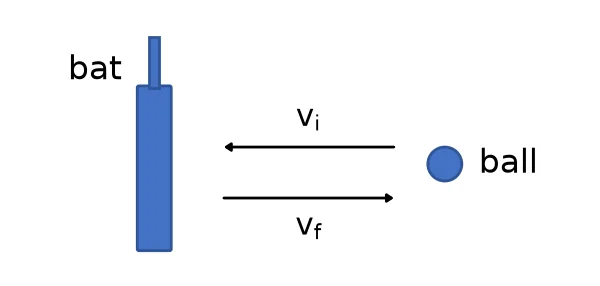
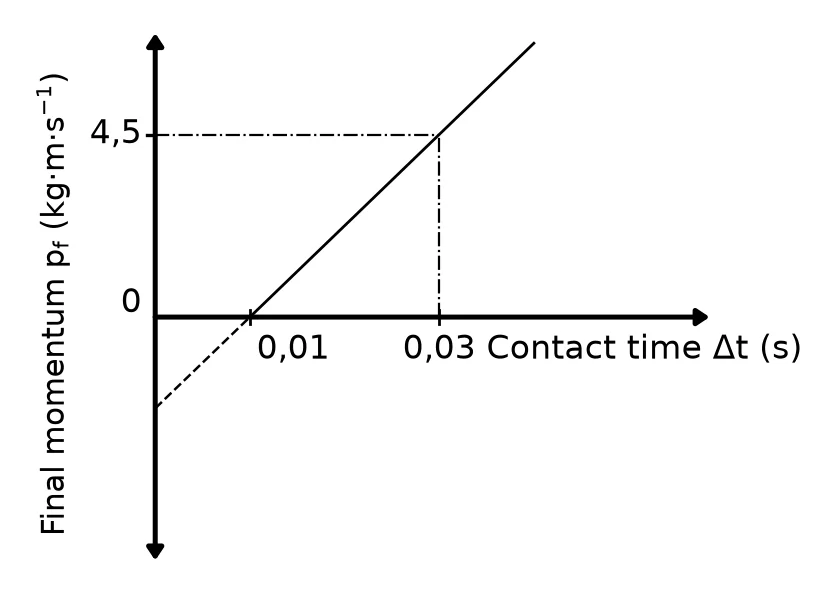 4.2 Calculate the:4.2.1 Average net force acting on the ball(3)
Show the memo (3 ticks)Memo
- ✓METHOD 1: Change in final momentum (numerator)Gradient
1 mark · Read a graph of results
- ✓METHOD 1: Change in contact time (denominator) N
1 mark · Read a graph of results
- ✓METHOD 1: Answer with direction N to the right / opposite to the original direction of the ball
1 mark · Read a graph of results
- ✓
5. Question 10.3.2 · May/June 2025 · Paper 1 · National (DBE) · 4 marks
Light of different frequencies is incident on a metal plate. The sketch graph below shows the relationship between the maximum kinetic energy, , of the photoelectrons and the energy of the incident photons.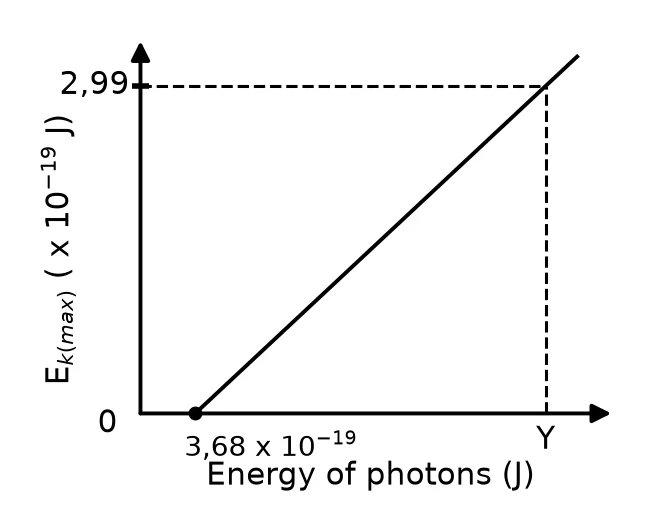 10.3 Calculate the:10.3.2 Value of Y(4)
Show the memo (4 ticks)Memo
- ✓METHOD 1: Formula (or )
1 mark · Use the photoelectric equation
- ✓METHOD 1: Work function
1 mark · Use the photoelectric equation
- ✓METHOD 1: Kinetic energy
1 mark · Use the photoelectric equation
- ✓METHOD 1: Answer (J)
1 mark · Use the photoelectric equation
- ✓
6. Question 6.3 · November 2025 · Paper 1 · National (DBE) · 2 marks
An investigation is performed to determine the relationship between the velocity of a moving sound source and the frequency of the sound detected.
The siren of an ambulance produces sound with a constant frequency. The ambulance, with its siren on, moves towards a stationary sound detector (Part A) and away from the stationary sound detector (Part B) at constant velocities. The experiment is repeated for different velocities of the ambulance. The detected frequency is measured for EACH velocity. The results obtained are shown in the graph below.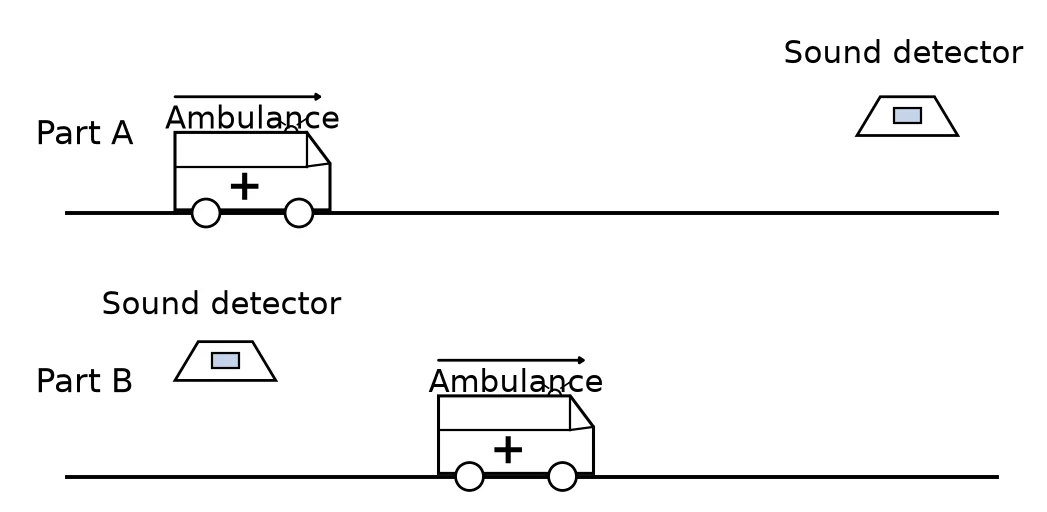
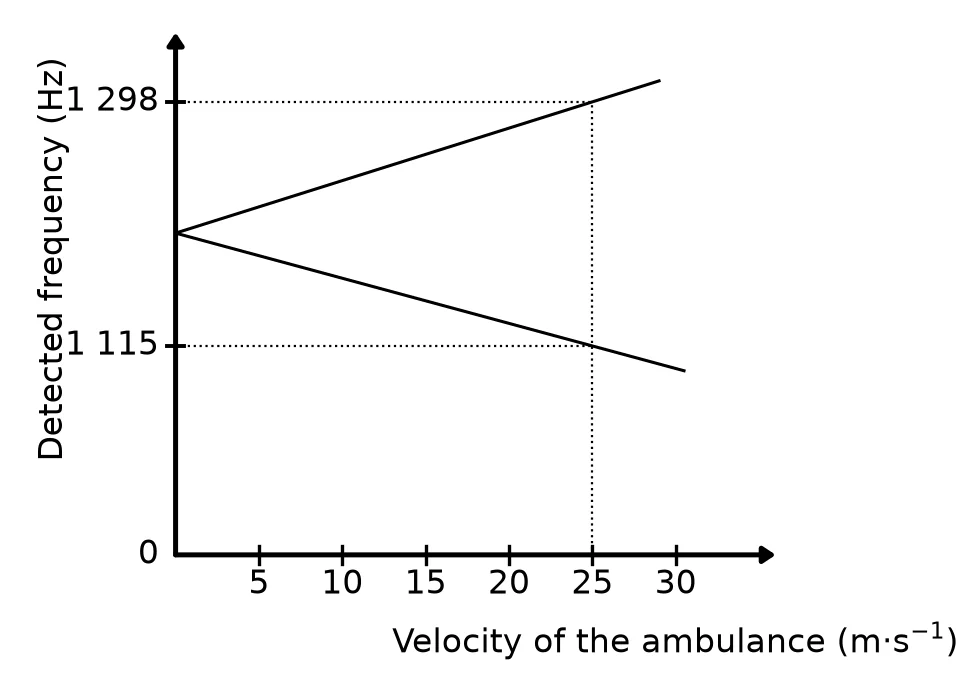 6.3 What conclusion can be made for Part B of this experiment?(2)
Show the memo (1 tick)Memo
- ✓Conclusion for Part BAs the velocity of the ambulance increases, the detected frequency decreases.
- ✓
7. Question 1.4 · May/June 2025 · Paper 2 · National (DBE) · 2 marks
1.4 Two gases are added into each of four empty containers at the same temperature. The diagrams below show the molecules of the gases and the volumes of the containers at the start of the reaction.
In which ONE of the following containers is the initial reaction rate the highest?(2)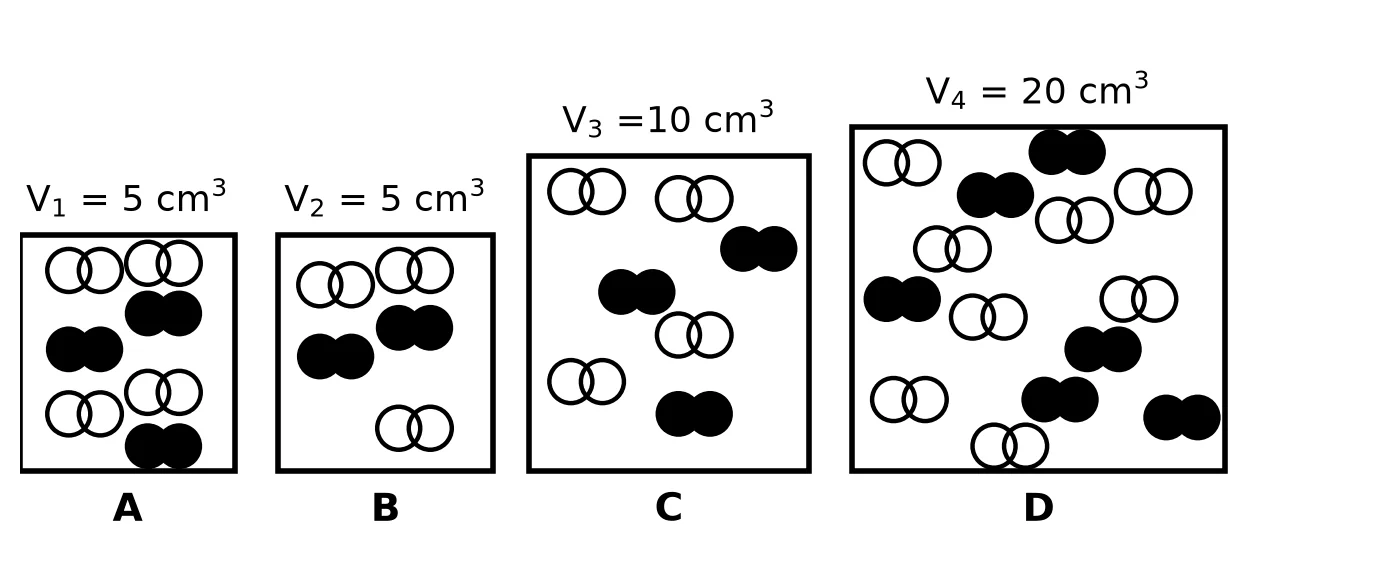
Show the memo (1 tick)Memo
- ✓Correct optionCount the molecules per volume: A has 7 molecules in cm, B has 5 in cm, C has 7 in cm and D has 14 in cm. A has the most particles per unit volume (highest concentration), so the most effective collisions per unit time.
Answer: A2 marks · Explain rate using collision theory
- ✓
8. Question 4.1.3 · May/June 2024 · Paper 2 · National (DBE) · 2 marks
4.1 In an experiment, a test tube containing methanol, propanoic acid and a catalyst is heated in a water bath, as shown below.
Write down: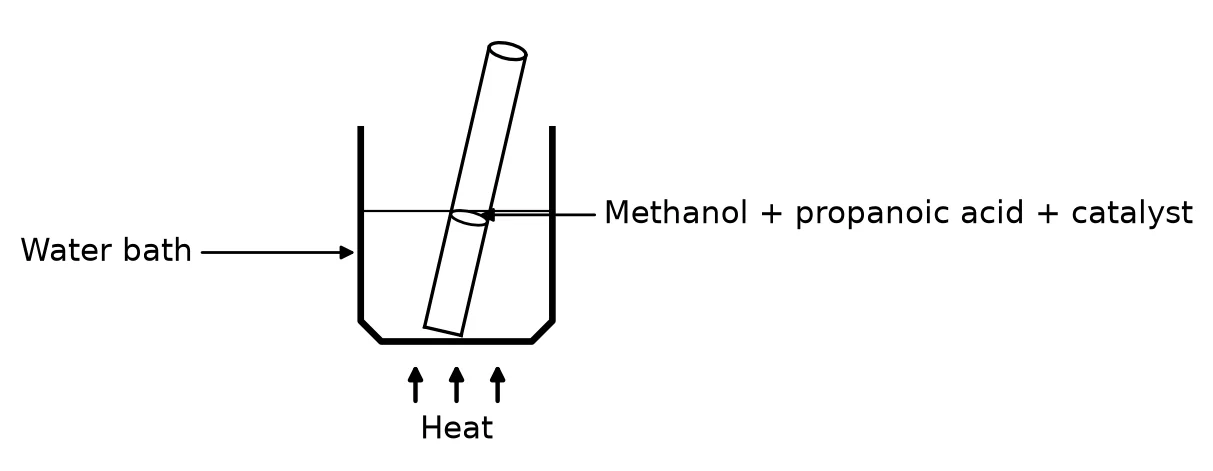 4.1.3 TWO reasons why the use of a water bath is preferred in this experiment(2)
Show the memo (2 ticks)Memo
- ✓First reasonAlcohol/methanol/reactant is flammable/catches fire easily.
1 mark · Describe and evaluate an experiment
- ✓Second reasonTo heat evenly / a steady, controlled, gradual increase in temperature. (OR: Alcohol/methanol will evaporate too quickly/is volatile.)
1 mark · Describe and evaluate an experiment
- ✓
9. Question 5.1.1 · May/June 2024 · Paper 2 · National (DBE) · 2 marks
The reaction between aluminium and EXCESS sulphuric acid is used to investigate factors affecting rates of reactions.5.1 INVESTIGATION I
The effect of a catalyst on the rate of reaction is determined.
Aluminium powder of mass 5 g reacts with excess mol·dm at °C.
Consider the following energy diagrams (not drawn to scale) for this investigation. X and Y in diagram B represent the activation energies.
Answer the questions that follow.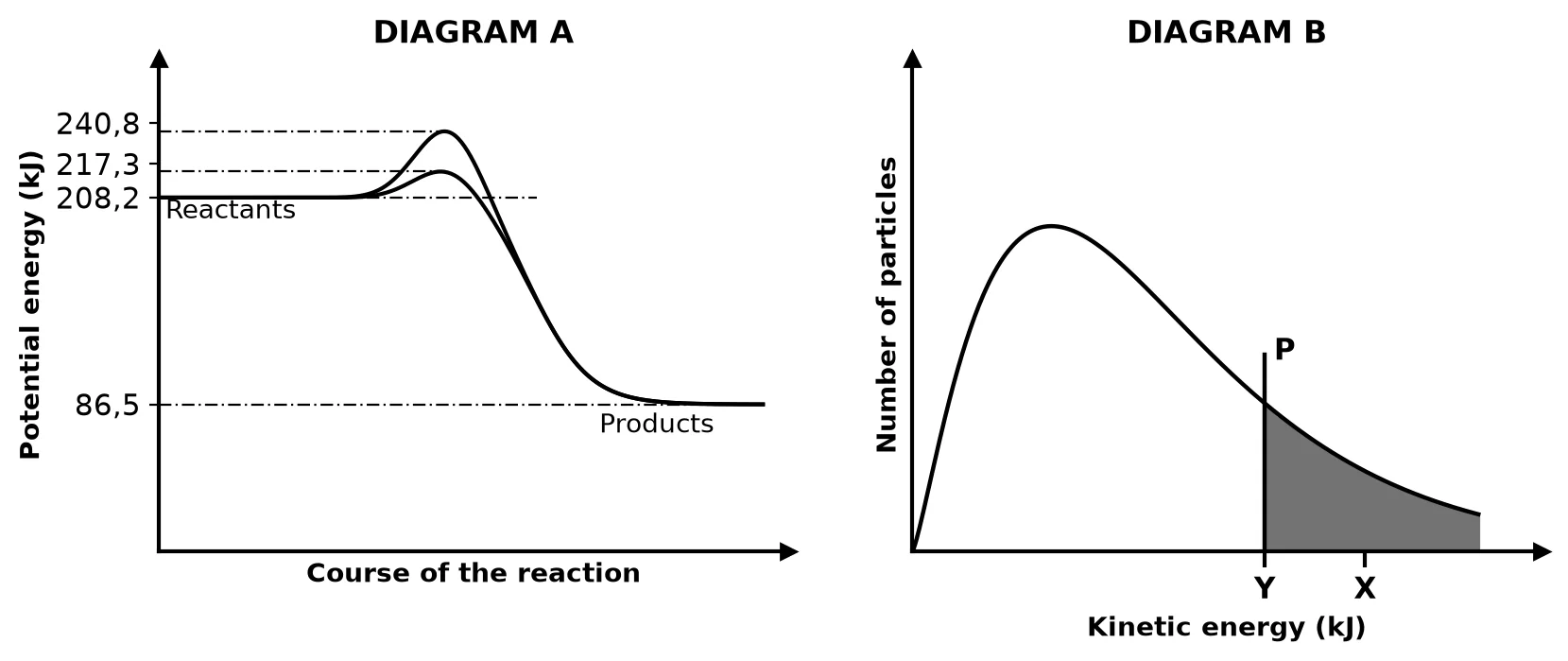 5.1.1 Is the reaction between Aℓ(s) and dilute (aq) ENDOTHERMIC or EXOTHERMIC? Give a reason for the answer by referring to the above diagrams.(2)
Show the memo (2 ticks)Memo
- ✓ExothermicExothermic
- ✓ReasonLower (potential) energy of the products than reactants. / / negative / kJ / More energy is released than absorbed.
- ✓
10. Question 5.1.2 · November 2024 · Paper 2 · National (DBE) · 6 marks
5.1 The reaction between pure aluminium, Aℓ(s), and EXCESS hydrochloric acid, HCℓ(aq), is used to investigate the factors that affect the rate of a reaction.
The balanced equation for the reaction is:
Answer the questions that follow.EXPERIMENT I
In this experiment, mol·dm HCℓ solution reacts with a g Aℓ strip from an aluminium roll at room temperature.
The graph of volume (g) versus time for this experiment, not drawn to scale, is shown below.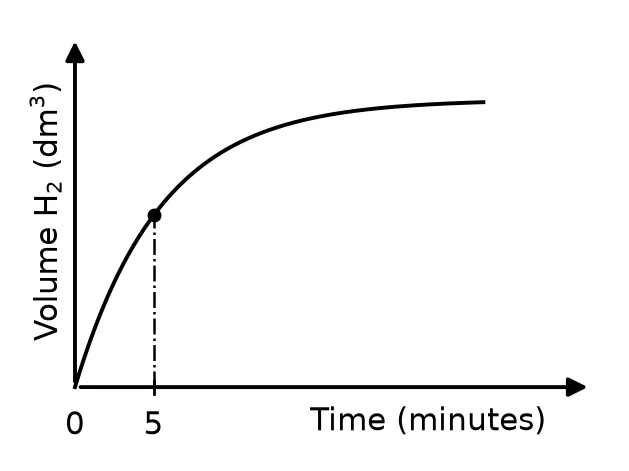 5.1.2 For the time interval t = 0 to t = 5 minutes, the average reaction rate for the formation of (g) is dm·min.
Calculate the mass of Aℓ present in the container at t = 5 minutes.
Take the molar gas volume as dm·mol.(6)Show the memo (6 ticks)Memo
- ✓(a) Substitute 0,033 and 5 in rate formulaRate
dm1 mark · Calculate reaction rate
- ✓(b) Substitute 24,5 in mol
1 mark · Calculate number of moles
- ✓(c) Use mol ratio n(Aℓ) : n(H) = 2 : 3 mol
1 mark · Use the mole ratio
- ✓(d) Substitute 27 g·mol in
g (0,121) used1 mark · Calculate number of moles
- ✓(e) Subtract m(Aℓ) used from m(Aℓ) initial
1 mark · Identify the limiting reagent
- ✓(f) Final correct answer g (0,379 g)
1 mark · Identify the limiting reagent
- ✓
Rates of Reaction Grade 12 videos
Short lessons from South African teachers first. Videos load only when you tap play, to save your data.
Free on Android
Know exactly which skill is costing you marks.
Mark past papers tick by tick in the NavyBlue app. It remembers every mark you lose, shows you the skills to fix first, and picks your next questions.
Get NavyBlue free on Google Play
