Grade 12 Physical Sciences · Paper 2 (Chemistry)
Chemical Change Grade 12
Real past paper questions and answers from 2024 to 2025, with each memo split into the ticks examiners give. Try one, mark yourself, and see exactly which skill cost you marks.
- past paper questions
- 325 past paper questions
- skills
- 34 skills
- videos
- 34 videos
Try a real exam question
No sign-up. Takes 3 minutes.
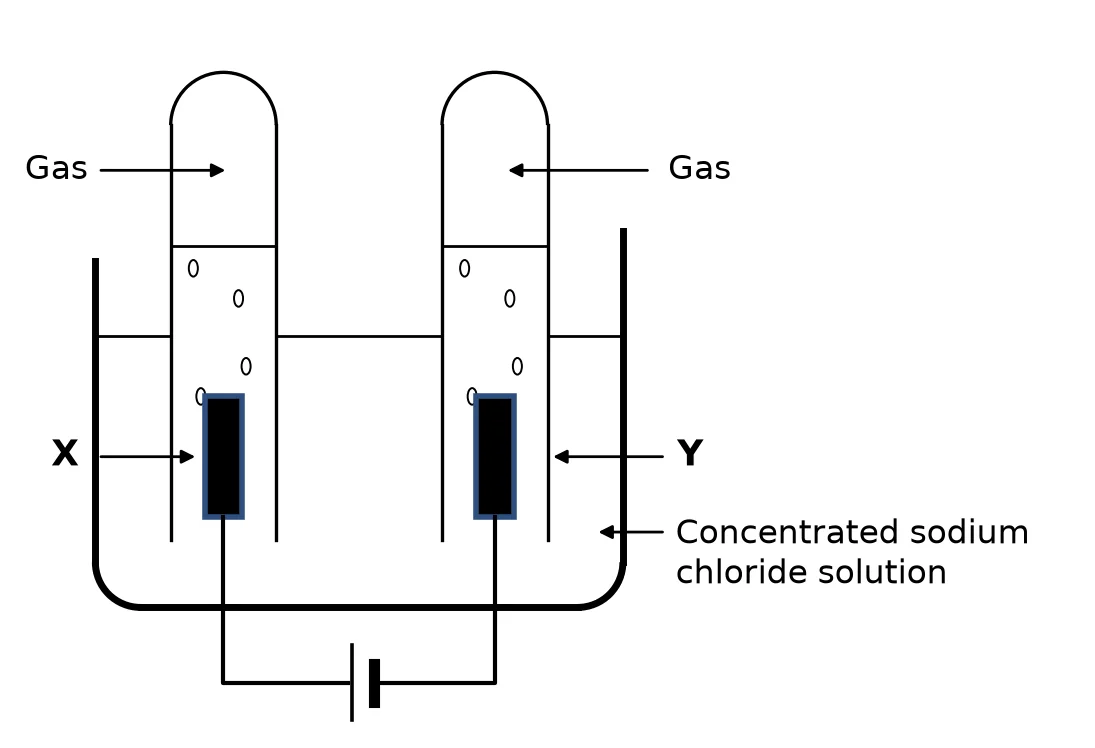
Question 9.1 · May/June 2025 · Paper 2 · National (DBE) · 2 marks
X and Y are carbon electrodes.
Work it out on paper first. Then mark yourself with the official memo, one tick at a time.
What's in Chemical Change Grade 12
Each skill is one thing a memo gives a tick for. Tap a skill for its own questions, notes and videos.
Reaction Rate84 past paper questions
- Define rate and energy termsGive the exact meaning of words like exothermic, endothermic, activation energy, activated complex, reaction rate and catalyst.10 past paper questions · 3 videos
- Interpret the energy change of reactionsDecide if a reaction is exothermic or endothermic from ΔH or an energy graph, and calculate ΔH or activation energy (burning releases heat, so ΔH < 0).21 past paper questions · 3 videos
- Explain rate using collision theoryExplain how temperature, concentration, surface area or a catalyst changes reaction rate using particle collisions (powder reacts faster than lumps).13 past paper questions · 4 videos
- Calculate reaction rateCalculate reaction rate as change in amount over change in time (20 cm³ of gas made in 10 s is 2 cm³/s).8 past paper questions · 3 videos
- Interpret reaction rate graphsRead reaction rate graphs to see when a reaction is fastest or stops, or sketch the curve for new conditions such as a higher temperature.8 past paper questions · 3 videos
- Sketch a Maxwell-Boltzmann curveSketch or read the curve of how many particles have each kinetic energy, and show how it shifts at a higher temperature.10 past paper questions · 3 videos
- Identify variables in an investigationName the independent, dependent and controlled variables in an experiment (in a test of temperature on reaction rate, temperature is independent).13 past paper questions · 3 videos
- Write investigative question or conclusionWrite an investigative question, hypothesis or conclusion that links two variables (How does the length of a wire affect its resistance?).10 past paper questions · 3 videos
- Describe and evaluate an experimentName apparatus, describe or explain steps of a method, and give safety precautions (repeat readings and work out an average).6 past paper questions · 3 videos
- Read a graph of resultsRead values from a graph or table of results, or calculate a gradient (finding resistance from the gradient of a V-I graph).13 past paper questions · 3 videos
Chemical Equilibrium83 past paper questions
- State equilibrium principle and termsState Le Chatelier's principle in full, or define dynamic equilibrium, a closed system or a reversible reaction.10 past paper questions · 3 videos
- Write the Kc expressionWrite the Kc expression as products over reactants with powers from the balanced equation, leaving out solids and pure liquids.9 past paper questions · 2 videos
- Complete an equilibrium tableFill in a table of initial, change and equilibrium amounts using the mole ratio (if 1 mol N₂ reacts, 3 mol H₂ also reacts).12 past paper questions · 3 videos
- Calculate KcSubstitute equilibrium concentrations into the Kc expression to calculate Kc, or use Kc to find an unknown concentration.10 past paper questions · 3 videos
- Apply Le Chatelier's principlePredict and explain how an equilibrium shifts when concentration, pressure or temperature changes (adding more reactant pushes it towards products).30 past paper questions · 4 videos
- Interpret equilibrium graphsRead concentration-time or rate-time graphs to find when equilibrium is reached and which change was made at a given time.15 past paper questions · 3 videos
- Describe and evaluate an experimentName apparatus, describe or explain steps of a method, and give safety precautions (repeat readings and work out an average).6 past paper questions · 3 videos
- Read a graph of resultsRead values from a graph or table of results, or calculate a gradient (finding resistance from the gradient of a V-I graph).13 past paper questions · 3 videos
Acids and Bases76 past paper questions
- Calculate concentration of a solutionCalculate the concentration of a solution with c = n/V, volume in dm³, or work out a dilution (2 mol in 4 dm³ is 0,5 mol/dm³).37 past paper questions · 3 videos
- Define acid and base termsGive the exact meaning of acid-base words like Lowry-Brønsted acid, strong acid, ampholyte and equivalence point.8 past paper questions · 3 videos
- Identify conjugate acid-base pairsFind the acid, the base and their conjugates in a proton-transfer reaction (in NH₃ + H₂O, NH₄⁺ is the conjugate acid).15 past paper questions · 3 videos
- Write acid-base reaction equationsWrite equations for acids reacting with bases, oxides or carbonates, or with water (HCl + NaOH → NaCl + H₂O).11 past paper questions · 3 videos
- Use acid-base indicatorsExplain what an indicator is and give its colour in acids or bases (phenolphthalein turns pink in a base).3 past paper questions · 2 videos
- Compare strong and weak acidsTell strong from weak acids and concentrated from dilute solutions, and give the reason (HCl ionises fully, so it is a strong acid).14 past paper questions · 3 videos
- Calculate and interpret pHCalculate pH with pH = −log[H₃O⁺], or use Kw to find a concentration (a [H₃O⁺] of 0,01 mol/dm³ gives pH 2).12 past paper questions · 3 videos
- Do titration calculationsUse titration results to find an unknown concentration or volume with the mole ratio, for example cₐVₐ/c_bV_b = nₐ/n_b.9 past paper questions · 3 videos
- Predict salt pH and choose indicatorPredict whether a salt solution is acidic, basic or neutral, and choose a suitable indicator for a titration (sodium ethanoate solution is basic).11 past paper questions · 3 videos
- Describe and evaluate an experimentName apparatus, describe or explain steps of a method, and give safety precautions (repeat readings and work out an average).6 past paper questions · 3 videos
Electrochemical Reactions103 past paper questions
- Calculate current or voltage from chargeCalculate current with I = Q/Δt or potential difference with V = W/Q (5 C passing in 2 s is a current of 2,5 A).10 past paper questions · 3 videos
- Define redox and cell termsGive the exact meaning of redox words like oxidation, reduction, oxidising agent, anode and cathode.12 past paper questions · 3 videos
- Identify oxidising and reducing agentsSay which substance is oxidised or reduced, or which is the oxidising or reducing agent, and why (zinc loses electrons, so it is oxidised).11 past paper questions · 3 videos
- Write half-reactionsWrite the oxidation or reduction half-reaction for a substance, with electrons on the correct side (Cu²⁺ + 2e⁻ → Cu).14 past paper questions · 3 videos
- Combine half-reactions into net equationCombine two half-reactions so the electrons cancel to give the balanced overall reaction (Zn + Cu²⁺ → Zn²⁺ + Cu).6 past paper questions · 3 videos
- Compare oxidising and reducing agent strengthUse the table of standard reduction potentials to decide which substance is oxidised or reduced, and whether a reaction will happen.21 past paper questions · 3 videos
- Calculate the emf of a cellCalculate a cell's emf using E°cell = E°cathode − E°anode, and use a positive value to show the reaction is spontaneous.8 past paper questions · 3 videos
- Describe a galvanic cellDescribe how a galvanic cell makes electricity, including electron flow, the salt bridge and cell notation (chemical energy changes to electrical energy).20 past paper questions · 3 videos
- Describe an electrolytic cellDescribe how an electrolytic cell uses electricity to cause a reaction, including what forms at each electrode (electroplating a spoon with silver).23 past paper questions · 4 videos
More Chemical Change Grade 12 questions and answers
Try each one on paper before you open the memo.
1. Question 1.5 · November 2025 · Paper 2 · National (DBE) · 2 marks
Various options are provided as possible answers to the following questions. Each question has only ONE correct answer.1.5 The following reaction reaches equilibrium in a closed container:
The reaction rate versus time graph for the reaction is given below.
What change was made to the system at time ?(2)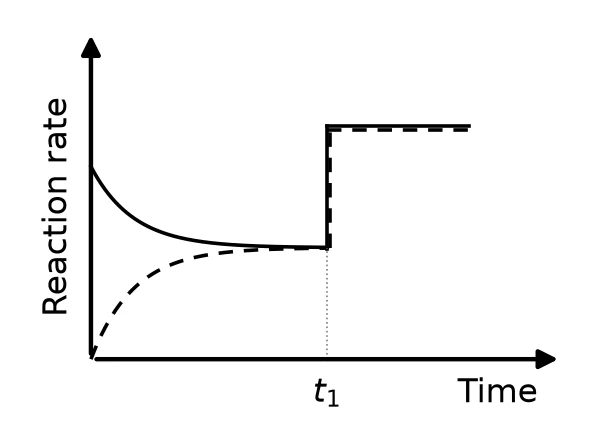
Show the memo (1 tick)Memo
- ✓Correct optionAt both rates jump up suddenly by the same amount and stay equal, so the equilibrium position does not shift. There is 1 mol of gas on each side, so increasing the pressure raises both rates equally. Increasing the temperature would favour the endothermic reverse reaction, so the reverse rate would rise more. Adding would only make the forward rate jump. Increasing the volume would lower the rates.
Answer: A2 marks · Interpret equilibrium graphs
- ✓
2. Question 8.3 · May/June 2024 · Paper 2 · National (DBE) · 2 marks
The relationship between the concentration of the electrolyte and the cell potential is investigated using the following electrochemical cell represented by the cell notation:
Aℓ(s) | (aq) || (aq) | M(s)
The concentration of is changed and the corresponding emf is measured. The concentration of (aq) and the temperature are at standard conditions. The graph below shows the results of this investigation.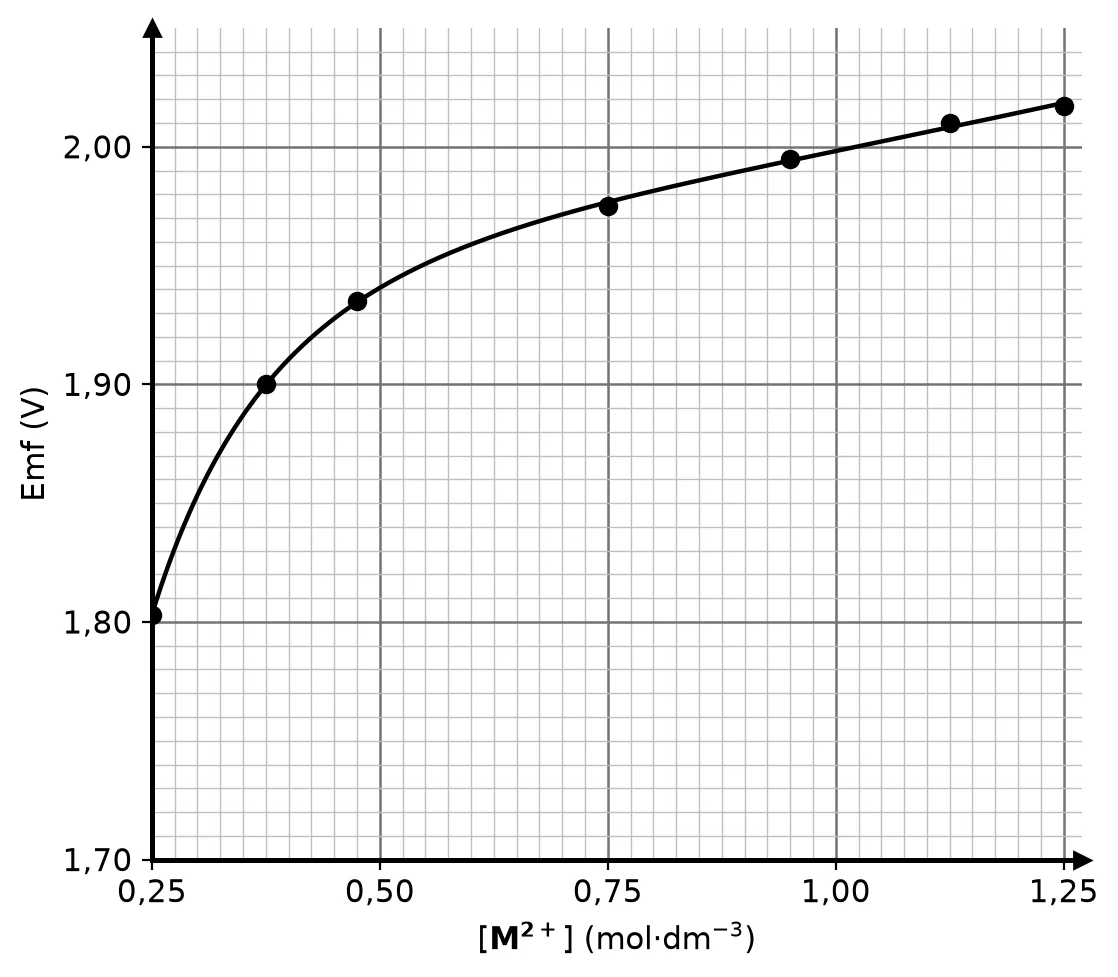 8.3 How will the concentration of (aq) be affected as the cell operates? Choose from INCREASES, DECREASES or REMAINS THE SAME.
Give a reason for the answer.(2)Show the memo (2 ticks)Memo
- ✓Effect on [M]Decreases
1 mark · Describe a galvanic cell
- ✓Reason is reduced / used up / is the oxidising agent.
1 mark · Describe a galvanic cell
- ✓
3. Question 7.1.1 · May/June 2024 · Paper 2 · National (DBE) · 3 marks
7.1 A standard solution is prepared by dissolving 10 g of sodium carbonate, (s), in dm of water.
Answer the questions that follow.7.1.1 Calculate the concentration of the solution.(3)Show the memo (3 ticks)Memo
- ✓Formula
- ✓Substitution
- ✓Answer with unit mol·dm
- ✓
4. Question 4.2.1 · November 2025 · Paper 1 · National (DBE) · 3 marks
Cricketers at an academy conduct an experiment to determine the relationship between the contact time and the final momentum of a ball for a constant average net force.
A cricket ball of mass g is thrown horizontally with a certain initial velocity and is struck by a bat so that the ball moves in the opposite direction, as shown in the diagram below. The average net force acting on the ball is horizontal.
The experiment is repeated using the same ball. The average net force and the initial velocity of the ball are kept constant. The contact time between the bat and the ball is changed EACH time. The results obtained are shown in the sketch graph below.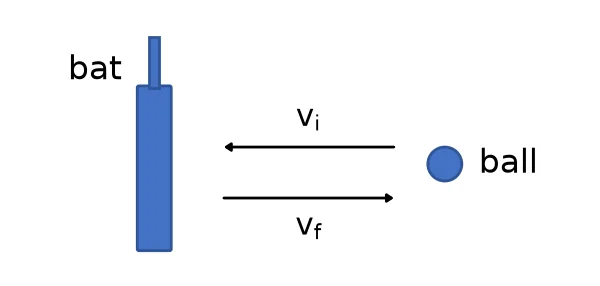
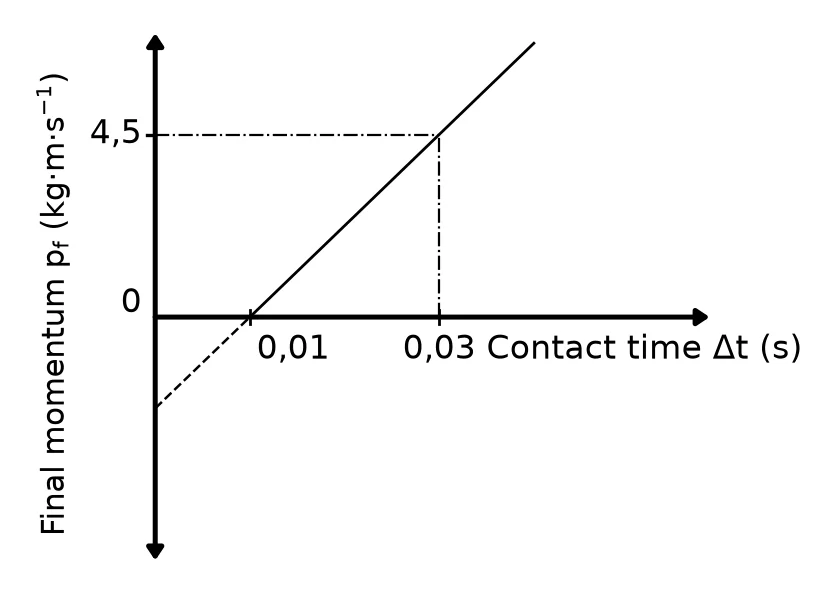 4.2 Calculate the:4.2.1 Average net force acting on the ball(3)
Show the memo (3 ticks)Memo
- ✓METHOD 1: Change in final momentum (numerator)Gradient
1 mark · Read a graph of results
- ✓METHOD 1: Change in contact time (denominator) N
1 mark · Read a graph of results
- ✓METHOD 1: Answer with direction N to the right / opposite to the original direction of the ball
1 mark · Read a graph of results
- ✓
5. Question 1.5 · November 2024 · Paper 2 · National (DBE) · 2 marks
Various options are provided as possible answers to the following questions. Each question has only ONE correct answer. Choose the answer and write only the letter (A–D) next to the question numbers (1.1 to 1.10) in the ANSWER BOOK, e.g. 1.11 E.1.5 Initially, an equal number of moles of hydrogen gas, (g), and iodine gas, (g), are mixed in a closed container. The reaction reaches equilibrium at a constant temperature according to the balanced equation.
Which ONE of the following is ALWAYS TRUE at equilibrium?(2)Show the memo (1 tick)Memo
- ✓Correct option and start with equal amounts and react in a ratio, so the same amount of each is used. At equilibrium both are : always.
How much HI forms depends on , so B, C and D are true only for particular values of .
Answer: A2 marks · Complete an equilibrium table
- ✓
Chemical Change Grade 12 videos
Short lessons from South African teachers first. Videos load only when you tap play, to save your data.
Free on Android
Know exactly which skill is costing you marks.
Mark past papers tick by tick in the NavyBlue app. It remembers every mark you lose, shows you the skills to fix first, and picks your next questions.
Get NavyBlue free on Google Play
