Grade 12 Physical Sciences · Chemical Change · Calculate Kc
Equilibrium Constant Kc Grade 12
Substitute equilibrium concentrations into the K_c expression to calculate K_c, or use K_c to find an unknown concentration.
- questions use it, all grades · 20 past paper, 17 practice
- 37 questions use it, all grades · 20 past paper, 17 practice
- videos
- 3 videos
Learn it: calculate kc
Pick one and watch it, then try the questions below. Videos load only when you tap play.
Now try it on a real exam question
No sign-up. Takes 3 minutes.
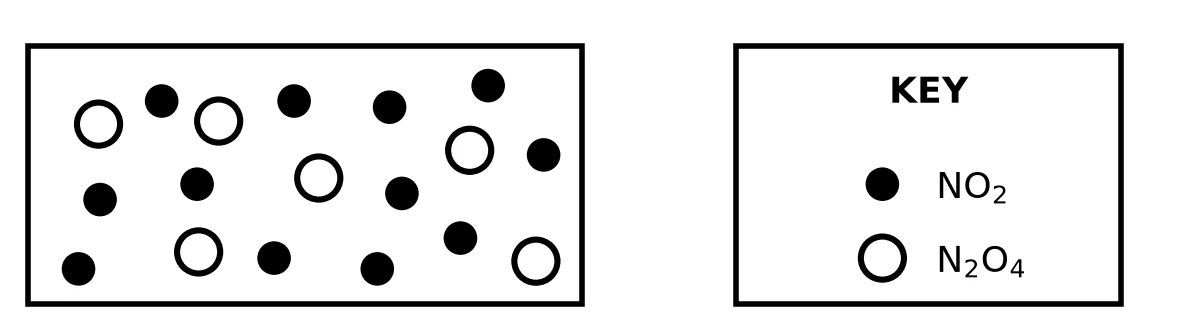
Question 1.5 · November 2023 · Paper 2 · National (DBE) · 2 marks
The balanced equation for this reaction is:
Which ONE of the following is TRUE for the value of the equilibrium constant, , for the reaction at T °C?(2)
Work it out on paper first. Then mark yourself with the official memo, one tick at a time.
More past paper questions: calculate kc
Work each one out first, then open the memo and check every tick.
3. Question 6.2 · November 2022 · Paper 2 · National (DBE) · 4 marks
Carbon, C(s), reacts with sulphur, S(g), according to the following balanced equation:
The system reaches equilibrium at temperature T in a sealed dm container.
The value is at temperature T.At equilibrium, mole of carbon disulphide, (g), is present in the container.6.2 Calculate the concentration of S(g) present at equilibrium.(4)Show the memo (4 ticks)Memo
- ✓Kc expression
1 mark · Write the Kc expression
- ✓Substitute Kc value
1 mark · Calculate Kc
- ✓Substitute [CS₂]
1 mark · Calculate Kc
- ✓Final answer
mol·dm1 mark · Calculate Kc
- ✓
4. Question 6.2.3 · May/June 2022 · Paper 2 · National (DBE) · 6 marks
6.2 The equation below represents the reversible reaction that takes place when (g) is converted to (g).
Initially, mol of (g) is sealed in a dm container at K. When equilibrium is established at this temperature, mol (g) is present in the container.
Answer the questions that follow.moles of (g) is now added to the equilibrium mixture above. When the NEW equilibrium is established at K, it is found that the amount of (g) increased by moles.6.2.3 Calculate the value of .(6)Show the memo (6 ticks)Memo
- ✓Add 0,79 mol to N2O4Initial (new): ; mol
1 mark · Complete an equilibrium table
- ✓Mole ratio: 0,6 mol N2O4Ratio
Change: mol; mol1 mark · Complete an equilibrium table
- ✓New equilibrium amounts mol
mol
Concentrations ( dm): ; mol·dm1 mark · Complete an equilibrium table
- ✓Substitution into Kc expression
1 mark · Calculate Kc
- ✓Equating the two Kc expressions
1 mark · Calculate Kc
- ✓Final answer
(mol)1 mark · Calculate Kc
- ✓
5. Question 6.4 · May/June 2025 · Paper 2 · National (DBE) · 5 marks
The reaction between powdered carbon, C(s), and carbon dioxide gas, (g), takes place in a closed dm container according to the balanced equation below.
Equilibrium is reached at temperature T °C.
The graph below, not drawn to scale, shows the curves for the mass of the reactants in the container against time.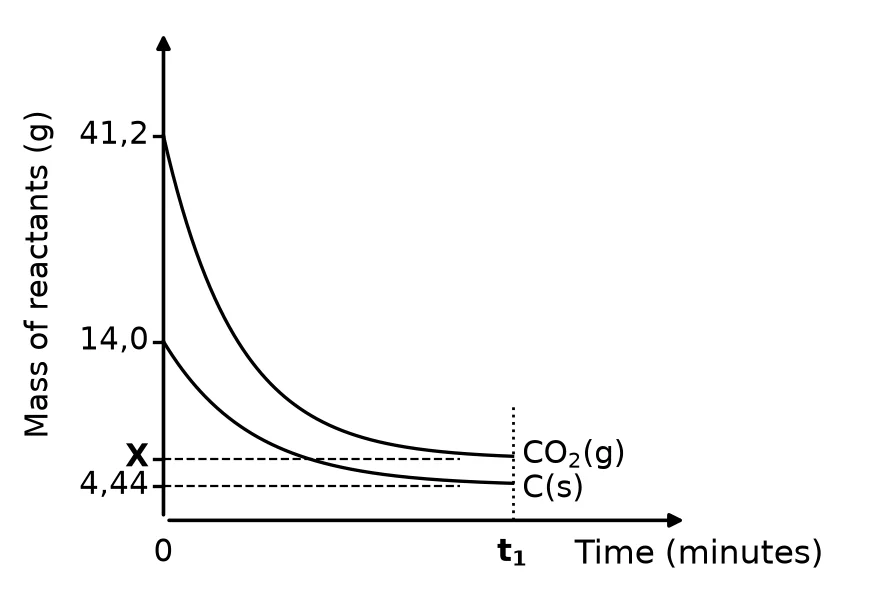 6.4 Calculate the equilibrium constant, Kc, at T °C.(5)
Show the memo (5 ticks)Memo
- ✓(a) Ratio n(CO2) : n(CO) = 1 : 2 mol
Ratio CO : CO = 1 : 2
Initial (mol): CO ; CO
Change (mol): CO ; CO
Equilibrium (mol): CO ; CO1 mark · Complete an equilibrium table
- ✓(b) Divide by 3 dm3Equilibrium concentration (mol·dm): ;
- ✓(c) Kc expression
1 mark · Write the Kc expression
- ✓(d) Substitution
1 mark · Calculate Kc
- ✓(e) Final answer
1 mark · Calculate Kc
- ✓
6. Question 6.2 · September 2026 · Paper 2 · Provincial · 2 marks
The following reversible reaction takes place when cobalt chloride is dissolved in water:
(dark blue) ⇌ (light pink)
The cobalt chloride ion, , has a dark blue colour whereas the cobalt hexahydrate ion, , has a light pink colour.
The system reaches equilibrium and the solution has a light pink colour.6.2 What will the value be for this reaction? Write GREATER THAN ONE or LESS THAN ONE. Give a reason for your answer.(2)Show the memo (2 ticks)Memo
- ✓Kc greater than oneGREATER THAN ONE
1 mark · Calculate Kc
- ✓ReasonForward reaction is favoured / the solution is pink.
1 mark · Calculate Kc
- ✓
Free on Android
Know exactly which skill is costing you marks.
Mark past papers tick by tick in the NavyBlue app. It remembers every mark you lose, shows you the skills to fix first, and picks your next questions.
Get NavyBlue free on Google Play