Grade 12 Physical Sciences · Chemical Change
Explain rate using collision theory
Explain how temperature, concentration, surface area or a catalyst changes reaction rate using particle collisions (powder reacts faster than lumps).
- past paper questions use it
- 13 past paper questions use it
- videos
- 4 videos
Learn it: explain rate using collision theory
Pick one and watch it, then try the questions below. Videos load only when you tap play.
Now try it on a real exam question
No sign-up. Takes 3 minutes.
Question 1.4 · November 2025 · Paper 2 · National (DBE) · 2 marks
Which ONE of the following changes will NOT increase the initial rate of the reaction?(2)
Work it out on paper first. Then mark yourself with the official memo, one tick at a time.
More past paper questions: explain rate using collision theory
Work each one out first, then open the memo and check every tick.
3. Question 5.3.3 · November 2025 · Paper 2 · National (DBE) · 3 marks
5.3 The reaction between sulphur dioxide, (g), and oxygen, (g), takes place in a sealed container according to the balanced equation below.
kJ·mol
Answer the questions that follow.5.3.3 A catalyst, vanadium pentoxide, is added to the reaction. Explain, in terms of the collision theory, why the rate of the reaction will increase.(3)Show the memo (3 ticks)Memo
- ✓Lower activation energyCatalyst provides an alternative path with lower activation energy / lowers the activation energy.
1 mark · Explain rate using collision theory
- ✓More particles with enough energyMore particles have sufficient (kinetic) energy / kinetic energy greater than (or equal to) activation energy.
1 mark · Explain rate using collision theory
- ✓More effective collisions per unit timeMore effective collisions per unit time/second.
OR Higher frequency of effective collisions.1 mark · Explain rate using collision theory
- ✓
4. Question 1.4 · May/June 2025 · Paper 2 · National (DBE) · 2 marks
1.4 Two gases are added into each of four empty containers at the same temperature. The diagrams below show the molecules of the gases and the volumes of the containers at the start of the reaction.
In which ONE of the following containers is the initial reaction rate the highest?(2)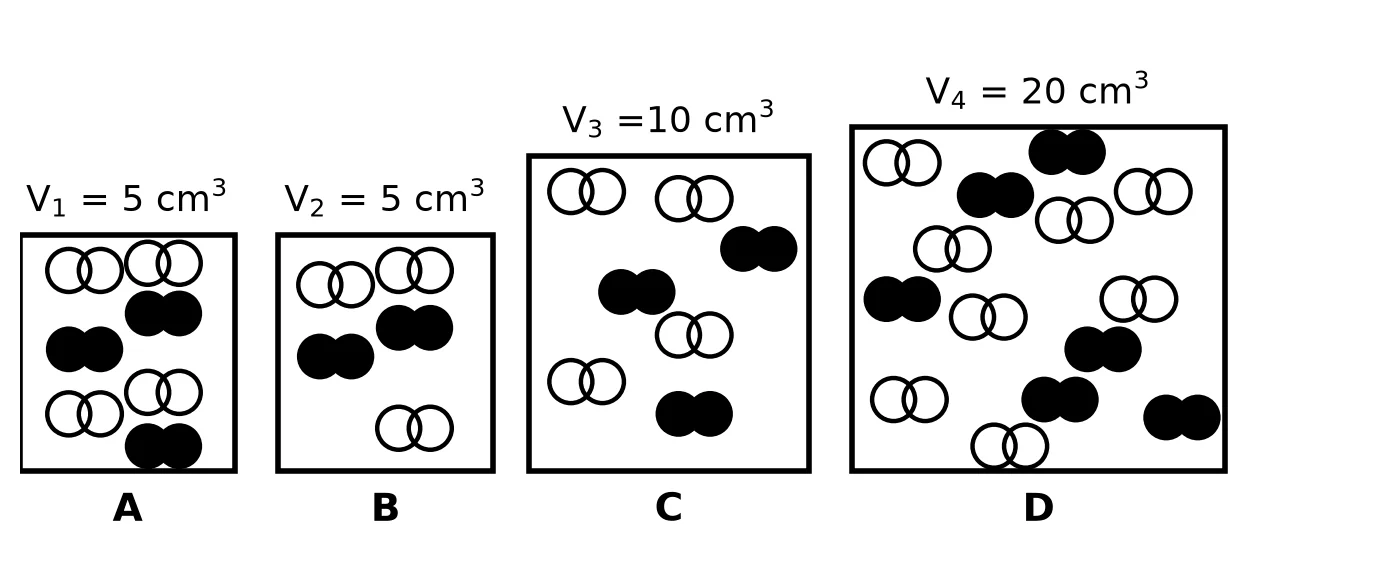
Show the memo (1 tick)Memo
- ✓Correct optionCount the molecules per volume: A has 7 molecules in cm, B has 5 in cm, C has 7 in cm and D has 14 in cm. A has the most particles per unit volume (highest concentration), so the most effective collisions per unit time.
Answer: A2 marks · Explain rate using collision theory
- ✓
5. Question 5.1.3 · November 2024 · Paper 2 · National (DBE) · 4 marks
5.1 The reaction between pure aluminium, Aℓ(s), and EXCESS hydrochloric acid, HCℓ(aq), is used to investigate the factors that affect the rate of a reaction.
The balanced equation for the reaction is:
Answer the questions that follow.Assume that the concentration of the HCℓ(aq) stays constant for the duration of the reaction.5.1.3 Use the collision theory to explain the change in the reaction rate from t = 0 to t = 5 minutes.(4)Show the memo (4 ticks)Memo
- ✓Surface area decreasesThe surface area/contact area/mass/size of aluminium decreases.
1 mark · Explain rate using collision theory
- ✓Less particles exposedLess particles exposed.
1 mark · Explain rate using collision theory
- ✓Less effective collisions per unit timeLess effective collisions per unit time/second.
OR: Lower frequency of effective collisions.1 mark · Explain rate using collision theory
- ✓Reaction rate decreasesReaction rate decreases / Lower reaction rate / Reaction slows down.
1 mark · Explain rate using collision theory
- ✓
6. Question 5.3.2 · May/June 2024 · Paper 2 · National (DBE) · 3 marks
The reaction between aluminium and EXCESS sulphuric acid is used to investigate factors affecting rates of reactions.5.3 INVESTIGATION III
In this investigation, 5 g of the same sample of IMPURE aluminium powder reacts with an EXCESS diluted at °C in each of three runs. The table below summarises the conditions and the results obtained. (Assume that the impurities do not react.)
Answer the questions that follow.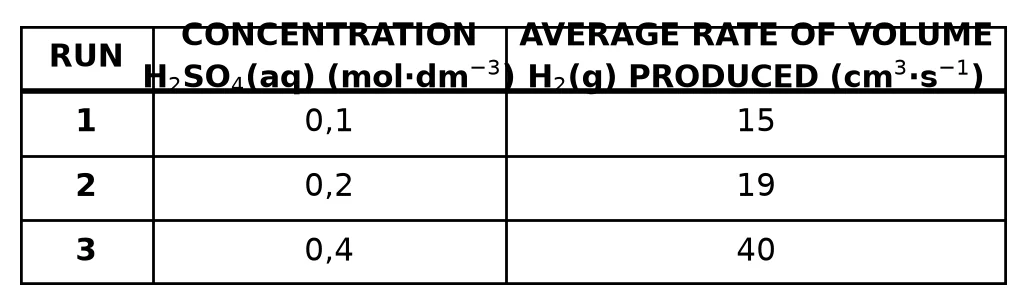 5.3.2 Use the collision theory to explain how the average rate of the reaction is affected in this investigation.(3)
Show the memo (3 ticks)Memo
- ✓Particles per unit volumeMore () particles per unit volume.
1 mark · Explain rate using collision theory
- ✓Effective collisions per unit timeMore effective collisions per unit time. / Higher frequency of effective collisions.
1 mark · Explain rate using collision theory
- ✓ConclusionHigher reaction rate.
1 mark · Explain rate using collision theory
- ✓
Free on Android
Know exactly which skill is costing you marks.
Mark past papers tick by tick in the NavyBlue app. It remembers every mark you lose, shows you the skills to fix first, and picks your next questions.
Get NavyBlue free on Google Play
