Grade 12 Physical Sciences · Chemical Change · Describe an electrolytic cell
Electrolytic Cells Grade 12
Describe how an electrolytic cell uses electricity to cause a reaction, including what forms at each electrode (electroplating a spoon with silver).
- questions use it, all grades · 52 past paper, 15 practice
- 67 questions use it, all grades · 52 past paper, 15 practice
- videos
- 4 videos
Learn it: describe an electrolytic cell
Pick one and watch it, then try the questions below. Videos load only when you tap play.
Now try it on a real exam question
No sign-up. Takes 3 minutes.
Question 1.10 · November 2025 · Paper 2 · National (DBE) · 2 marks
Which ONE of the following combinations for the ANODE and REACTION AT THE CATHODE is CORRECT?(2)
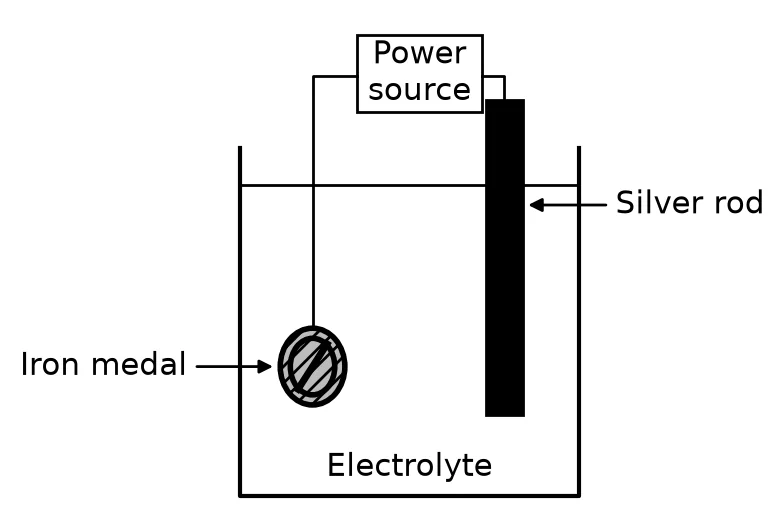
Work it out on paper first. Then mark yourself with the official memo, one tick at a time.
More past paper questions: describe an electrolytic cell
Work each one out first, then open the memo and check every tick.
3. Question 1.10 · November 2024 · Paper 2 · National (DBE) · 2 marks
Various options are provided as possible answers to the following questions. Each question has only ONE correct answer. Choose the answer and write only the letter (A–D) next to the question numbers (1.1 to 1.10) in the ANSWER BOOK, e.g. 1.11 E.1.10 An electrolytic cell is set up to electroplate an iron rod with nickel, as shown in the diagram below.
Consider the following statements:
(i) The iron rod is the negative electrode.
(ii) The metal ions in the solution undergo reduction.
(iii) The anode is pure nickel.
Which of the above statements are TRUE?(2)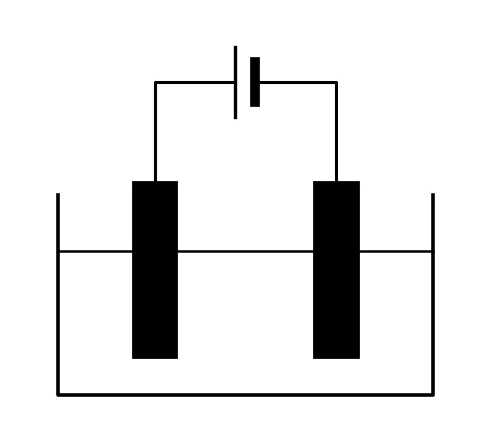
Show the memo (2 ticks)Memo
- ✓Correct option(i) The object to be plated (iron rod) is the cathode, which in an electrolytic cell is the negative electrode. TRUE.
(ii) ions in the solution gain electrons at the cathode and are deposited as Ni: reduction. TRUE.
(iii) The anode is made of the plating metal, pure nickel, which is oxidised to replace the ions. TRUE.
Answer: D2 marks · Describe an electrolytic cell
- ✓
4. Question 1.9 · May/June 2024 · Paper 2 · National (DBE) · 2 marks
1.9 Copper is purified by electrolysis, as shown in the diagram below.
Which ONE of the following combinations is CORRECT for the changes occurring at the anode, cathode and in the electrolyte when the cell is in operation?(2)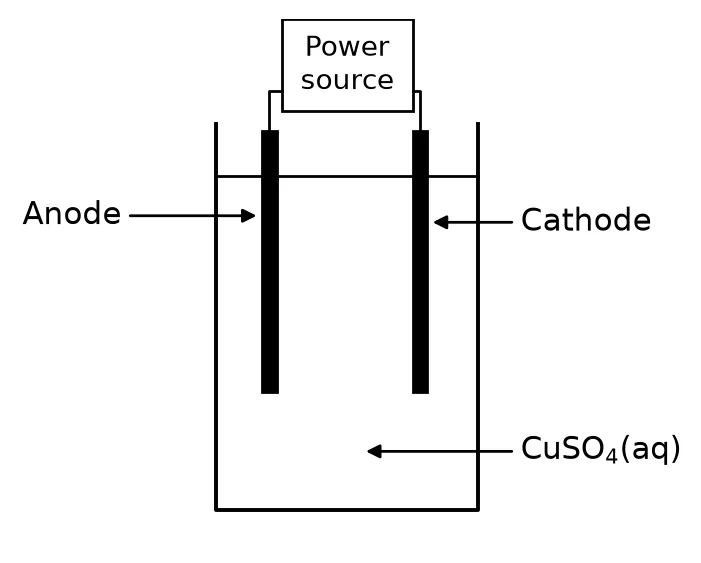
Show the memo (2 ticks)Memo
- ✓Choose the correct optionThe impure copper anode is oxidised (), so it loses mass. At the pure copper cathode ions are reduced to Cu, so it gains mass. Copper ions enter the solution at the same rate as they leave it, so and the blue colour stay the same.
Answer: B2 marks · Describe an electrolytic cell
- ✓
5. Question 9.2.3 · November 2024 · Paper 2 · National (DBE) · 2 marks
9.2 The simplified diagram below represents an electrolytic cell. The electrodes are made of carbon.
Answer the questions that follow.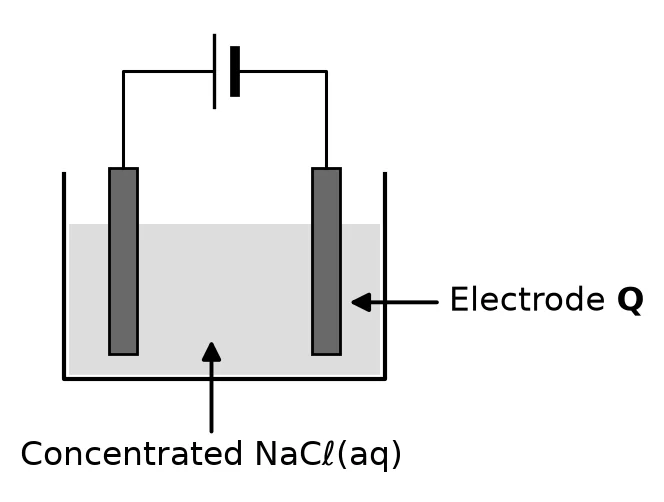 9.2.3 Write down the NAMES or FORMULAE of the products formed at electrode Q.(2)
Show the memo (2 ticks)Memo
- ✓Hydroxide ionsHydroxide ions / / sodium hydroxide / NaOH
1 mark · Describe an electrolytic cell
- ✓HydrogenHydrogen /
1 mark · Describe an electrolytic cell
- ✓
6. Question 1.10 · May/June 2023 · Paper 2 · National (DBE) · 2 marks
1.10 A concentrated solution of sodium chloride, NaCℓ(aq), undergoes electrolysis.
Which ONE of the combinations correctly shows the products formed at each electrode?(2)Show the memo (2 ticks)Memo
- ✓Products of the electrolysis of concentrated NaCℓ(aq)Cathode (reduction): water is a stronger oxidising agent than , so .
Anode (oxidation): in a CONCENTRATED chloride solution, .
Answer: D2 marks · Describe an electrolytic cell
- ✓
Free on Android
Know exactly which skill is costing you marks.
Mark past papers tick by tick in the NavyBlue app. It remembers every mark you lose, shows you the skills to fix first, and picks your next questions.
Get NavyBlue free on Google Play