Grade 12 Physical Sciences · Paper 1 (Physics)
Mechanics Grade 12
Real past paper questions and answers from 2024 to 2025, with each memo split into the ticks examiners give. Try one, mark yourself, and see exactly which skill cost you marks.
- past paper questions
- 169 past paper questions
- skills
- 24 skills
- videos
- 24 videos
Try a real exam question
No sign-up. Takes 3 minutes.
Question 4.4 · May/June 2025 · Paper 1 · National (DBE) · 2 marks
Ignore ALL frictional and rotational effects.
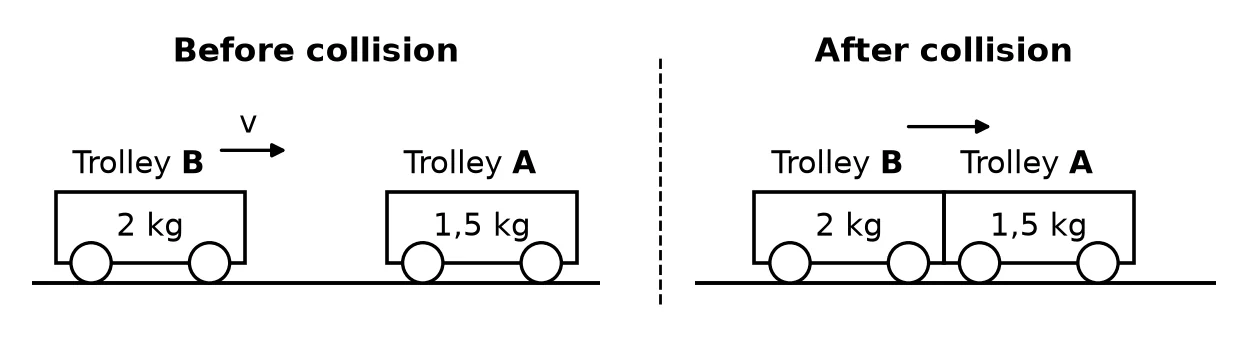
Choose from INCREASES, DECREASES or REMAINS THE SAME.
Write down a relevant equation that supports the answer.(2)
Work it out on paper first. Then mark yourself with the official memo, one tick at a time.
What's in Mechanics Grade 12
Each skill is one thing a memo gives a tick for. Tap a skill for its own questions, notes and videos.
Momentum and Impulse42 past paper questions
- Use the equations of motionChoose and use an equation of motion to find an unknown, such as v_f = v_i + aΔt for a car speeding up from rest.16 past paper questions · 4 videos
- Calculate kinetic and potential energyCalculate kinetic energy with Ek = ½mv² or gravitational potential energy with Ep = mgh (a 2 kg ball 5 m high has about 98 J of potential energy).16 past paper questions · 3 videos
- State momentum laws and definitionsState momentum definitions and laws in full, for example momentum, impulse, an isolated system or conservation of linear momentum.7 past paper questions · 3 videos
- Calculate momentum and its changeCalculate momentum with p = mv, or its change Δp = m(v_f − v_i), keeping track of direction (a 1000 kg car at 20 m/s has 20 000 kg·m/s).5 past paper questions · 3 videos
- Use the impulse-momentum theoremUse F_netΔt = Δp to find a force, a time or a change in momentum (a 0,5 kg ball's momentum changes by 10 kg·m/s).11 past paper questions · 3 videos
- Apply conservation of momentumUse total momentum before equals total momentum after to find a velocity or mass when two objects collide or push apart.10 past paper questions · 3 videos
- Decide if a collision is elasticCompare total kinetic energy before and after a collision to decide if it is elastic (kinetic energy kept) or inelastic (kinetic energy lost).4 past paper questions · 3 videos
- Explain using impulse and momentumExplain how a longer contact time lowers the force for the same change in momentum, for example how airbags protect drivers.1 past paper question · 2 videos
- Describe and evaluate an experimentName apparatus, describe or explain steps of a method, and give safety precautions (repeat readings and work out an average).6 past paper questions · 3 videos
Vertical Projectile Motion48 past paper questions
- Define vector and motion termsGive the exact meaning of motion words like displacement, velocity and acceleration, or sort a quantity as a vector or a scalar (speed is a scalar).16 past paper questions · 4 videos
- Describe motion from graphs or wordsDescribe how an object moves by reading a position-time, velocity-time or acceleration-time graph (a flat line on a position-time graph means the object is at rest).16 past paper questions · 4 videos
- Calculate from a motion graphWork out values from a motion graph, for example velocity from the gradient of a position-time graph or displacement from the area under a velocity-time graph.8 past paper questions · 3 videos
- Use equations of motion for projectilesUse equations of motion with a = g for objects thrown up or dropped, for example finding the maximum height of a ball thrown up at 10 m/s.25 past paper questions · 4 videos
- Sketch projectile motion graphsSketch position-time, velocity-time or acceleration-time graphs for a ball thrown up or bouncing, with the right shape and key values.7 past paper questions · 3 videos
Work, Energy and Power89 past paper questions
- State energy laws and definitionsState energy definitions and laws in full, for example kinetic energy, gravitational potential energy or the law of conservation of mechanical energy.14 past paper questions · 3 videos
- Calculate kinetic and potential energyCalculate kinetic energy with Ek = ½mv² or gravitational potential energy with Ep = mgh (a 2 kg ball 5 m high has about 98 J of potential energy).16 past paper questions · 3 videos
- Use conservation of mechanical energyUse the idea that mechanical energy stays the same without friction to find a speed or height (a ball dropped from 5 m hits the ground at about 9,9 m/s).18 past paper questions · 4 videos
- Draw a free-body or force diagramDraw every force acting on an object as a labelled arrow, for example weight, normal force, friction and applied force on a box.20 past paper questions · 3 videos
- Calculate work done by a forceCalculate the work a force does with W = FΔx cos θ (pulling a box 5 m with 20 N along the ground does 100 J).8 past paper questions · 3 videos
- Use the work-energy theoremUse the fact that net work equals the change in kinetic energy (W_net = ΔEk) to find a speed, force or distance.13 past paper questions · 3 videos
- Solve energy problems with frictionSolve energy problems where friction or a push does work, using W_nc = ΔEk + ΔEp (a box sliding down a rough slope).8 past paper questions · 2 videos
- Calculate mechanical powerCalculate how fast work is done using P = W/Δt or P = Fv (a motor doing 600 J in 2 s has a power of 300 W).4 past paper questions · 3 videos
- Identify variables in an investigationName the independent, dependent and controlled variables in an experiment (in a test of temperature on reaction rate, temperature is independent).13 past paper questions · 3 videos
- Write investigative question or conclusionWrite an investigative question, hypothesis or conclusion that links two variables (How does the length of a wire affect its resistance?).10 past paper questions · 3 videos
- Read a graph of resultsRead values from a graph or table of results, or calculate a gradient (finding resistance from the gradient of a V-I graph).13 past paper questions · 3 videos
More Mechanics Grade 12 questions and answers
Try each one on paper before you open the memo.
1. Question 4.2.2 · November 2025 · Paper 1 · National (DBE) · 4 marks
Cricketers at an academy conduct an experiment to determine the relationship between the contact time and the final momentum of a ball for a constant average net force.
A cricket ball of mass g is thrown horizontally with a certain initial velocity and is struck by a bat so that the ball moves in the opposite direction, as shown in the diagram below. The average net force acting on the ball is horizontal.
The experiment is repeated using the same ball. The average net force and the initial velocity of the ball are kept constant. The contact time between the bat and the ball is changed EACH time. The results obtained are shown in the sketch graph below.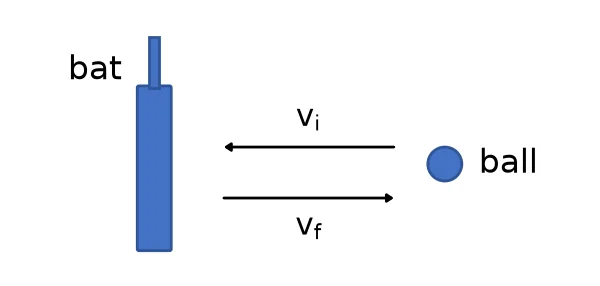
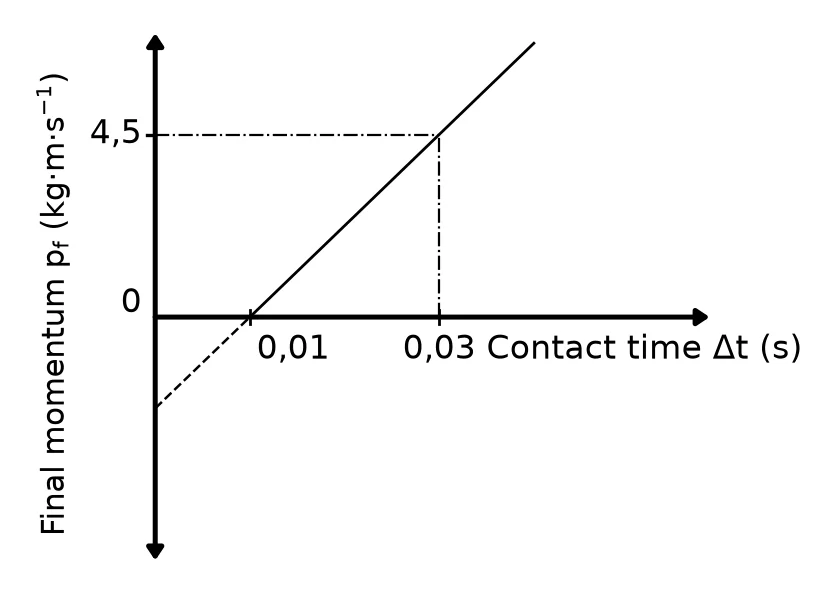 4.2 Calculate the:4.2.2 Magnitude of the initial velocity of the ball(4)
Show the memo (4 ticks)Memo
- ✓METHOD 1: FormulaAny one:
1 mark · Use the impulse-momentum theorem
- ✓METHOD 1: Substitution of impulse
1 mark · Use the impulse-momentum theorem
- ✓METHOD 1: Substitution of momentum
1 mark · Use the impulse-momentum theorem
- ✓METHOD 1: Answer m·s
m·s1 mark · Use the impulse-momentum theorem
- ✓
2. Question 3.3.1 · May/June 2024 · Paper 1 · National (DBE) · 3 marks
A hot-air balloon moves vertically downwards at a constant velocity of m·s. When the balloon is m above the ground, a small ball is dropped from the balloon. Refer to the diagram below.
The ball strikes the ground and bounces vertically upwards. The hot-air balloon continues to move downwards at the same constant velocity.
Ignore the effects of air friction acting on the ball.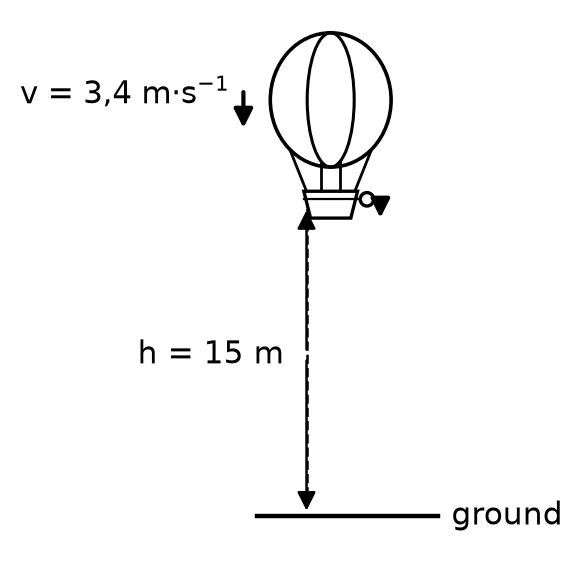 3.3 Use only EQUATIONS OF MOTION to calculate:3.3.1 The value of indicated on the graph(3)
Show the memo (3 ticks)Memo
- ✓Formula with Downwards as positive:
- ✓Substitution
- ✓Final answer s, so s
- ✓
3. Question 5.3 · November 2024 · Paper 1 · National (DBE) · 4 marks
A constant force F is applied at an angle of to the horizontal on a crate of mass kg that is initially at rest, as shown in the diagram below.
A constant frictional force of N acts on the crate as it moves from rest at point A along a horizontal surface to point B. The distance between point A and point B is m. The speed of the crate at point B is m·s.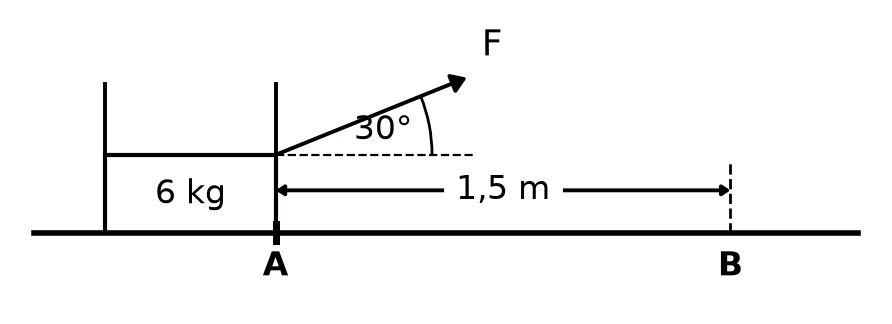 5.3 Using ENERGY PRINCIPLES ONLY, calculate the magnitude of force F.(4)
Show the memo (4 ticks)Memo
- ✓METHOD 1: Formula (any one)
1 mark · Solve energy problems with friction
- ✓METHOD 1: Work done by the forces
1 mark · Solve energy problems with friction
- ✓METHOD 1: Energy changes
1 mark · Solve energy problems with friction
- ✓METHOD 1: Answer N
1 mark · Solve energy problems with friction
- ✓
4. Question 4.2 · May/June 2024 · Paper 1 · National (DBE) · 5 marks
Two trolleys A and B of mass kg and kg respectively are held at rest on a straight horizontal, frictionless track, with a compressed spring between them, as shown in the diagram below.
After the trolleys are released, the spring extends to its natural length and then falls onto the track. Trolley A now moves with a constant velocity of m·s to the left, while trolley B moves with a constant unknown velocity to the right. Trolley B reaches the end of the track after s.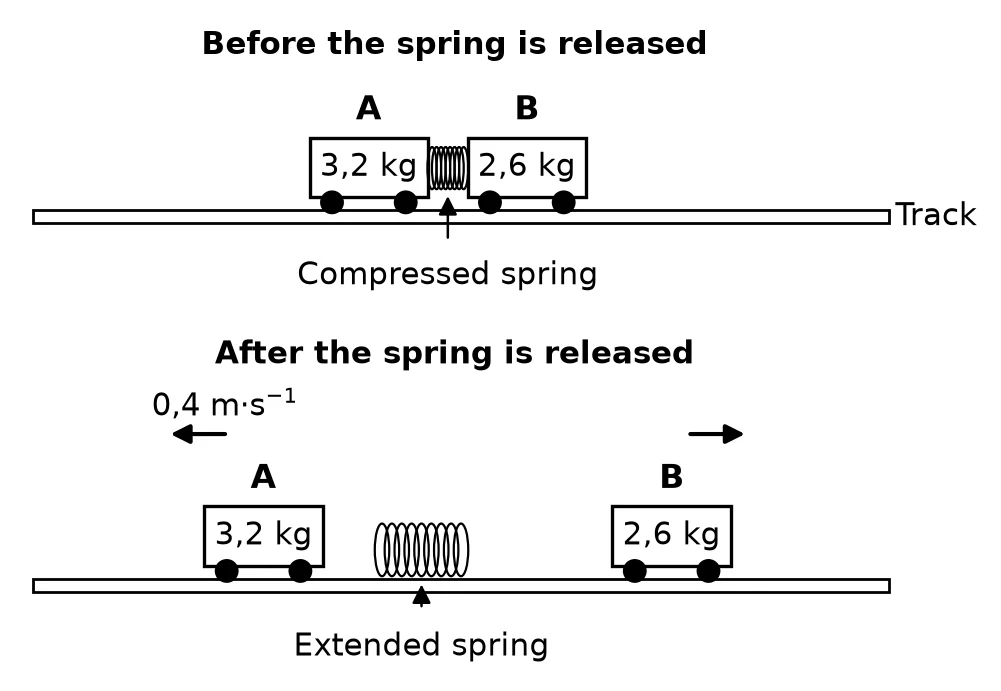 4.2 Calculate the distance travelled by trolley B in s.(5)
Show the memo (5 ticks)Memo
- ✓Momentum formulaRight as positive:
Any one:1 mark · Apply conservation of momentum
- ✓Initial momentum is zero
1 mark · Apply conservation of momentum
- ✓Substitution of final momenta
m·s1 mark · Apply conservation of momentum
- ✓Substitution into equation of motion
OR - ✓Final answer m
- ✓
5. Question 3.1.1 · November 2024 · Paper 1 · National (DBE) · 5 marks
Ball A is thrown vertically upwards at m·s from the top of a building. Two seconds after ball A was thrown upwards, ball B is thrown vertically downwards at m·s from the top of the same building. Both balls, A and B, strike the ground at time t seconds.
Ignore the effects of air friction.
The position-time sketch graphs for both balls are shown below.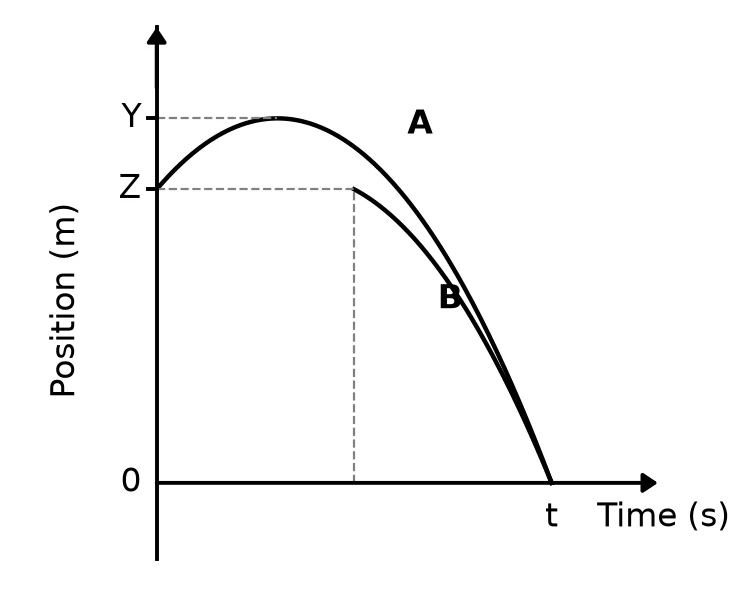 3.1 Using EQUATIONS OF MOTION ONLY, calculate the value of EACH of the following, as shown in the graphs:3.1.1 t(5)
Show the memo (5 ticks)Memo
- ✓FormulaUpwards as positive:
Ball A: - ✓Substitution for ball A ...... Eqn (1)
- ✓Substitution for ball B ...... Eqn (2)
- ✓Equate displacements:
- ✓Answer
(s)
- ✓
Mechanics Grade 12 videos
Short lessons from South African teachers first. Videos load only when you tap play, to save your data.
Free on Android
Know exactly which skill is costing you marks.
Mark past papers tick by tick in the NavyBlue app. It remembers every mark you lose, shows you the skills to fix first, and picks your next questions.
Get NavyBlue free on Google Play
