Grade 10 Physical Sciences · Mechanics
Use the equations of motion
Choose and use an equation of motion to find an unknown, such as v_f = v_i + aΔt for a car speeding up from rest.
- past paper questions use it
- 16 past paper questions use it
- videos
- 4 videos
Learn it: use the equations of motion
Pick one and watch it, then try the questions below. Videos load only when you tap play.
Now try it on a real exam question
No sign-up. Takes 3 minutes.
Question 2.1 · May/June 2023 · Paper 1 · National (DBE) · 3 marks
When block B is released, it moves vertically downwards and strikes the ground with a velocity of m·s.
Ignore the effects of friction.
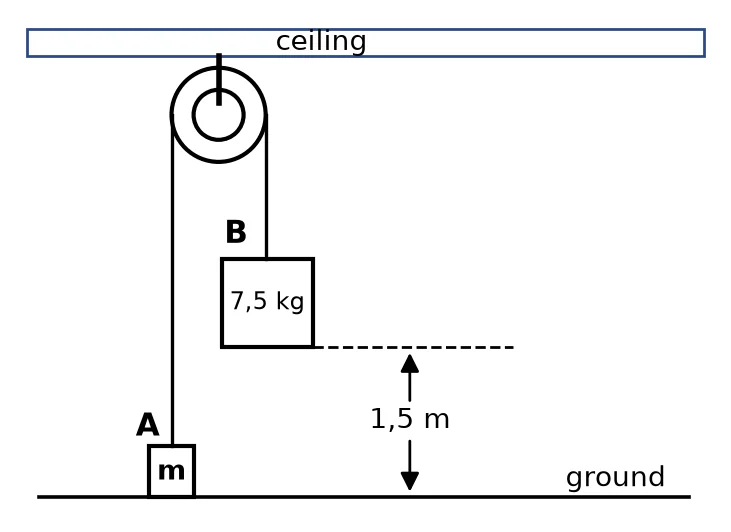
Work it out on paper first. Then mark yourself with the official memo, one tick at a time.
More past paper questions: use the equations of motion
Work each one out first, then open the memo and check every tick.
3. Question 3.3.2 · May/June 2024 · Paper 1 · National (DBE) · 4 marks
A hot-air balloon moves vertically downwards at a constant velocity of m·s. When the balloon is m above the ground, a small ball is dropped from the balloon. Refer to the diagram below.
The ball strikes the ground and bounces vertically upwards. The hot-air balloon continues to move downwards at the same constant velocity.
Ignore the effects of air friction acting on the ball.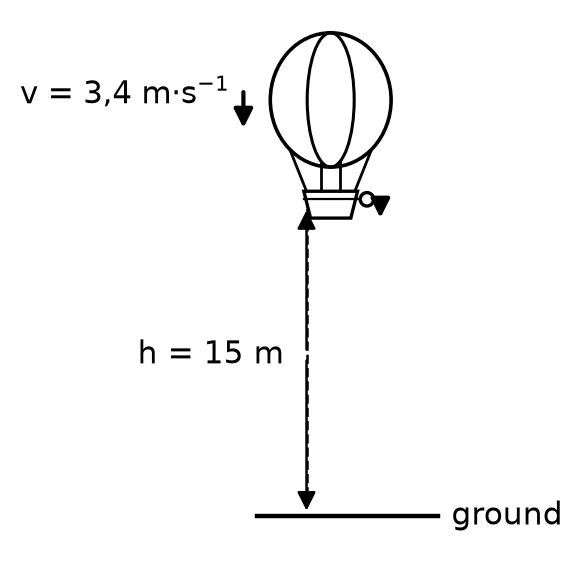 3.3 Use only EQUATIONS OF MOTION to calculate:3.3.2 The height of the hot-air balloon above the ground at the instant when the ball struck the ground(4)
Show the memo (4 ticks)Memo
- ✓FormulaUpwards as positive:
1 mark · Use the equations of motion
- ✓Substitution
m1 mark · Use the equations of motion
- ✓Subtraction from the initial heightHeight
1 mark · Use the equations of motion
- ✓Final answerHeight m
1 mark · Use the equations of motion
- ✓
4. Question 1.2 · November 2022 · Paper 1 · Provincial · 2 marks
Four options are provided as possible answers to the following questions. Each question has only ONE correct answer.1.2 In the equation , the part represents the ...(2)Show the memo (1 tick)Memo
- ✓Choose the correct optionEvery term in an equation has the same unit as the left-hand side. is a displacement, so must also be a displacement: (m·s)(s) = m. It is the displacement the object would have if it kept moving at .
Answer: D2 marks · Use the equations of motion
- ✓
5. Question 3.2 · November 2022 · Paper 1 · Provincial · 4 marks
Car A driving at km.h approaches a stationery car B. The driver of car B noticed that car A is approaching him at a very high speed. The driver of car B reacted suddenly by accelerating his car from rest at m·s for s. After s car B continued driving with a ______.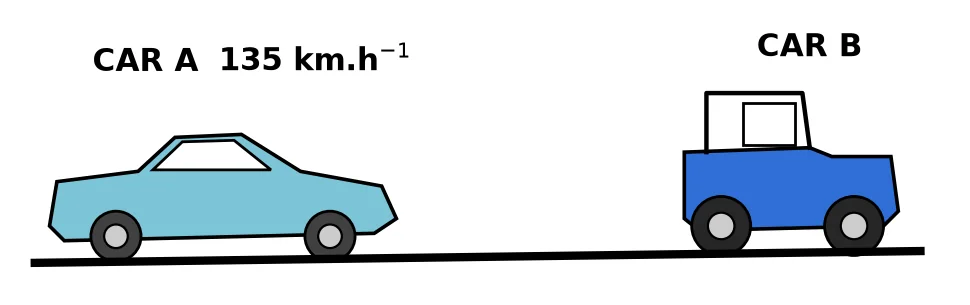 3.2 Determine the velocity of car B while trying to avoid car A.(4)
Show the memo (4 ticks)Memo
- ✓Formula
1 mark · Use the equations of motion
- ✓Initial velocity zero
1 mark · Use the equations of motion
- ✓Substitution of a and t
1 mark · Use the equations of motion
- ✓Answer with unit m·s
1 mark · Use the equations of motion
- ✓
6. Question 2.5 · May/June 2022 · Paper 1 · National (DBE) · 5 marks
A man faces difficulty while swimming in a dam. During the rescue operation, an inflated tube attached to a helicopter by a rope is dropped from the helicopter.
The man, of mass kg, holds onto the inflated tube of mass kg, while the helicopter is flying horizontally at a CONSTANT speed. An average frictional force of N is exerted on the man-tube combination while they are dragged horizontally along the surface of the water by the helicopter. The rope makes an angle of with the surface of the water, as shown in the diagram below.
Assume that the rope is inextensible and massless, and the water of the dam does not flow.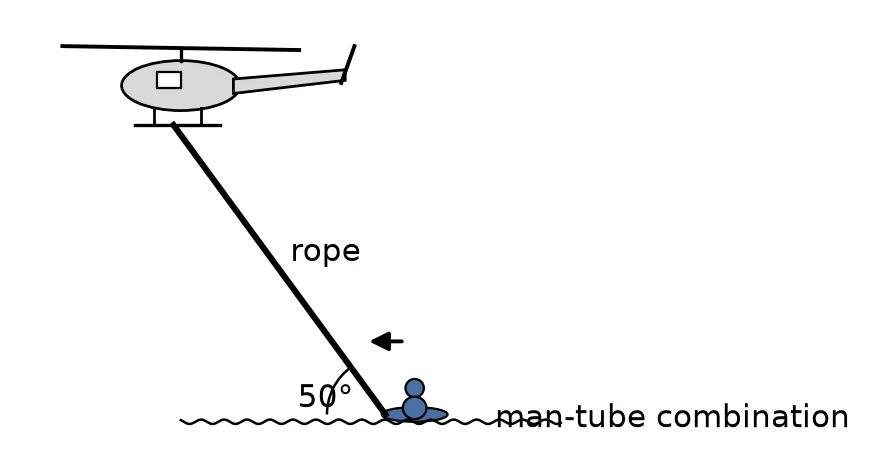 In another rescue operation, the inflated tube of mass kg is dropped from the stationary helicopter and it strikes the water at a speed of m·s. The tube sinks vertically downwards into the water to a depth of m and then rises to the surface. The rope hangs loosely, as shown in the diagram below.
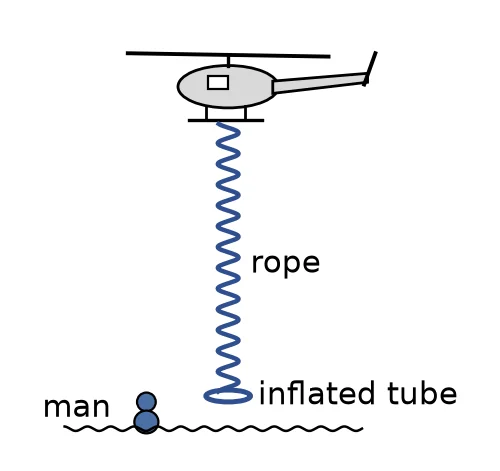 2.5 Calculate the magnitude of the average upward force exerted on the inflated tube while it is sinking. Assume that the average upward force is constant for the motion.(5)
Show the memo (5 ticks)Memo
- ✓METHOD 1: Substitution to calculate aDownwards as positive:
m·s1 mark · Use the equations of motion
- ✓METHOD 1: Formula
(Any one: or )1 mark · Apply Newton's second law
- ✓METHOD 1: Substitution of the weight
1 mark · Apply Newton's second law
- ✓METHOD 1: Substitution of ma
1 mark · Apply Newton's second law
- ✓METHOD 1: Answer with unit N
N1 mark · Apply Newton's second law
- ✓
Free on Android
Know exactly which skill is costing you marks.
Mark past papers tick by tick in the NavyBlue app. It remembers every mark you lose, shows you the skills to fix first, and picks your next questions.
Get NavyBlue free on Google Play
