Grade 10 Physical Sciences · Mechanics
Use conservation of mechanical energy
Use the idea that mechanical energy stays the same without friction to find a speed or height (a ball dropped from 5 m hits the ground at about 9,9 m/s).
- past paper questions use it
- 18 past paper questions use it
- videos
- 4 videos
Learn it: use conservation of mechanical energy
Pick one and watch it, then try the questions below. Videos load only when you tap play.
Now try it on a real exam question
No sign-up. Takes 3 minutes.
Question 5.2 · May/June 2024 · Paper 1 · National (DBE) · 3 marks
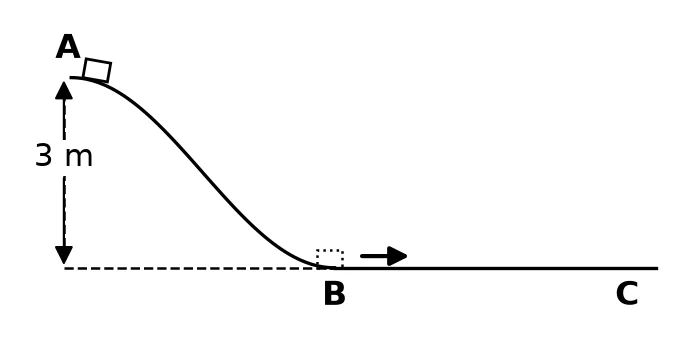
Work it out on paper first. Then mark yourself with the official memo, one tick at a time.
More past paper questions: use conservation of mechanical energy
Work each one out first, then open the memo and check every tick.
3. Question 1.5 · May/June 2024 · Paper 1 · National (DBE) · 2 marks
Various options are provided as possible answers to the following questions. Each question has only ONE correct answer. Choose the answer and write only the letter (A–D) next to the question numbers (1.1 to 1.10).1.5 A stone of mass m is dropped from a height h above the ground. Ignore the effects of air friction.
Which ONE of the following combinations CORRECTLY represents the kinetic energy and the total mechanical energy of the stone at the instant the stone has fallen through a distance of h?(2)Show the memo (1 tick)Memo
- ✓Choose the correct optionWith no air friction, mechanical energy is conserved: it stays equal to its starting value, .
After falling h the stone is at height h, so and .
Answer: D2 marks · Use conservation of mechanical energy
- ✓
4. Question 1.3 · November 2023 · Paper 1 · National (DBE) · 2 marks
Various options are provided as possible answers to the following questions. Each question has only ONE correct answer.1.3 A ball is projected vertically upwards from the top edge of a building. Points P, Q, R and S represent different positions during the motion of the ball, as shown in the diagram below.
Ignore the effects of air friction.
Between which two points will the ball undergo the greatest change in kinetic energy?(2)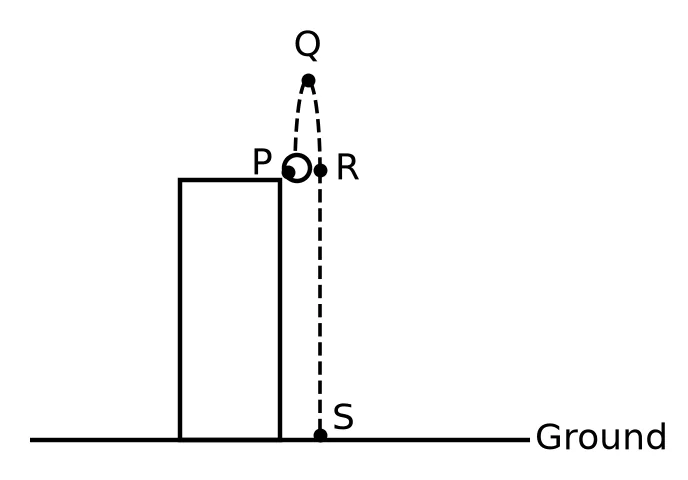
Show the memo (1 tick)Memo
- ✓Correct optionWithout friction mechanical energy is conserved, so the change in kinetic energy equals the change in potential energy, . The largest height difference is between Q (highest point, ) and S (ground, largest speed).
Answer: D2 marks · Use conservation of mechanical energy
- ✓
5. Question 1.3 · November 2022 · Paper 1 · National (DBE) · 2 marks
Various options are provided as possible answers to the following questions. Each question has only ONE correct answer.1.3 A ball is projected vertically upwards from the ground and reaches its maximum height after a while.
Ignore the effects of air friction.
How will the ACCELERATION and TOTAL MECHANICAL ENERGY of the ball at its maximum height compare to that immediately after it was projected?(2)Show the memo (1 tick)Memo
- ✓Acceleration and mechanical energy of a projectileWith no air friction the only force is gravity, so the acceleration is (downwards) at every point, including the top: EQUAL TO.
Only gravity (a conservative force) does work, so total mechanical energy is conserved: EQUAL TO.
Answer: A2 marks · Use conservation of mechanical energy
- ✓
6. Question 1.7 · November 2023 · Paper 1 · Provincial · 2 marks
1.7 An object of mass is dropped from the top of the building and strikes the ground with kinetic energy . Another object of mass is dropped FROM THE SAME HEIGHT and strikes the ground. Its kinetic energy will be equal to ...(2)Show the memo (1 tick)Memo
- ✓Kinetic energy at the ground equals mghMechanical energy is conserved: at the ground at the top . For the same height, doubling the mass doubles , so the kinetic energy at the ground is .
Answer: D2 marks · Use conservation of mechanical energy
- ✓
Free on Android
Know exactly which skill is costing you marks.
Mark past papers tick by tick in the NavyBlue app. It remembers every mark you lose, shows you the skills to fix first, and picks your next questions.
Get NavyBlue free on Google Play
