Grade 12 Physical Sciences · Mechanics
Use equations of motion for projectiles
Use equations of motion with a = g for objects thrown up or dropped, for example finding the maximum height of a ball thrown up at 10 m/s.
- past paper questions use it
- 25 past paper questions use it
- videos
- 4 videos
Learn it: use equations of motion for projectiles
Pick one and watch it, then try the questions below. Videos load only when you tap play.
Now try it on a real exam question
No sign-up. Takes 3 minutes.
Question 3.2 · May/June 2025 · Paper 1 · National (DBE) · 4 marks
Ignore the effects of air friction.
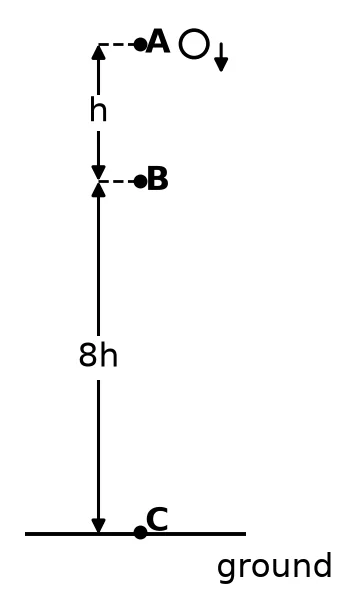
Work it out on paper first. Then mark yourself with the official memo, one tick at a time.
More past paper questions: use equations of motion for projectiles
Work each one out first, then open the memo and check every tick.
3. Question 3.1.2 · November 2024 · Paper 1 · National (DBE) · 3 marks
Ball A is thrown vertically upwards at m·s from the top of a building. Two seconds after ball A was thrown upwards, ball B is thrown vertically downwards at m·s from the top of the same building. Both balls, A and B, strike the ground at time t seconds.
Ignore the effects of air friction.
The position-time sketch graphs for both balls are shown below.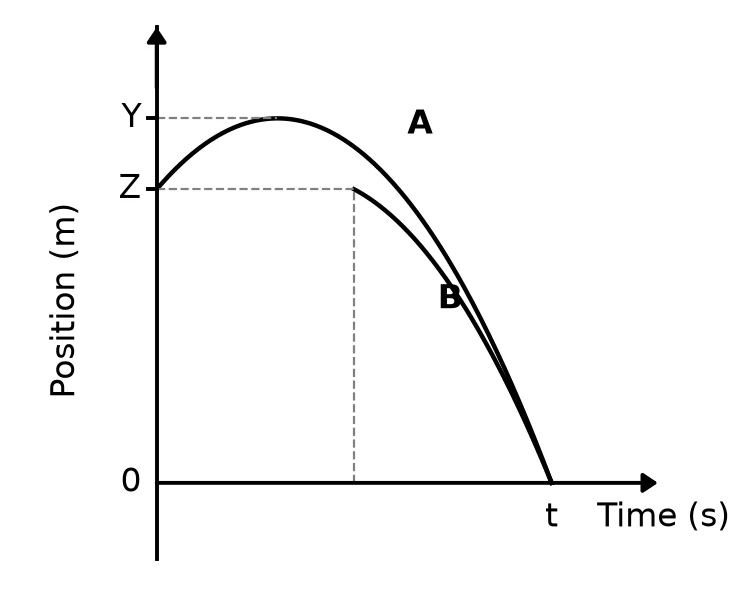 3.1 Using EQUATIONS OF MOTION ONLY, calculate the value of EACH of the following, as shown in the graphs:3.1.2 Z(3)
Show the memo (3 ticks)Memo
- ✓FormulaUpwards as positive, ball A:
- ✓Substitution
- ✓Answer m
(m)
- ✓
4. Question 3.3.1 · May/June 2024 · Paper 1 · National (DBE) · 3 marks
A hot-air balloon moves vertically downwards at a constant velocity of m·s. When the balloon is m above the ground, a small ball is dropped from the balloon. Refer to the diagram below.
The ball strikes the ground and bounces vertically upwards. The hot-air balloon continues to move downwards at the same constant velocity.
Ignore the effects of air friction acting on the ball.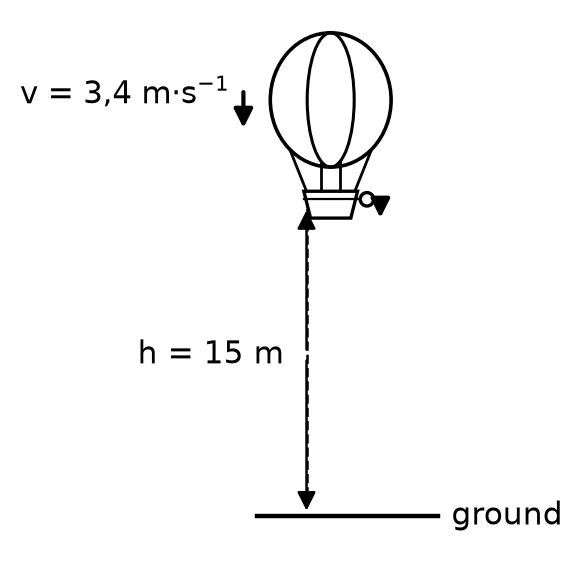 3.3 Use only EQUATIONS OF MOTION to calculate:3.3.1 The value of indicated on the graph(3)
Show the memo (3 ticks)Memo
- ✓Formula with Downwards as positive:
- ✓Substitution
- ✓Final answer s, so s
- ✓
5. Question 3.2.1 · May/June 2023 · Paper 1 · National (DBE) · 3 marks
Ball A is dropped from rest from the top of a building m high.
After ball A has fallen m, a second ball B is projected vertically upwards from the ground. After a while, the two balls strike the ground at the SAME time.
Ignore the effects of air resistance.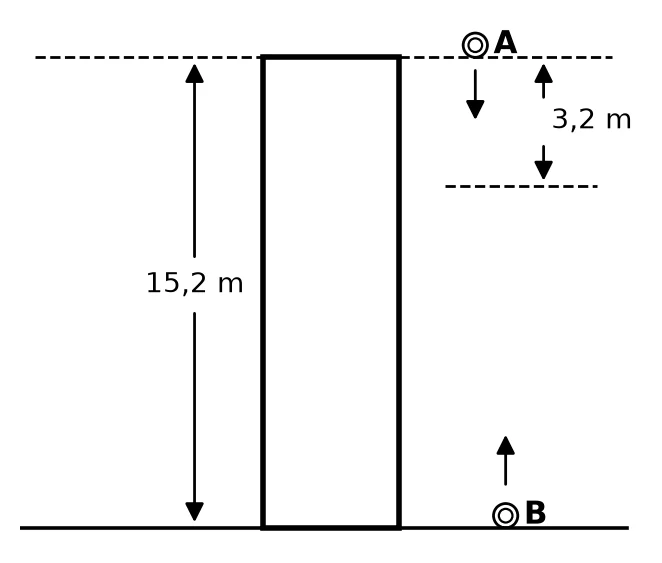 3.2 Calculate the:3.2.1 Time taken for ball A to strike the ground(3)
Show the memo (3 ticks)Memo
- ✓FormulaDownwards as positive:
- ✓Substitution
- ✓Answer with unit s
- ✓
6. Question 2.5 · May/June 2023 · Paper 1 · National (DBE) · 5 marks
Block A of mass m is connected to block B of mass kg by a light inextensible rope passing over a frictionless pulley. Block B is initially held at a height of m above the ground, while block A is initially stationary on the ground, as shown in the diagram below.
When block B is released, it moves vertically downwards and strikes the ground with a velocity of m·s.
Ignore the effects of friction.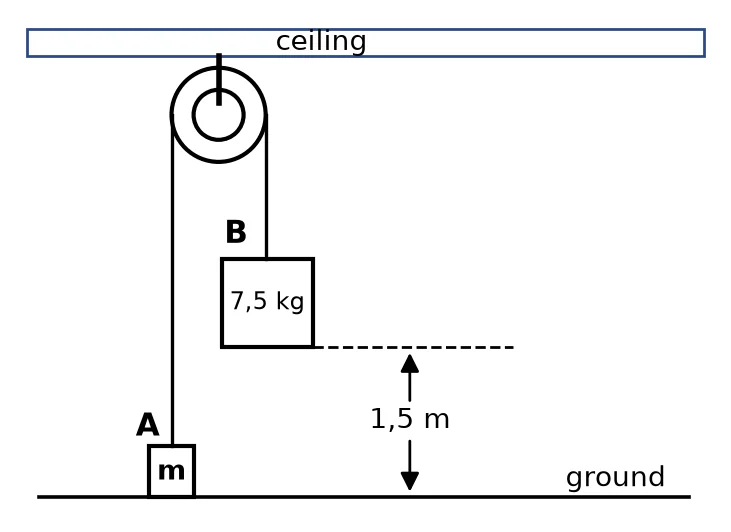 2.5 Calculate the maximum height above the ground reached by block A.(5)
Show the memo (5 ticks)Memo
- ✓METHOD 1: FormulaUpwards as positive:
- ✓METHOD 1: Substitution of and
- ✓METHOD 1: Substitution of g
m - ✓METHOD 1: Adding 1,5 mMaximum height
- ✓METHOD 1: Answer with unit m
- ✓
Free on Android
Know exactly which skill is costing you marks.
Mark past papers tick by tick in the NavyBlue app. It remembers every mark you lose, shows you the skills to fix first, and picks your next questions.
Get NavyBlue free on Google Play
