Grade 12 Physical Sciences · Mechanics
Calculate work done by a force
Calculate the work a force does with W = FΔx cos θ (pulling a box 5 m with 20 N along the ground does 100 J).
- past paper questions use it
- 8 past paper questions use it
- videos
- 3 videos
Learn it: calculate work done by a force
Pick one and watch it, then try the questions below. Videos load only when you tap play.
Now try it on a real exam question
No sign-up. Takes 3 minutes.
Question 1.5 · November 2025 · Paper 1 · National (DBE) · 2 marks
Which ONE of the following combinations of ACCELERATION and NET WORK DONE ON THE BLOCK is CORRECT?(2)

Work it out on paper first. Then mark yourself with the official memo, one tick at a time.
More past paper questions: calculate work done by a force
Work each one out first, then open the memo and check every tick.
3. Question 1.5 · November 2023 · Paper 1 · National (DBE) · 2 marks
Various options are provided as possible answers to the following questions. Each question has only ONE correct answer.1.5 A box moves on a horizontal surface. The diagram below shows all the forces acting on the box.
Which ONE of the following combinations of forces do work on the box?(2)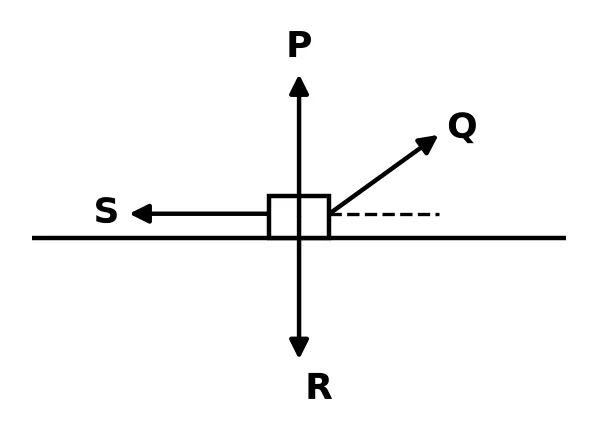
Show the memo (1 tick)Memo
- ✓Correct option. The box moves horizontally. P and R are vertical, at to the displacement, so and they do no work. Q has a horizontal component and S is horizontal, so both do work.
Answer: B2 marks · Calculate work done by a force
- ✓
4. Question 1.5 · November 2022 · Paper 1 · National (DBE) · 2 marks
Various options are provided as possible answers to the following questions. Each question has only ONE correct answer.1.5 Block X is placed on a horizontal table and is connected to block Y by a light inextensible string passing over a frictionless pulley, as shown below.
A constant frictional force acts on block X while it moves to the right.
P, Q and R are points on the table such that the distance from P to Q is equal to that from Q to R.
When block X reaches point Q, the string is cut and block X continues to move towards point R. Ignore the effect of air friction.
Consider the following statements:
(i) The work done by the frictional force acting on block X is greater when the block moves from point P to point Q than when the block moves from point Q to point R.
(ii) Both the momentum and kinetic energy of block X decrease when the block moves from point Q to point R.
(iii) The total mechanical energy of block X remains constant when the block moves from point Q to point R.
Which of the statements above is/are CORRECT as block X moves from point Q to point R?(2)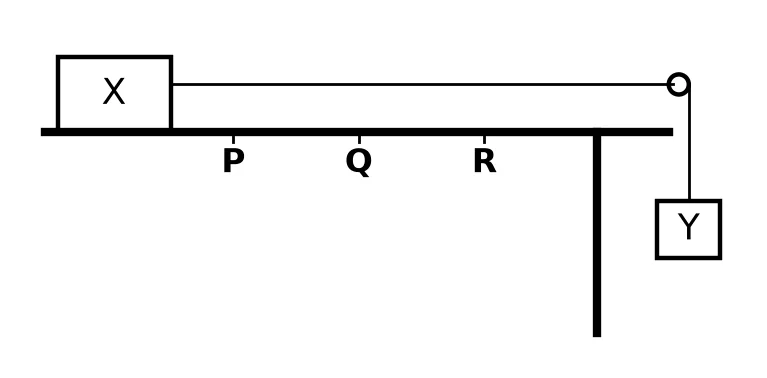
Show the memo (1 tick)Memo
- ✓Evaluate each statement(i) . The friction and the distances PQ and QR are equal, so the work done by friction is the same on both sections. FALSE.
(ii) After the string is cut, only friction acts horizontally, so X slows down: its momentum () and kinetic energy () both decrease. TRUE.
(iii) Friction is a non-conservative force doing work on X, so its mechanical energy decreases. FALSE.
Answer: B2 marks · Calculate work done by a force
- ✓
5. Question 5.4 · November 2022 · Paper 1 · National (DBE) · 5 marks
A kg block is initially at rest at point A at the bottom of a ROUGH inclined plane. The block is pulled up the incline by a constant force F acting parallel to the incline. The block reaches point B, which is at a vertical height of m above the horizontal, with a speed of m·s. See the diagram below.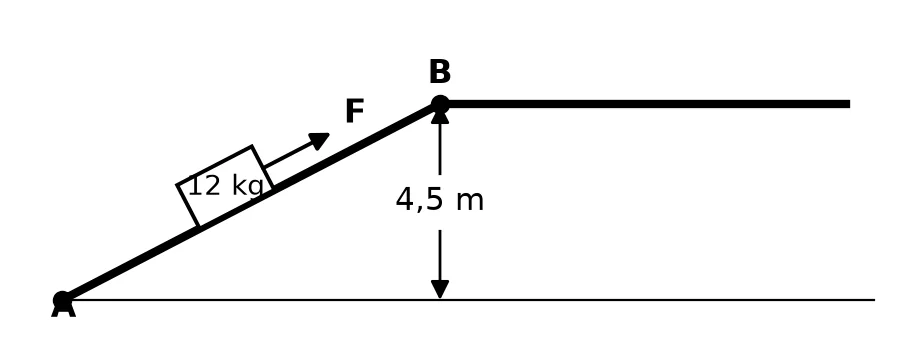 The same constant force F now moves the block at a CONSTANT VELOCITY across a rough horizontal surface from point B to point C, as shown below. Force F acts parallel to the horizontal surface.
The magnitude of the constant frictional force acting on the block while moving from point B to point C is N LARGER than the magnitude of the constant frictional force acting on the block when it moves from point A to point B.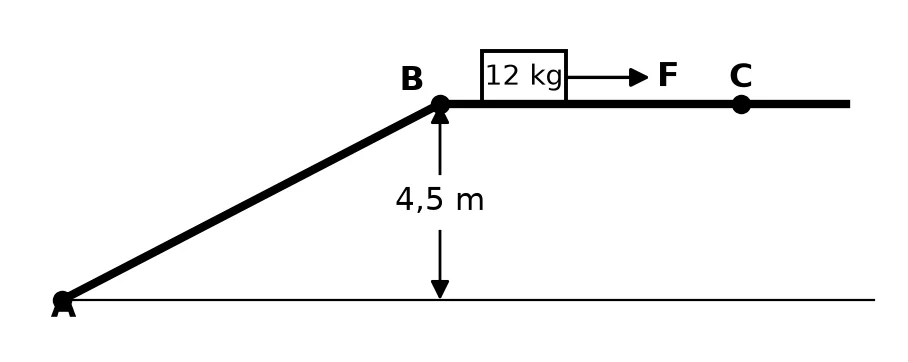 5.4 Calculate the distance from point A to point B.(5)
Show the memo (5 ticks)Memo
- ✓Formula for Along the incline (AB):
(any one: )1 mark · Calculate work done by a force
- ✓Substitution of J ... (1)
1 mark · Calculate work done by a force
- ✓Force equation on the horizontal (constant velocity)Along the horizontal (BC):
(OR )1 mark · Apply Newton's second law
- ✓Relating the two frictional forces
... (2)1 mark · Apply Newton's second law
- ✓AnswerSubstitute (2) into (1):
m1 mark · Calculate work done by a force
- ✓
6. Question 5.4 · November 2025 · Paper 1 · National (DBE) · 5 marks
A crate of mass kg is at rest at point A on a frictionless horizontal surface. A constant horizontal force F of N acts on the crate and moves it from point A to point B. The crate then moves down a rough plane, inclined at to the horizontal. The distance from point A to point B is m and from point B to point C is m, as shown in the diagram below.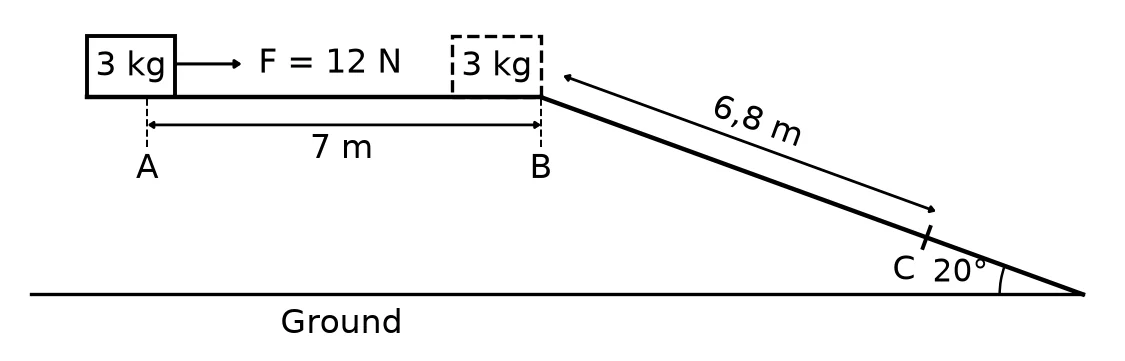 5.4 Using ENERGY PRINCIPLES ONLY, determine whether the crate will pass point C.(5)
Show the memo (5 ticks)Memo
- ✓METHOD 1: Work done by gravity
1 mark · Calculate work done by a force
- ✓METHOD 1: Work done by friction
1 mark · Calculate work done by a force
- ✓METHOD 1: Change in kinetic energy
1 mark · Use the work-energy theorem
- ✓METHOD 1: Final answer m
1 mark · Use the work-energy theorem
- ✓METHOD 1: Conclusion m m
The crate will pass point C.1 mark · Use the work-energy theorem
- ✓
Free on Android
Know exactly which skill is costing you marks.
Mark past papers tick by tick in the NavyBlue app. It remembers every mark you lose, shows you the skills to fix first, and picks your next questions.
Get NavyBlue free on Google Play
