Grade 12 Physical Sciences · Mechanics
Calculate momentum and its change
Calculate momentum with p = mv, or its change Δp = m(v_f − v_i), keeping track of direction (a 1000 kg car at 20 m/s has 20 000 kg·m/s).
- past paper questions use it
- 5 past paper questions use it
- videos
- 3 videos
Learn it: calculate momentum and its change
Pick one and watch it, then try the questions below. Videos load only when you tap play.
Now try it on a real exam question
No sign-up. Takes 3 minutes.
Question 1.4 · November 2025 · Paper 1 · National (DBE) · 2 marks
The velocity of P is ...(2)
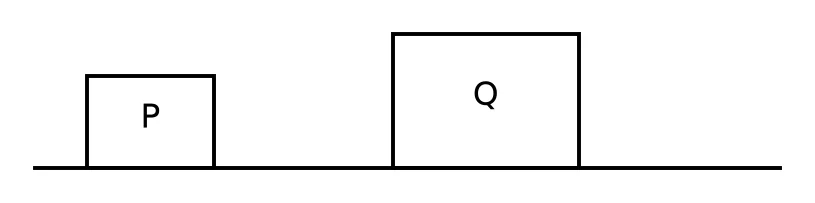
Work it out on paper first. Then mark yourself with the official memo, one tick at a time.
More past paper questions: calculate momentum and its change
Work each one out first, then open the memo and check every tick.
3. Question 4.3.1 · November 2024 · Paper 1 · National (DBE) · 3 marks
Two trolleys, A and B, of masses of kg and kg respectively, are held in a stationary position on a straight, horizontal, frictionless track, with a compressed spring between them. The trolleys are released and the spring takes t seconds to return to its natural length. The spring then falls to the ground.
Trolley A moves to the left, while trolley B moves to the right and then up a frictionless inclined plane, rising to a maximum vertical height of m, as shown in the diagram below.
Ignore the rotational effects of the wheels.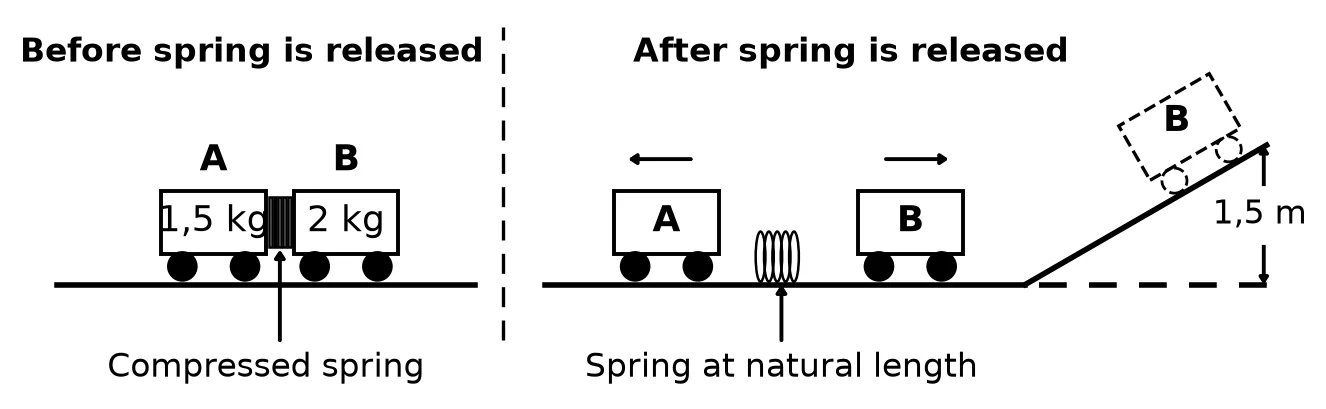 4.3 For the t seconds that the spring takes to return to its natural length:4.3.1 Calculate the change in momentum of trolley B(3)
Show the memo (3 ticks)Memo
- ✓Formula (any one) OR
1 mark · Calculate momentum and its change
- ✓Substitution
1 mark · Calculate momentum and its change
- ✓Answer with direction kg·m·s right
1 mark · Calculate momentum and its change
- ✓
4. Question 4.2.2 · November 2025 · Paper 1 · National (DBE) · 4 marks
Cricketers at an academy conduct an experiment to determine the relationship between the contact time and the final momentum of a ball for a constant average net force.
A cricket ball of mass g is thrown horizontally with a certain initial velocity and is struck by a bat so that the ball moves in the opposite direction, as shown in the diagram below. The average net force acting on the ball is horizontal.
The experiment is repeated using the same ball. The average net force and the initial velocity of the ball are kept constant. The contact time between the bat and the ball is changed EACH time. The results obtained are shown in the sketch graph below.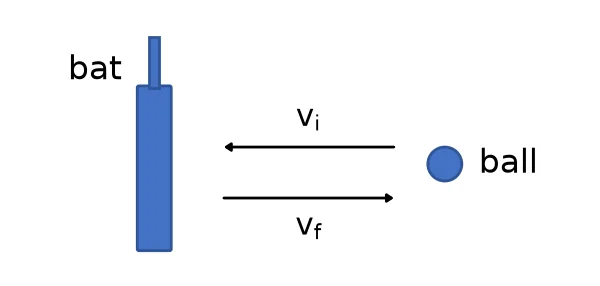
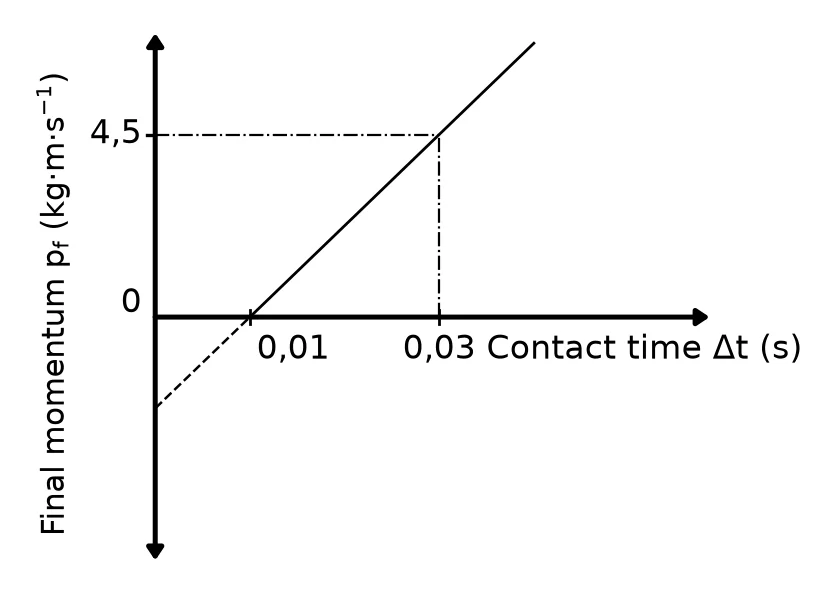 4.2 Calculate the:4.2.2 Magnitude of the initial velocity of the ball(4)
Show the memo (4 ticks)Memo
- ✓METHOD 1: FormulaAny one:
1 mark · Use the impulse-momentum theorem
- ✓METHOD 1: Substitution of impulse
1 mark · Use the impulse-momentum theorem
- ✓METHOD 1: Substitution of momentum
1 mark · Use the impulse-momentum theorem
- ✓METHOD 1: Answer m·s
m·s1 mark · Use the impulse-momentum theorem
- ✓
Free on Android
Know exactly which skill is costing you marks.
Mark past papers tick by tick in the NavyBlue app. It remembers every mark you lose, shows you the skills to fix first, and picks your next questions.
Get NavyBlue free on Google Play
