Grade 12 Physical Sciences · Mechanics · Calculate mechanical power
Power Grade 12
Calculate how fast work is done using P = W t or P = Fv (a motor doing 600 J in 2 s has a power of 300 W).
- questions use it, all grades · 8 past paper, 12 practice
- 20 questions use it, all grades · 8 past paper, 12 practice
- videos
- 3 videos
Learn it: calculate mechanical power
Pick one and watch it, then try the questions below. Videos load only when you tap play.
Now try it on a real exam question
No sign-up. Takes 3 minutes.
Question 1.5 · May/June 2025 · Paper 1 · National (DBE) · 2 marks
Which ONE of the following statements is CORRECT when P and Q each operate at their maximum power output?(2)
Work it out on paper first. Then mark yourself with the official memo, one tick at a time.
More past paper questions: calculate mechanical power
Work each one out first, then open the memo and check every tick.
3. Question 5.3.3 · May/June 2025 · Paper 1 · National (DBE) · 3 marks
Water is drawn from a water source m below the ground by an electric pump. The water is lifted vertically upwards at a constant speed, as shown in the simplified diagram below.
The pump lifts the water upwards at a rate of kg·s. Ignore ALL frictional and capillarity effects.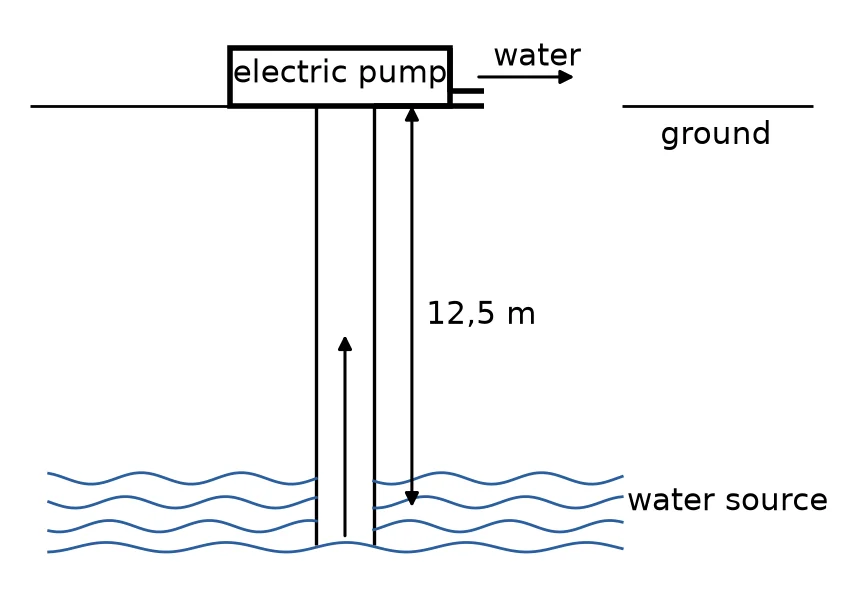 5.3 The pump lifts kg of water from the source to the ground at a constant speed. Calculate the:5.3.3 Average power dissipated by the pump
Ignore energy losses in the form of heat and sound.(3)Show the memo (3 ticks)Memo
- ✓Formula
1 mark · Calculate mechanical power
- ✓Substitution
1 mark · Calculate mechanical power
- ✓Answer W
1 mark · Calculate mechanical power
- ✓
4. Question 1.4 · November 2022 · Paper 1 · National (DBE) · 2 marks
Various options are provided as possible answers to the following questions. Each question has only ONE correct answer.1.4 A car travels at CONSTANT VELOCITY along a horizontal road. A constant frictional force acts on the car during its motion.
Which ONE of the following statements about the power dissipated by the engine of the car during the motion is CORRECT?
The power ...(2)Show the memo (2 ticks)Memo
- ✓Power at constant velocityConstant velocity means , so the engine's force equals the constant frictional force.
: both and are constant, so the power remains constant.
Answer: D2 marks · Calculate mechanical power
- ✓
5. Question 1.4 · September 2026 · Paper 1 · Provincial · 2 marks
Various options are provided as possible answers to the following questions. Each question has only ONE correct answer. Choose the answer and write only the letter (A–D) next to the question numbers in the ANSWER BOOK.1.4 The power provided by an electrical motor is W. What is the energy provided by the motor over a period of three hours?(2)Show the memo (2 ticks)Memo
- ✓Correct option A, so .
s
J
Answer: A2 marks · Calculate mechanical power
- ✓
6. Question 1.5 · September 2026 · Paper 1 · Provincial · 2 marks
Four options are provided as possible answers to the following questions. Each question has only ONE correct answer. Choose the answer and write only the letter (A – D) next to the question numbers (1.1 to 1.10) in the ANSWER BOOK, e.g. 1.11 D.1.5 An object of mass kg is attached to a motor by a light, inextensible string that runs over a frictionless pulley. The motor is used to lift the object from the bottom of a frictionless surface, as shown in the diagram. The object is raised to a vertical height of cm at a constant speed of m·s.
Which of the following gives the rate of increase of potential energy of the object (in watt) if the object is moved from the bottom of the slope to point A?(2)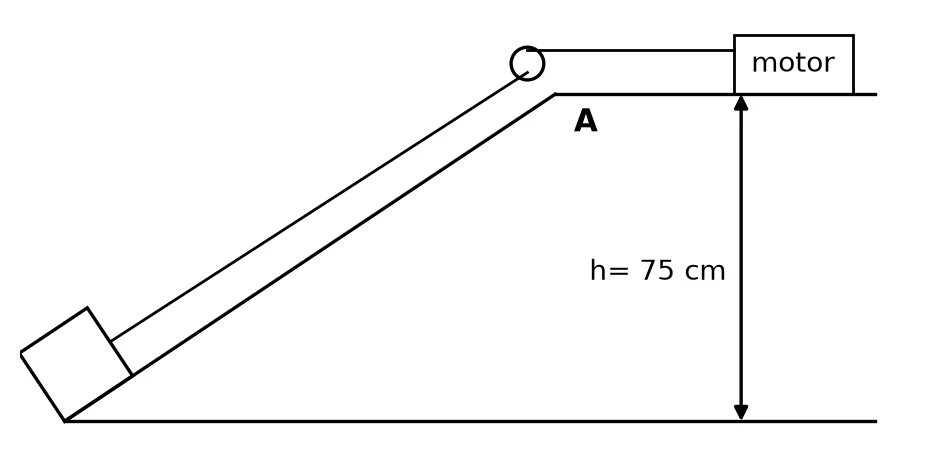
Show the memo (2 ticks)Memo
- ✓Correct optionRate of increase of potential energy is power: .
W.
B uses the height instead of a speed (that is energy, not power) and C is kinetic energy.
Answer: A2 marks · Calculate mechanical power
- ✓
Free on Android
Know exactly which skill is costing you marks.
Mark past papers tick by tick in the NavyBlue app. It remembers every mark you lose, shows you the skills to fix first, and picks your next questions.
Get NavyBlue free on Google Play