Grade 12 Physical Sciences · Mechanics · Draw momentum vector diagrams
Draw momentum vector diagrams Grade 12
Draw arrows for the initial momentum, final momentum and change in momentum, including when an object bounces back, for example a ball that hits a wall with 4 kg·m/s and rebounds with 3 kg·m/s has Δp = 7 kg·m/s away from the wall.
- practice questions use it, all grades
- 7 practice questions use it, all grades
Now try it on a question
No sign-up. Takes 3 minutes.
Practice · NavyBlue · 2 marks
Work it out on paper first. Then mark yourself with the memo, one tick at a time.
More questions: draw momentum vector diagrams
Work each one out first, then open the memo and check every tick.
3. Practice · NavyBlue · 3 marks
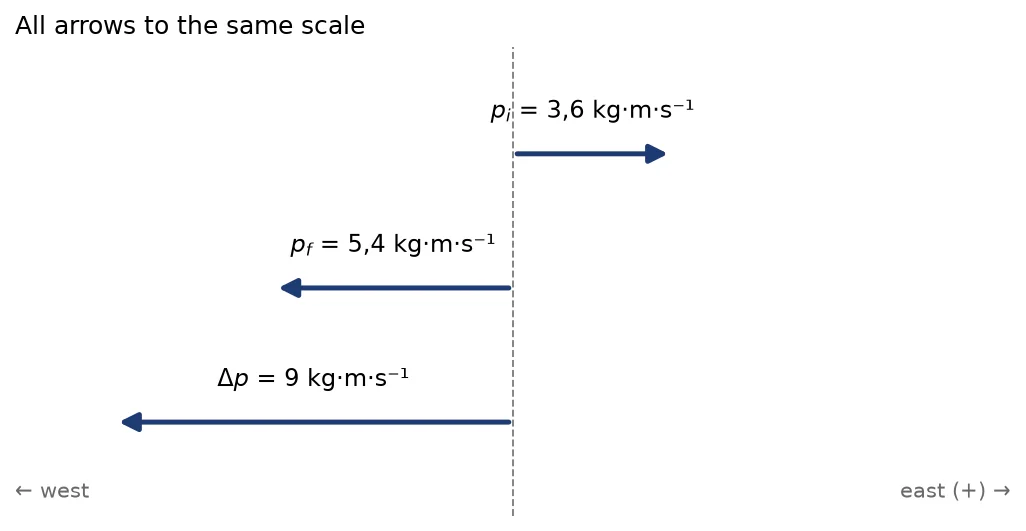
A soccer ball of mass kg rolls east at m·s. A player kicks it and it moves west at m·s. Take east as positive.(c) Draw a vector diagram, roughly to scale, that shows the initial momentum, the final momentum and the change in momentum of the ball.(3)Show the memo (3 ticks)Memo
- ✓Initial momentum arrow: arrow pointing east, length representing kg·m·s
1 mark · Draw momentum vector diagrams
- ✓Final momentum arrow: arrow pointing west, times as long as ( kg·m·s)
1 mark · Draw momentum vector diagrams
- ✓Change in momentum arrow: arrow pointing west, times as long as ( kg·m·s), so that
1 mark · Draw momentum vector diagrams
- ✓
4. Practice · NavyBlue · 2 marks
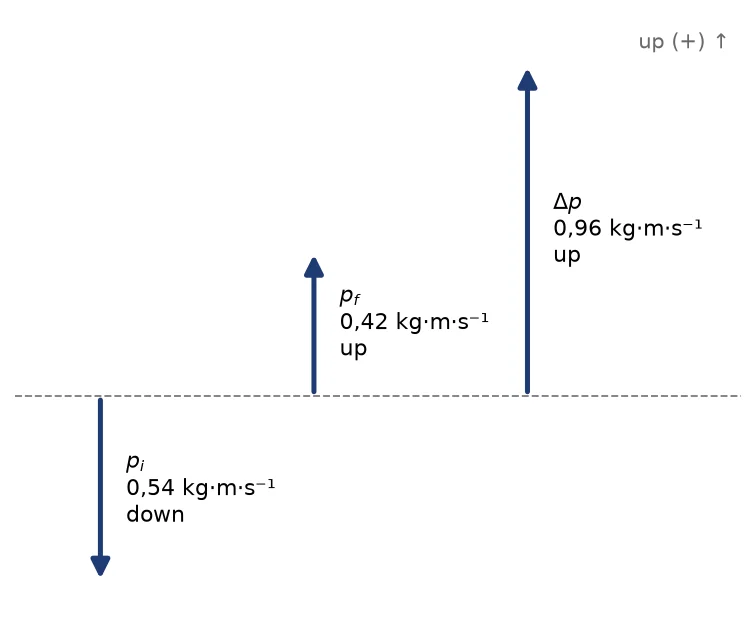
A tennis ball of mass g falls vertically and hits the court at m·s. It bounces straight up and leaves the court at m·s. Take upward as positive.(b) Draw a labelled vector diagram showing , and for the bounce.(2)Show the memo (2 ticks)Memo
- ✓Initial and final momentum arrows: downward arrow ( kg·m·s); : shorter upward arrow ( kg·m·s)
1 mark · Draw momentum vector diagrams
- ✓Change in momentum arrow: upward arrow, longest of the three ( kg·m·s)
1 mark · Draw momentum vector diagrams
- ✓
5. Practice · NavyBlue · 2 marks
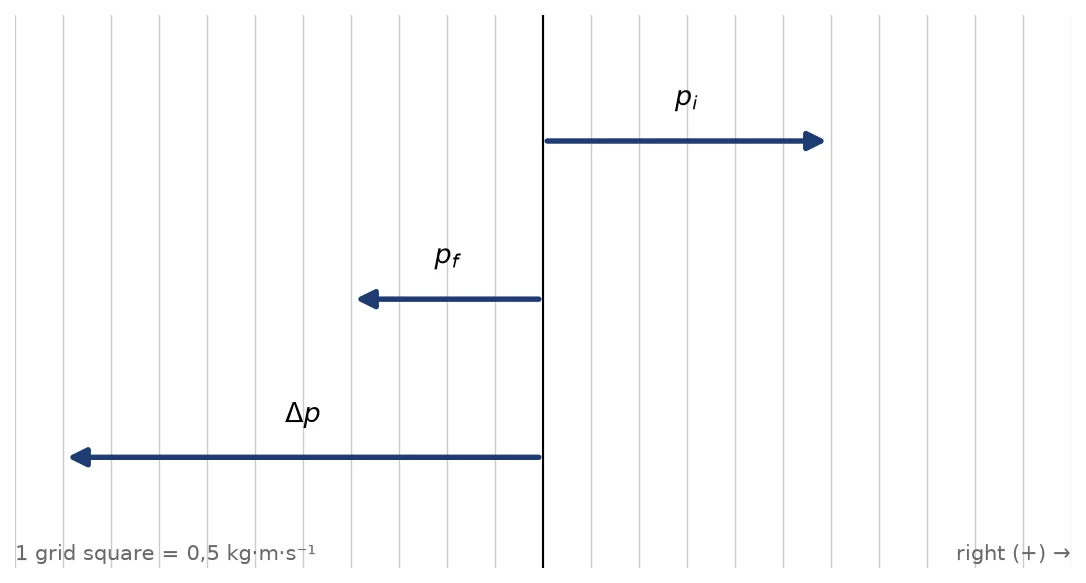
A ball of mass kg moves to the right and hits a wall. The vector diagram shows its initial momentum and its final momentum , drawn to scale on a grid in which one square represents kg·m·s. The ball is in contact with the wall for s. Take right as positive.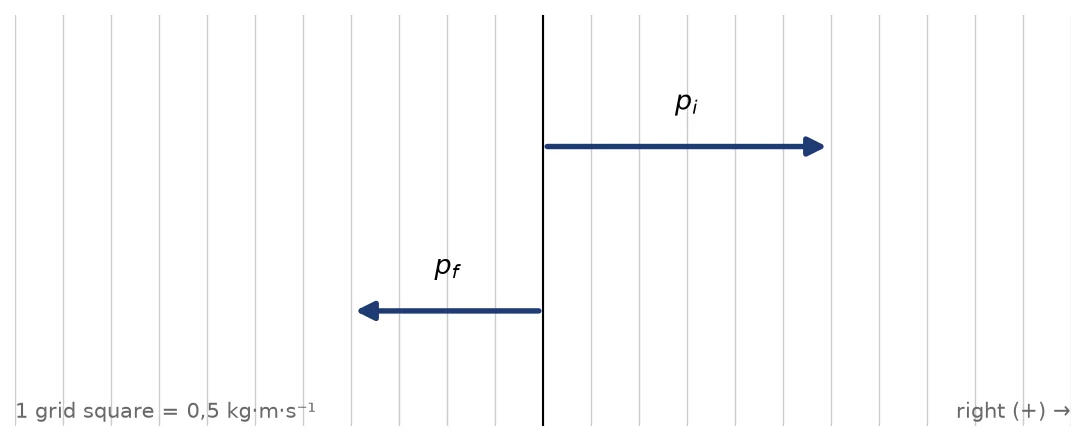 (c) Draw the change in momentum vector, to the same scale, and write down its magnitude and direction.(2)
Show the memo (2 ticks)Memo
- ✓Arrow and scale: an arrow squares long pointing left (from the head of to the head of when they share a tail)
1 mark · Draw momentum vector diagrams
- ✓Value kg·m·s to the left
1 mark · Draw momentum vector diagrams
- ✓
6. Practice · NavyBlue · 2 marks
A car of mass kg travels north. The driver speeds up from m·s to m·s. Take north as positive.(b) Draw a vector diagram, roughly to scale, showing the initial momentum, the final momentum and the change in momentum of the car.(2)Show the memo (2 ticks)Memo
- ✓Initial and final momentum arrows ( kg·m·s) and ( kg·m·s): both arrows point north, is times as long as
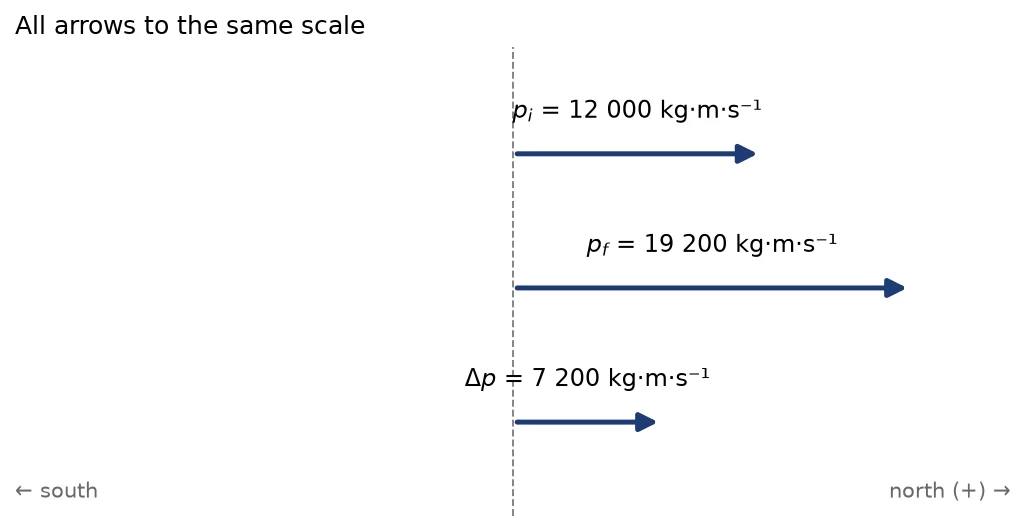
1 mark · Draw momentum vector diagrams
- ✓Change in momentum arrow: arrow pointing north ( kg·m·s), times the length of ;
1 mark · Draw momentum vector diagrams
- ✓
Free on Android
Know exactly which skill is costing you marks.
Mark past papers tick by tick in the NavyBlue app. It remembers every mark you lose, shows you the skills to fix first, and picks your next questions.
Get NavyBlue free on Google Play
