Grade 11 Physical Sciences · Paper 2 (Chemistry)
Chemical Change Grade 11
Real past paper questions and answers from 2024 to 2025, with each memo split into the ticks examiners give. Try one, mark yourself, and see exactly which skill cost you marks.
- past paper questions
- 86 past paper questions
- skills
- 18 skills
- videos
- 18 videos
Try a real exam question
No sign-up. Takes 3 minutes.
Question 1.5 · November 2025 · Paper 2 · Provincial · 2 marks
(I) The activation energy must be overcome to reach the activated complex.
(II) It is the unstable transition state from reactants to products.
(III) It is the energy released or absorbed during a chemical reaction.
Which of the above statement(s) is/are CORRECT about the activated complex?(2)
Work it out on paper first. Then mark yourself with the official memo, one tick at a time.
What's in Chemical Change Grade 11
Each skill is one thing a memo gives a tick for. Tap a skill for its own questions, notes and videos.
Stoichiometry49 past paper questions
- Use conservation of massShow that the total mass or number of atoms is the same before and after a reaction (no atoms are lost or gained).12 past paper questions · 2 videos
- Use the mole ratioUse the numbers in a balanced equation to change moles of one substance into moles of another (2 mol H₂ makes 2 mol H₂O).45 past paper questions · 3 videos
- Define stoichiometry terms and lawsGive the exact meaning of words like mole, molar mass, concentration and limiting reagent, or state a law in full.11 past paper questions · 3 videos
- Calculate number of molesCalculate number of moles from mass, particles or gas volume using n = m/M (36 g of water is 2 mol).56 past paper questions · 4 videos
- Calculate concentration of a solutionCalculate the concentration of a solution with c = n/V, volume in dm³, or work out a dilution (2 mol in 4 dm³ is 0,5 mol/dm³).37 past paper questions · 3 videos
- Determine empirical and molecular formulaeFind the simplest whole-number ratio of atoms in a compound from masses or percentages, then the molecular formula (CH₂O for glucose).18 past paper questions · 4 videos
- Identify the limiting reagentWork out which reactant runs out first and use it to calculate how much product forms or how much of the other reactant is left.20 past paper questions · 3 videos
- Calculate percentage yield or purityCalculate percentage yield or purity, for example actual mass ÷ expected mass × 100 (8 g made out of an expected 10 g is 80%).10 past paper questions · 3 videos
- Convert unitsChange values into the units a formula needs (500 g → 0,5 kg, 25 °C → 298 K, 72 km/h → 20 m/s).14 past paper questions · 3 videos
Energy and Chemical Change15 past paper questions
- Define rate and energy termsGive the exact meaning of words like exothermic, endothermic, activation energy, activated complex, reaction rate and catalyst.10 past paper questions · 3 videos
- Interpret the energy change of reactionsDecide if a reaction is exothermic or endothermic from ΔH or an energy graph, and calculate ΔH or activation energy (burning releases heat, so ΔH < 0).21 past paper questions · 3 videos
Types of Reactions24 past paper questions
- Define acid and base termsGive the exact meaning of acid-base words like Lowry-Brønsted acid, strong acid, ampholyte and equivalence point.8 past paper questions · 3 videos
- Identify conjugate acid-base pairsFind the acid, the base and their conjugates in a proton-transfer reaction (in NH₃ + H₂O, NH₄⁺ is the conjugate acid).15 past paper questions · 3 videos
- Write acid-base reaction equationsWrite equations for acids reacting with bases, oxides or carbonates, or with water (HCl + NaOH → NaCl + H₂O).11 past paper questions · 3 videos
- Use acid-base indicatorsExplain what an indicator is and give its colour in acids or bases (phenolphthalein turns pink in a base).3 past paper questions · 2 videos
- Compare strong and weak acidsTell strong from weak acids and concentrated from dilute solutions, and give the reason (HCl ionises fully, so it is a strong acid).14 past paper questions · 3 videos
- Calculate and interpret pHCalculate pH with pH = −log[H₃O⁺], or use Kw to find a concentration (a [H₃O⁺] of 0,01 mol/dm³ gives pH 2).12 past paper questions · 3 videos
- Do titration calculationsUse titration results to find an unknown concentration or volume with the mole ratio, for example cₐVₐ/c_bV_b = nₐ/n_b.9 past paper questions · 3 videos
More Chemical Change Grade 11 questions and answers
Try each one on paper before you open the memo.
1. Question 2.3.2 · November 2025 · Paper 2 · National (DBE) · 5 marks
The letters A to G in the table below represent organic compounds.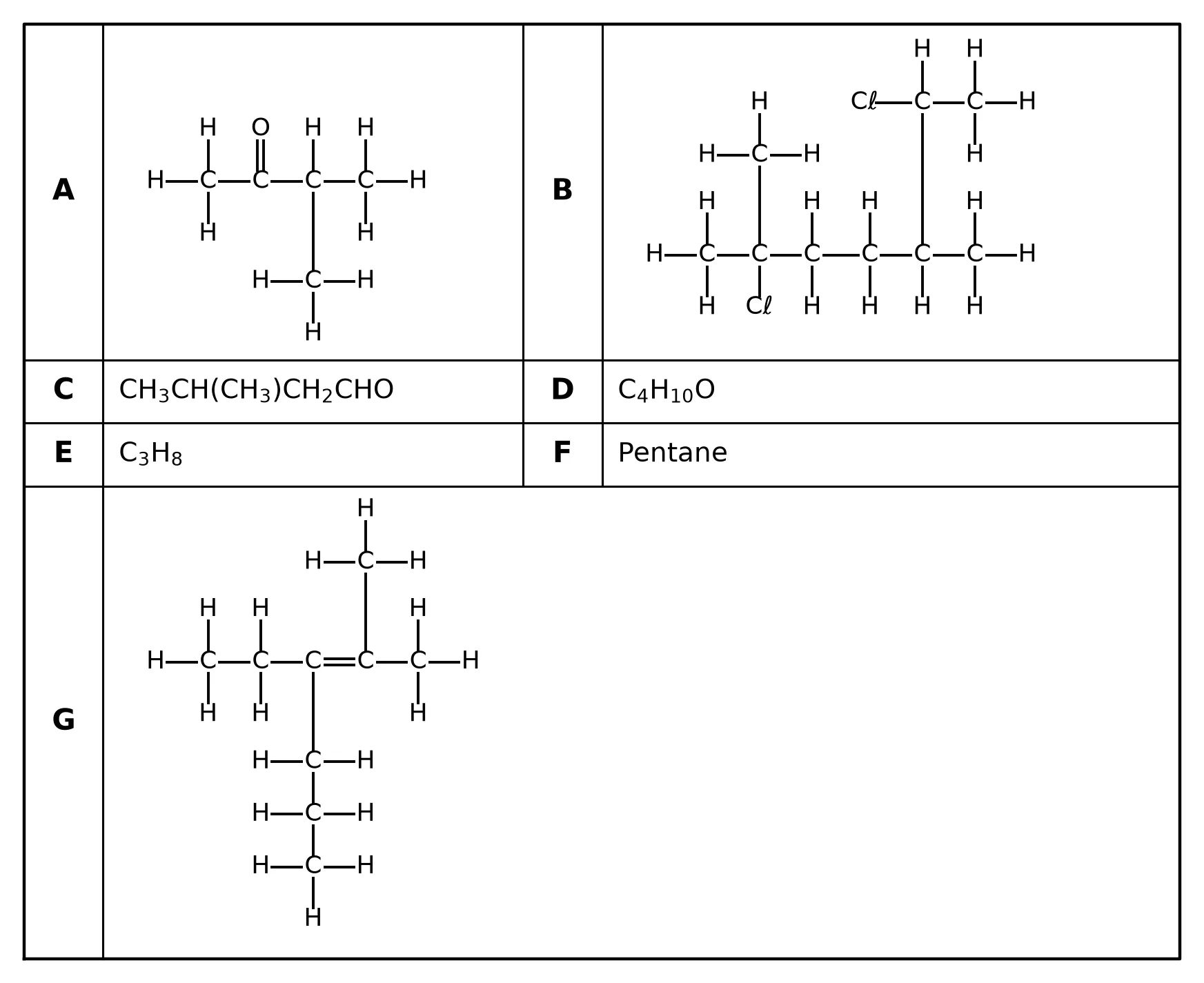 2.3 Compound E, (g), reacts with oxygen, (g), according to the balanced equation:
Initially cm of compound E and cm of oxygen were injected into a container of adjustable volume and allowed to react, as shown below.
Answer the questions that follow.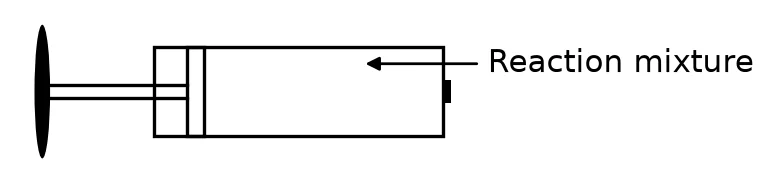 2.3.2 Calculate the TOTAL volume of the GASES present in the container at the end of the reaction.(5)
Show the memo (5 ticks)Memo
- ✓(a) Volume of O2 used (with volume of C3H8) cm
1 mark · Use the mole ratio
- ✓(b) Volumes of CO2 and H2O produced cm
cm1 mark · Use the mole ratio
- ✓(c) Volume of O2 remaining cm
1 mark · Identify the limiting reagent
- ✓(d) Addition of the three volumesVolume of gas in the container
1 mark · Identify the limiting reagent
- ✓(e) Final answerTotal volume of gas in the container cm (or dm)
1 mark · Identify the limiting reagent
- ✓
2. Question 5.1 · November 2024 · Paper 2 · Provincial · 2 marks
Consider the decomposition reaction of dinitrogen pentoxide:
The table below shows the different energies for the above reaction.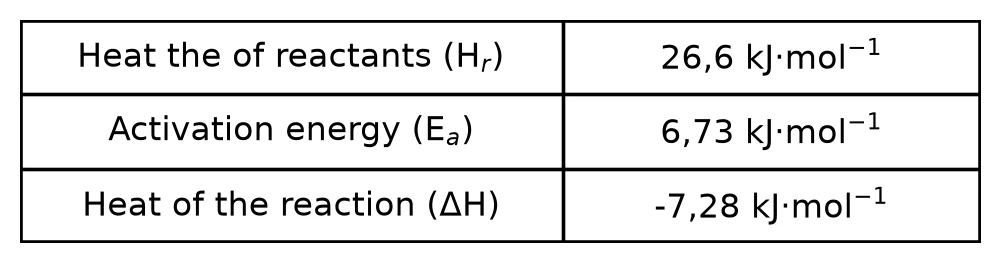 5.1 Define the term activation energy.(2)
Show the memo (1 tick)Memo
- ✓Definition of activation energyThe minimum energy needed for a reaction to take place.
2 marks · Define rate and energy terms
- ✓
3. Question 1.6 · November 2024 · Paper 2 · Provincial · 2 marks
1.6 Which ONE of the following is the conjugate acid of ?(2)Show the memo (1 tick)Memo
- ✓Conjugate acid: add one protonA conjugate acid is formed when a base gains ONE proton (). Adding adds one H and raises the charge by :
Answer: B2 marks · Identify conjugate acid-base pairs
- ✓
4. Question 5.6 · May/June 2025 · Paper 2 · National (DBE) · 2 marks
The reaction between magnesium carbonate pellets, (s), and EXCESS dilute hydrochloric acid, HCℓ(aq), is used to investigate the effect of concentration on the rate of a reaction.
The apparatus used for this investigation is shown below.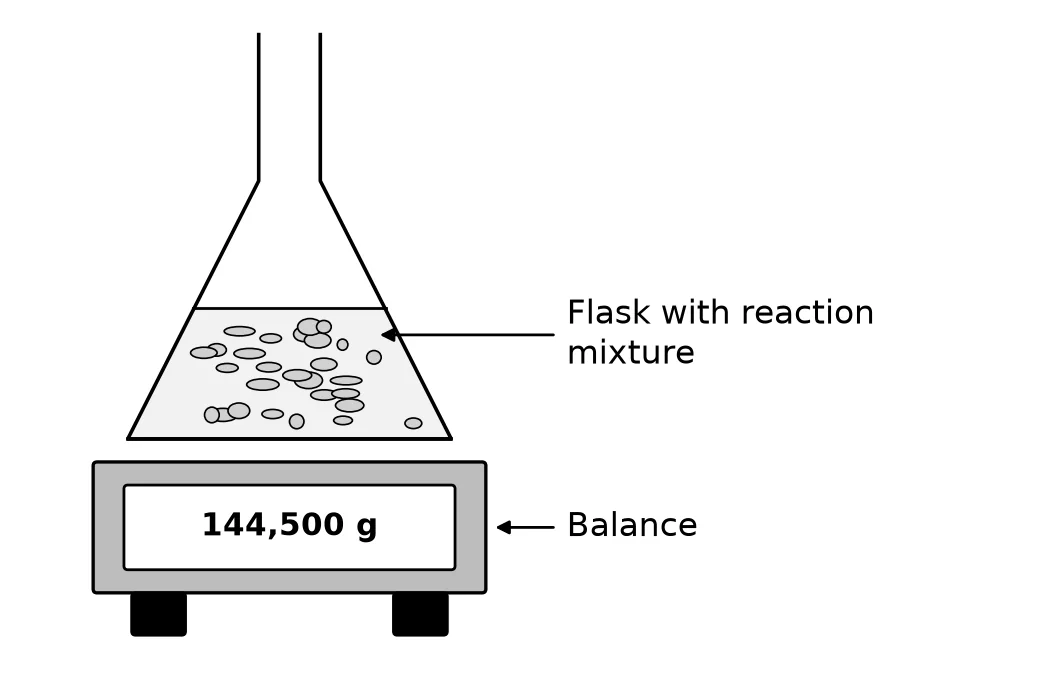 5.6 How will the final mass of (g) produced in EXPERIMENT 2 compare to that of EXPERIMENT 3? Choose from MORE THAN, LESS THAN or THE SAME.
Give a reason for the answer.(2)Show the memo (2 ticks)Memo
- ✓ComparisonThe same
1 mark · Identify the limiting reagent
- ✓ReasonThe same amount is used in each experiment.
1 mark · Identify the limiting reagent
- ✓
5. Question 1 · Siyavula Grade 11 Physical Sciences, 12.3 Activation energy and the activated complex, Worked example 1 · 2 marks
Refer to the graph of potential energy against time for a reaction and then answer the questions that follow.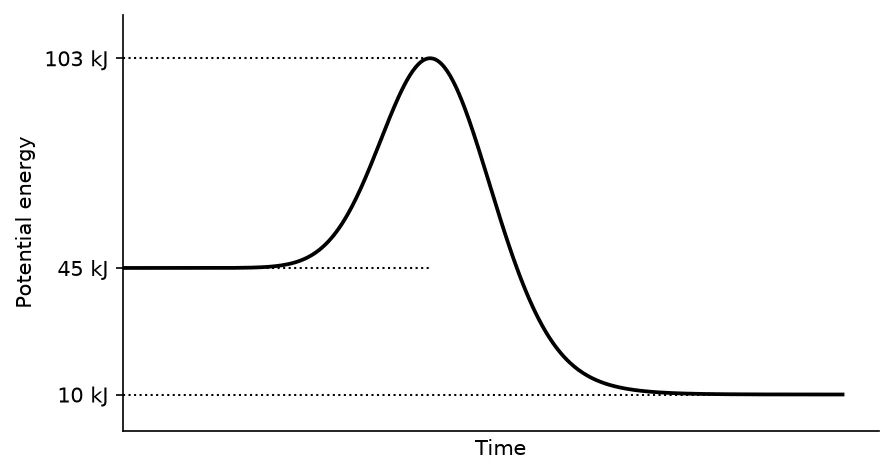 1 Calculate .(2)
Show the memo (2 ticks)Memo
- ✓Formula and values
- ✓Answer kJ
- ✓
Chemical Change Grade 11 videos
Short lessons from South African teachers first. Videos load only when you tap play, to save your data.
Free on Android
Know exactly which skill is costing you marks.
Mark past papers tick by tick in the NavyBlue app. It remembers every mark you lose, shows you the skills to fix first, and picks your next questions.
Get NavyBlue free on Google Play
