Grade 11 Physical Sciences · Paper 1 (Physics)
Waves, Sound and Light Grade 11
Real past paper questions from 2018 to 2019 and practice questions, with each memo split into the ticks examiners give. Try one, mark yourself, and see exactly which skill cost you marks.
- questions · 26 past paper, 85 practice
- 111 questions · 26 past paper, 85 practice
- skills
- 4 skills
- videos
- 4 videos
Try a real exam question
No sign-up. Takes 3 minutes.
Question 1.6 · November 2019 · Paper 1 · National (DBE) · 2 marks
Work it out on paper first. Then mark yourself with the official memo, one tick at a time.
What's in Waves, Sound and Light Grade 11
Each skill is one thing a memo gives a tick for. Tap a skill for its own questions, notes and videos.
Geometrical Optics90 questions (20 past paper)
- State optics laws and definitionsState the law of reflection, Snell's law or Huygens' principle, or define terms like refractive index, critical angle and the normal.25 questions (8 past paper) · 4 videos
- Apply Snell's lawUse $n_1 \sin\theta_1 = n_2 \sin\theta_2$ to find an angle, refractive index or critical angle when light passes from air into glass.35 questions (7 past paper) · 4 videos
- Explain refraction and total internal reflectionExplain why light bends when it changes speed between materials, and when total internal reflection happens (light trapped inside an optical fibre).38 questions (6 past paper) · 3 videos
2D and 3D Wavefronts46 questions (14 past paper)
- State optics laws and definitionsState the law of reflection, Snell's law or Huygens' principle, or define terms like refractive index, critical angle and the normal.25 questions (8 past paper) · 4 videos
- Explain diffractionExplain how waves spread out through a narrow gap, and how the spreading changes with wavelength and slit width (a narrower slit spreads more).21 questions (6 past paper) · 3 videos
More Waves, Sound and Light Grade 11 questions and answers
Try each one on paper before you open the memo.
1. Question 8.5 · November 2018 · Paper 1 · National (DBE) · 2 marks
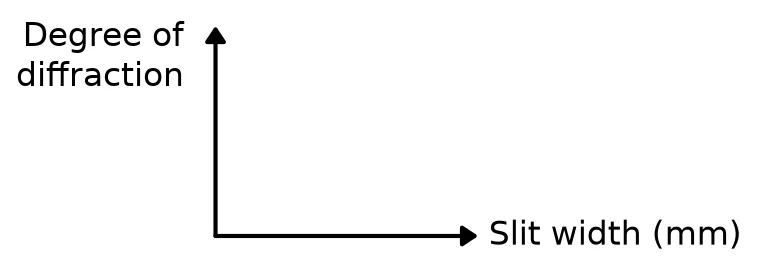
An experiment is performed to investigate the effect of wavelength on the degree of diffraction. Monochromatic light shines through a slit with a width of mm and the pattern produced is shown on a screen.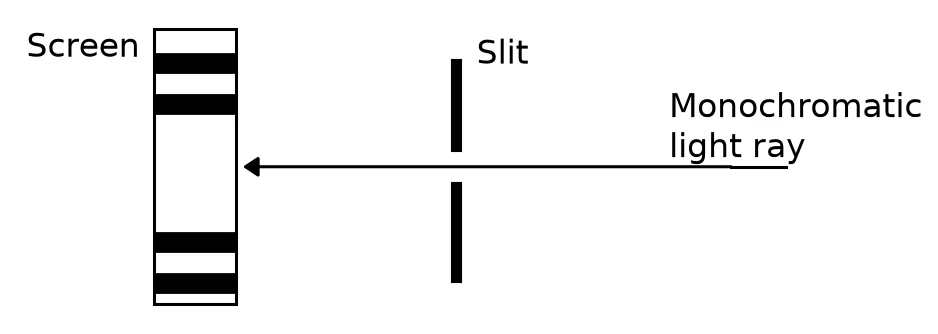 The experiment is repeated with only green light with a wavelength of nm, but the slit width is changed and the degree of diffraction is recorded.8.5 Copy the set of axes below into your ANSWER BOOK and draw a graph showing the relationship between slit width and degree of diffraction.(2)
Show the memo (2 ticks)Memo
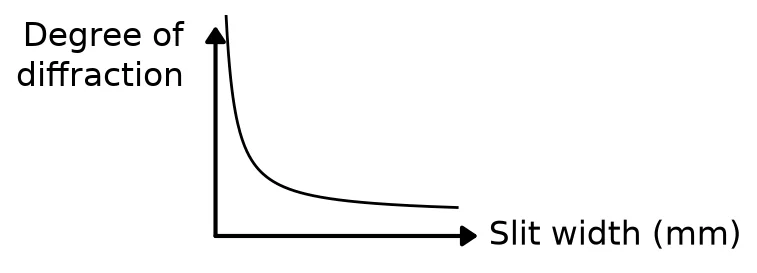
- ✓Inverse proportionality curveLine should indicate inverse proportionality: a curve that falls steeply at small slit widths and flattens out, approaching the slit-width axis without touching it.
2 marks · Explain diffraction
- ✓
2. Practice · Siyavula Grade 11 Physical Sciences · Example 1 · 2 marks
Calculate the speed of light through glycerine which has a refractive index of .(2)Show the memo (2 ticks)Memo
- ✓Formula and substitution, so
1 mark · Apply Snell's law
- ✓Answer with unit m·s
1 mark · Apply Snell's law
Question and solution adapted from Siyavula Education (CC BY 3.0)
- ✓
3. Practice · Siyavula Grade 11 Physical Sciences · Example 2 · 3 marks

 Two diffraction patterns are presented, determine which one has the longer wavelength based on the features of the diffraction pattern. The first pattern is for green light, the second pattern is for red light. The same diffraction grating is used to generate both diffraction patterns.(3)
Show the memo (3 ticks)Memo
- ✓Diffraction depends on wavelength and slit width
The same grating is used, so the slit width is fixed.1 mark · Explain diffraction
- ✓Compare the patternsThe red pattern is wider than the green pattern, so there is more diffraction for the red light:
1 mark · Explain diffraction
- ✓Conclusion: the wavelength of the red light is longer than that of the green light.
1 mark · Explain diffraction
Question and solution adapted from Siyavula Education (CC BY 3.0)
- ✓
4. Practice · Siyavula Grade 11 Physical Sciences · Example 2 · 3 marks
Light is refracted at the boundary between water and an unknown medium. If the angle of incidence is , and the angle of refraction is , calculate the refractive index of the unknown medium and identify the material. (The refractive index of water is ; typical glass has a refractive index between and .)(3)Show the memo (3 ticks)Memo
- ✓Snell's law substitution
1 mark · Apply Snell's law
- ✓Refractive index
1 mark · Apply Snell's law
- ✓Identify the mediumTypical glass has a refractive index between and . Therefore the unknown medium is typical glass.
1 mark · Apply Snell's law
Question and solution adapted from Siyavula Education (CC BY 3.0)
- ✓
5. Practice · Siyavula Grade 11 Physical Sciences · Ex 6.1 · 3 marks
A water break at the entrance to a harbour consists of a rock barrier with a m wide opening. Ocean waves of m wavelength approach the opening straight on. Light with a wavelength of m strikes a single slit of width m. Which waves are diffracted to a greater extent?(3)Show the memo (3 ticks)Memo
- ✓Diffraction of the water waves
1 mark · Explain diffraction
- ✓Diffraction of the light waves
1 mark · Explain diffraction
- ✓ConclusionThe light waves are diffracted more.
1 mark · Explain diffraction
Question and solution adapted from Siyavula Education (CC BY 3.0)
- ✓
Waves, Sound and Light Grade 11 videos
Short lessons from South African teachers first. Videos load only when you tap play, to save your data.
Free on Android
Know exactly which skill is costing you marks.
Mark past papers tick by tick in the NavyBlue app. It remembers every mark you lose, shows you the skills to fix first, and picks your next questions.
Get NavyBlue free on Google Play