Grade 11 Physical Sciences · Paper 2 (Chemistry)
Matter and Materials Grade 11
Real past paper questions and answers from 2023 to 2025, with each memo split into the ticks examiners give. Try one, mark yourself, and see exactly which skill cost you marks.
- past paper questions
- 88 past paper questions
- skills
- 17 skills
- videos
- 17 videos
Try a real exam question
No sign-up. Takes 3 minutes.
Question 3.1 · November 2024 · Paper 2 · National (DBE) · 2 marks
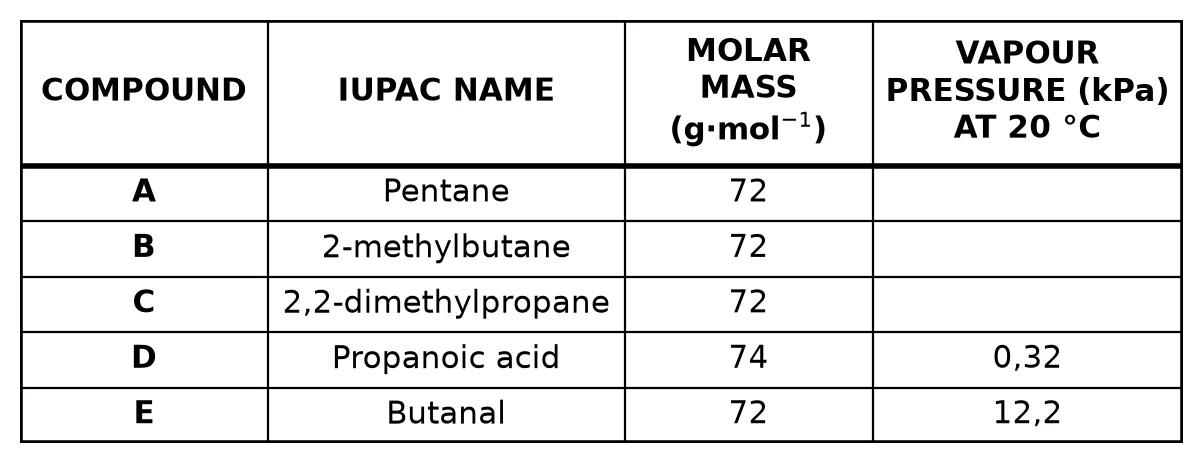
Work it out on paper first. Then mark yourself with the official memo, one tick at a time.
What's in Matter and Materials Grade 11
Each skill is one thing a memo gives a tick for. Tap a skill for its own questions, notes and videos.
Molecular Structure47 past paper questions
- Define bonding and intermolecular termsGive the exact meaning of bonding words like covalent bond, ionic bond, lone pair, electronegativity and bond energy.15 past paper questions · 4 videos
- Draw Lewis diagramsDraw Lewis dot diagrams showing valence electrons, shared pairs and lone pairs (water has two bonding pairs and two lone pairs).18 past paper questions · 3 videos
- Identify and compare chemical bondsName a bond as covalent, ionic or metallic and describe how it forms (electrons are shared in a covalent bond, as in H₂).17 past paper questions · 4 videos
- Interpret the bond energy graphRead bond length and bond energy from a graph of potential energy against distance between two atoms, and explain each part of the curve.4 past paper questions · 3 videos
- Predict molecular shapePredict the shape of a molecule from its electron pairs, such as linear, tetrahedral or angular (water is angular).10 past paper questions · 3 videos
- Determine bond and molecule polarityUse electronegativity difference and molecular shape to decide if a bond or molecule is polar (CO₂ has polar bonds but is non-polar).9 past paper questions · 4 videos
Intermolecular Forces41 past paper questions
- Define bonding and intermolecular termsGive the exact meaning of bonding words like covalent bond, ionic bond, lone pair, electronegativity and bond energy.15 past paper questions · 4 videos
- Identify the intermolecular forcesName the type of force between molecules, such as London forces, dipole-dipole forces or hydrogen bonds (water has hydrogen bonds).10 past paper questions · 3 videos
- Explain properties using intermolecular forcesExplain differences in boiling point, vapour pressure or solubility using the strength of forces between molecules (water boils higher than methane).15 past paper questions · 3 videos
- Explain organic boiling point trendsExplain why organic compounds have different boiling points using chain length, branching or functional group (longer chains boil at higher temperatures).27 past paper questions · 4 videos
- Identify variables in an investigationName the independent, dependent and controlled variables in an experiment (in a test of temperature on reaction rate, temperature is independent).13 past paper questions · 3 videos
- Write investigative question or conclusionWrite an investigative question, hypothesis or conclusion that links two variables (How does the length of a wire affect its resistance?).10 past paper questions · 3 videos
- Read a graph of resultsRead values from a graph or table of results, or calculate a gradient (finding resistance from the gradient of a V-I graph).13 past paper questions · 3 videos
Ideal Gases25 past paper questions
- State and explain the gas lawsState the gas laws, like Boyle's law, and explain gas behaviour with moving particles (squeezing a gas makes particles hit the walls more often).6 past paper questions · 4 videos
- Calculate with the gas equationsCalculate pressure, volume or temperature of a gas using p₁V₁/T₁ = p₂V₂/T₂ or pV = nRT, with temperature in kelvin.7 past paper questions · 3 videos
- Convert unitsChange values into the units a formula needs (500 g → 0,5 kg, 25 °C → 298 K, 72 km/h → 20 m/s).14 past paper questions · 3 videos
- Identify variables in an investigationName the independent, dependent and controlled variables in an experiment (in a test of temperature on reaction rate, temperature is independent).13 past paper questions · 3 videos
- Write investigative question or conclusionWrite an investigative question, hypothesis or conclusion that links two variables (How does the length of a wire affect its resistance?).10 past paper questions · 3 videos
- Describe and evaluate an experimentName apparatus, describe or explain steps of a method, and give safety precautions (repeat readings and work out an average).6 past paper questions · 3 videos
- Plot a graph from dataPlot results on a graph with labelled axes, units and a good scale, and draw the line or curve of best fit.3 videos
- Read a graph of resultsRead values from a graph or table of results, or calculate a gradient (finding resistance from the gradient of a V-I graph).13 past paper questions · 3 videos
More Matter and Materials Grade 11 questions and answers
Try each one on paper before you open the memo.
1. Question 9.2.2 · November 2025 · Paper 1 · Provincial · 2 marks
Learners investigate the relationship between current in a conductor and the potential differences across the ends of the conductor. The graph below is obtained from their investigation.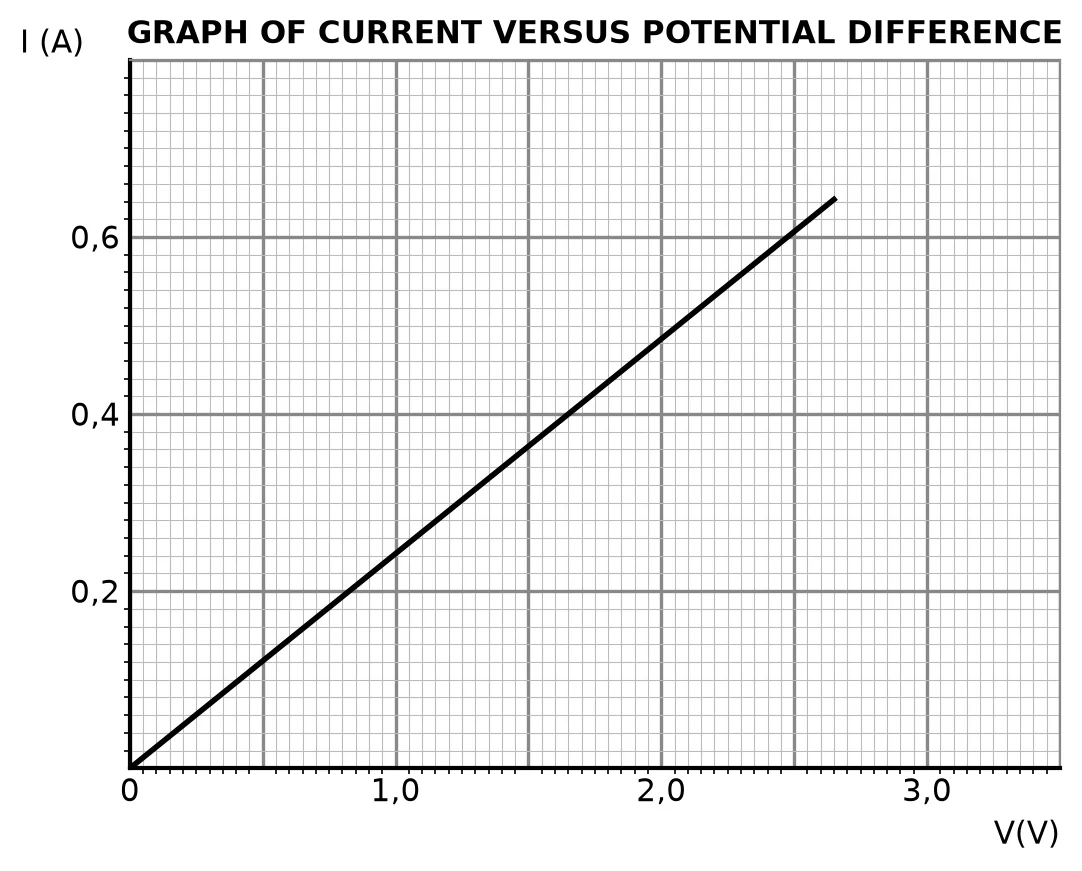 9.2 Write down the:9.2.2 Control variables for this investigation(2)
Show the memo (2 ticks)Memo
- ✓First control variableTemperature (accept resistance)
- ✓Second control variableLength of conductor (or thickness of conductor)
- ✓
2. Question 3.2.3 · November 2025 · Paper 2 · Provincial · 3 marks
3.2 Consider the boiling points of the hydrogen halides on group 16 as shown on the table below.
Answer the questions that follow.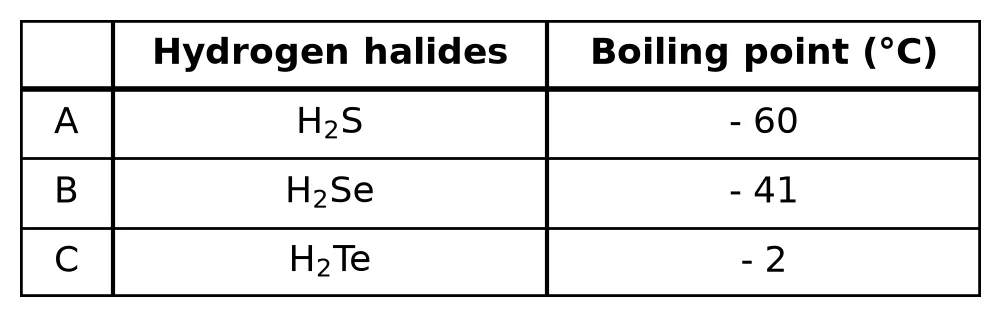 3.2.3 Explain the trend observed in the boiling points of the hydrogen halides by referring to the molecular size and energy involved.(3)
Show the memo (3 ticks)Memo
- ✓Molecular size increasesFrom to the molecular size increases.
- ✓Size and London forcesAs the molecular size increases so does the London forces.
- ✓Energy neededMore energy is needed to overcome the intermolecular forces from to .
- ✓
3. Question 1.3 · November 2024 · Paper 2 · Provincial · 2 marks
1.3 Which ONE of the following is NOT a property of the ideal gas?(2)Show the memo (1 tick)Memo
- ✓Properties of an ideal gasIn an ideal gas the molecules themselves have negligible volume compared with the volume of the container, there are no intermolecular forces and collisions are elastic. So the statement that the gas volume EQUALS the total volume of the molecules is not true of an ideal gas.
Answer: C2 marks · State and explain the gas laws
- ✓
4. Question 3.1 · November 2023 · Paper 2 · National (DBE) · 2 marks
The relationship between boiling point and the molecular mass of aldehydes, carboxylic acids and primary alcohols is investigated. Curves P, R and S are obtained. All compounds used are straight chain molecules.
GRAPH OF BOILING POINT VERSUS MOLECULAR MASS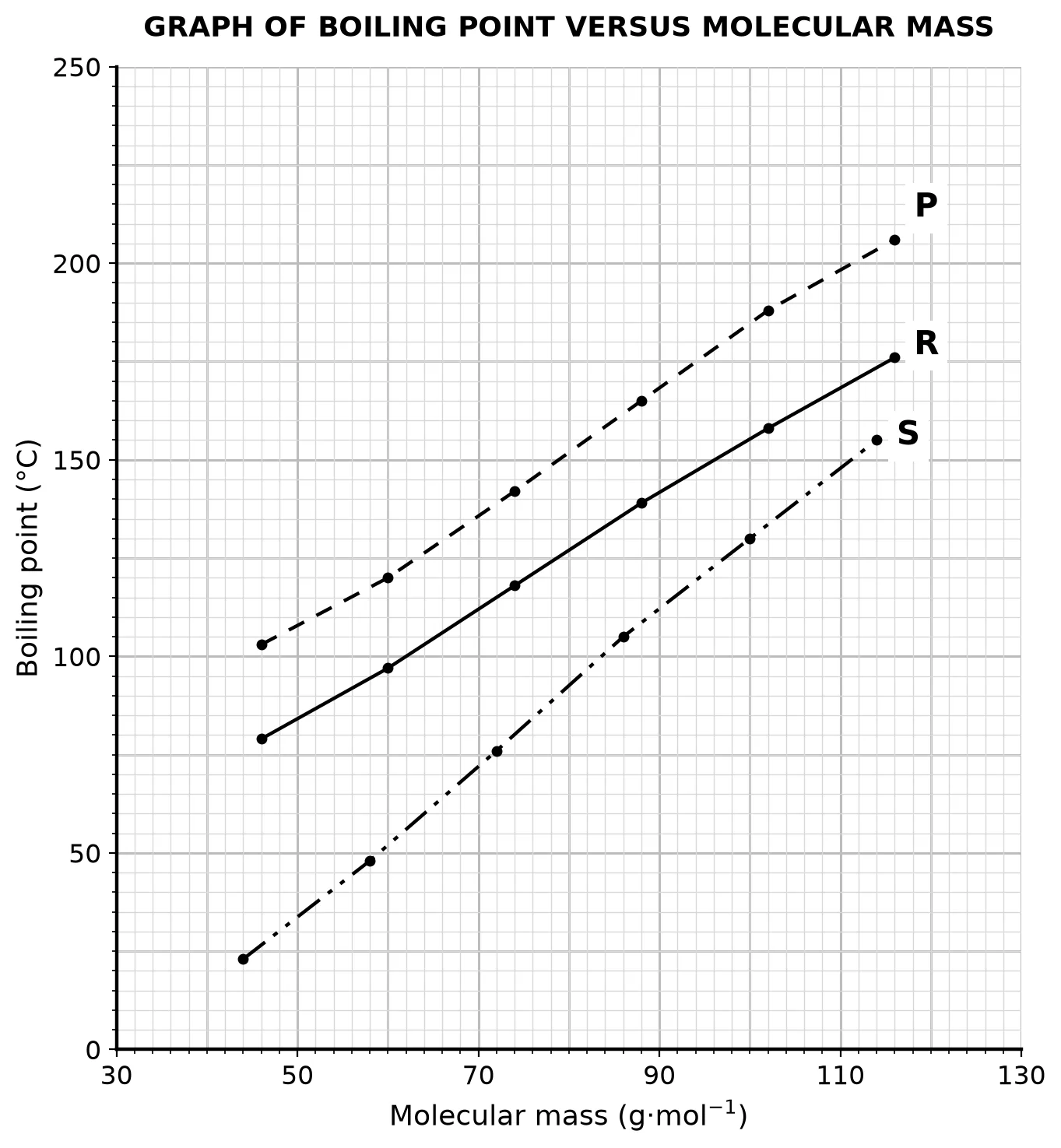 3.1 Define the term boiling point.(2)
Show the memo (1 tick)Memo
- ✓Definition of boiling pointThe temperature at which the vapour pressure of a substance equals atmospheric pressure.
2 marks · Define bonding and intermolecular terms
- ✓
5. Question 2.7 · November 2024 · Paper 2 · Provincial · 3 marks
Consider the following compounds. 2.7 Explain the answer to QUESTION 2.6 by referring to the molecular polarity and intermolecular forces involved in the compounds.(3)
Show the memo (3 ticks)Memo
- ✓: polarity and forces is a non-polar molecule and only contains London forces.
- ✓: polarity and forces is a non-polar molecule and only contains London forces.
- ✓Like dissolves likeBoth compounds are non-polar and only has London forces and "like dissolves like".
- ✓
Matter and Materials Grade 11 videos
Short lessons from South African teachers first. Videos load only when you tap play, to save your data.
Free on Android
Know exactly which skill is costing you marks.
Mark past papers tick by tick in the NavyBlue app. It remembers every mark you lose, shows you the skills to fix first, and picks your next questions.
Get NavyBlue free on Google Play
