Grade 11 Physical Sciences · Matter and Materials
Explain organic boiling point trends
Explain why organic compounds have different boiling points using chain length, branching or functional group (longer chains boil at higher temperatures).
- past paper questions use it
- 27 past paper questions use it
- videos
- 4 videos
Learn it: explain organic boiling point trends
Pick one and watch it, then try the questions below. Videos load only when you tap play.
Now try it on a real exam question
No sign-up. Takes 3 minutes.
Question 3.5 · November 2025 · Paper 2 · National (DBE) · 2 marks
The boiling points are used to distinguish between the two compounds.
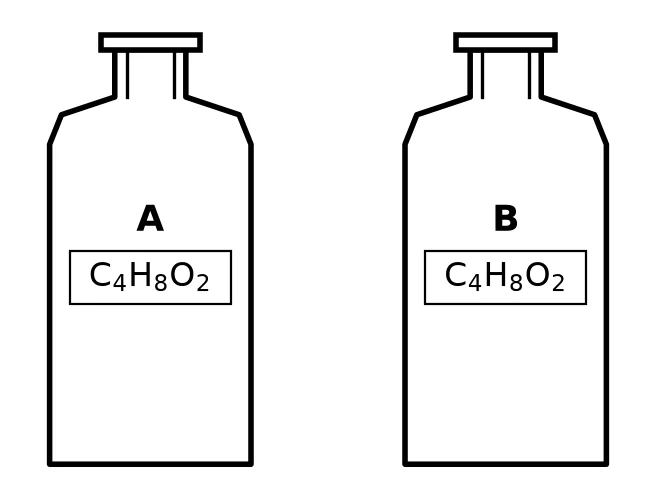
Work it out on paper first. Then mark yourself with the official memo, one tick at a time.
More past paper questions: explain organic boiling point trends
Work each one out first, then open the memo and check every tick.
3. Question 3.1.3(c) · May/June 2025 · Paper 2 · National (DBE) · 2 marks
3.1 The boiling points of straight chain aldehydes and straight chain carboxylic acids are compared. The table below shows the results obtained.
Answer the questions that follow.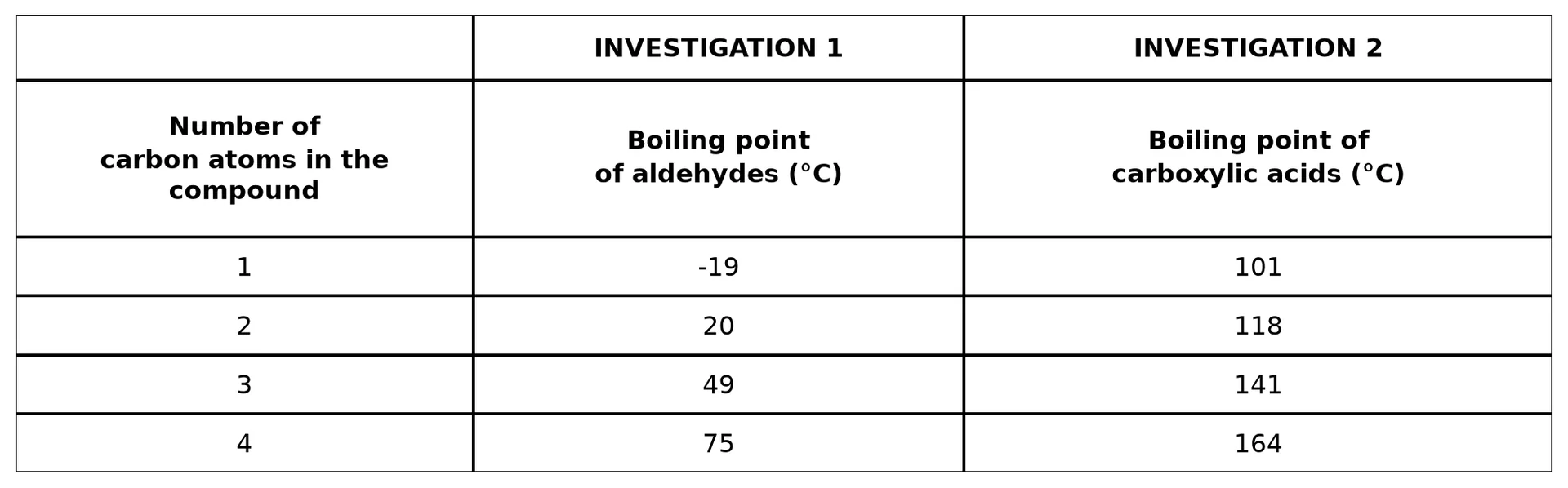 3.1.3 For INVESTIGATION 2:3.1.3(c) Fully explain the answer to QUESTION 3.1.3(b).(2)
Show the memo (2 ticks)Memo
- ✓Compare strength of IMFsAs the number of C atoms/chain length/surface area/contact area/molecular mass increases, the strength of intermolecular/London/dispersion forces increases.
1 mark · Explain organic boiling point trends
- ✓Compare energy neededMore energy is needed to overcome intermolecular forces/London/dispersion forces.
1 mark · Explain organic boiling point trends
- ✓
4. Question 3.4.2 · May/June 2024 · Paper 2 · National (DBE) · 2 marks
The boiling points of some organic compounds are shown in the table below. The atmospheric pressure is kPa.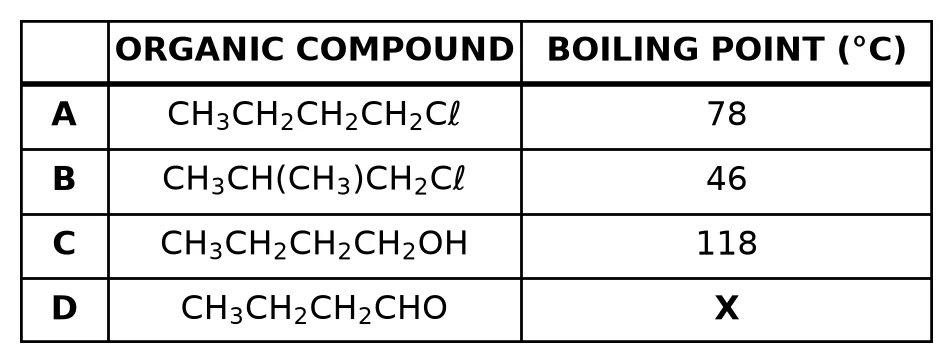 3.4 Consider the boiling points below.
 3.4.2 Fully explain the answer to QUESTION 3.4.1.(2)
Show the memo (2 ticks)Memo
- ✓Intermolecular forcesC (/butanol) has stronger intermolecular forces than D (/butanal).
OR D has weaker intermolecular forces than C.
OR A () is a more polar molecule than D, increasing the intermolecular forces.
OR The electron density of A is greater than D, increasing the intermolecular forces.1 mark · Explain organic boiling point trends
- ✓EnergyMore energy is needed to overcome or break the intermolecular forces (of C / of A).
OR Less energy is needed to overcome the intermolecular forces of D.
Accept: Boiling point of C will be more (in relation to C and D/ °C vs °C). Accept: Boiling point of D will be less (in relation to A and D).1 mark · Explain organic boiling point trends
- ✓
5. Question 3.3.2 · November 2024 · Paper 2 · National (DBE) · 4 marks
The vapour pressures of different organic compounds are determined at °C. The vapour pressures of compounds A, B and C are NOT shown in the table.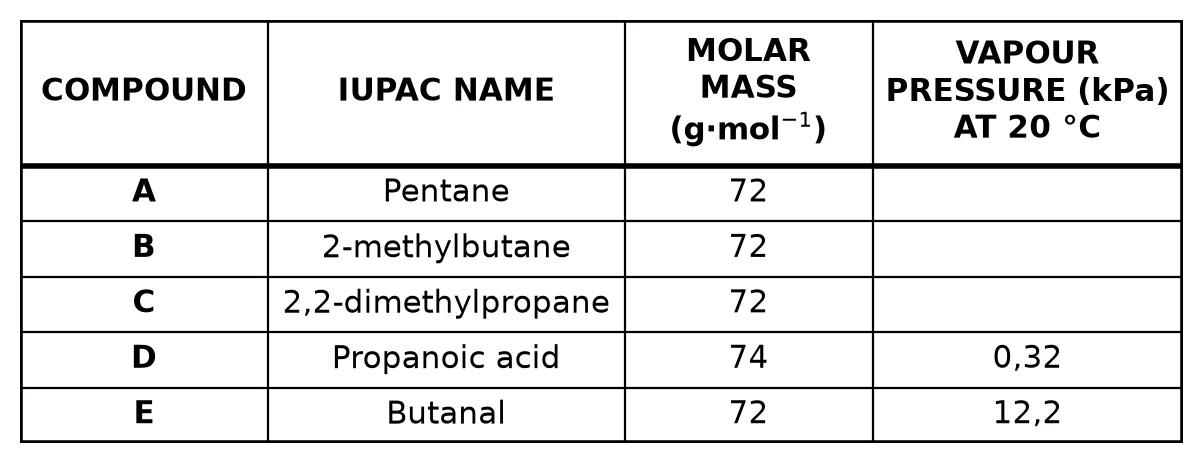 3.3 Compounds D and E are compared.3.3.2 Fully explain the difference in the vapour pressures between compounds D and E.(4)
Show the memo (4 ticks)Memo
- ✓Strongest IMF in D: hydrogen bondingCompound D / propanoic acid has hydrogen bonding (dipole-dipole and London forces) between molecules.
1 mark · Explain organic boiling point trends
- ✓Strongest IMF in E: dipole-dipoleCompound E / butanal has dipole-dipole forces (and London forces) between molecules.
1 mark · Explain organic boiling point trends
- ✓Compare strength of IMFIntermolecular forces between molecules of compound D / propanoic acid are stronger than intermolecular forces between molecules of compound E / butanal.
1 mark · Explain organic boiling point trends
- ✓Compare energy neededMore energy is needed to overcome/break intermolecular forces between molecules of compound D / propanoic acid than in compound E / butanal.
OR: Less energy is needed to overcome/break intermolecular forces between molecules of compound E / butanal than in compound D / propanoic acid.1 mark · Explain organic boiling point trends
- ✓
6. Question 3.2 · May/June 2023 · Paper 2 · National (DBE) · 4 marks
Learners investigate the boiling points of the four organic compounds given below.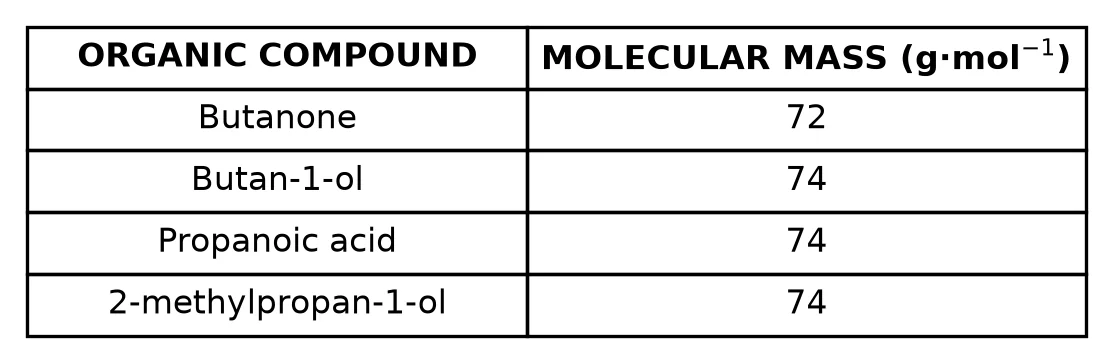 3.2 Which compound, butan-1-ol or 2-methylpropan-1-ol, will have the higher boiling point? Fully explain the answer.(4)
Show the memo (4 ticks)Memo
- ✓Correct compoundButan-1-ol
1 mark · Explain organic boiling point trends
- ✓Compare chain length/branching/surface areaButan-1-ol has a longer chain length / is less branched / has a larger surface area (contact area).
1 mark · Explain organic boiling point trends
- ✓Compare strength of intermolecular forcesStrength of the intermolecular forces is greater. / There are more sites for London forces.
1 mark · Explain organic boiling point trends
- ✓Compare energyMore energy is needed to overcome/break intermolecular forces.
1 mark · Explain organic boiling point trends
- ✓
Free on Android
Know exactly which skill is costing you marks.
Mark past papers tick by tick in the NavyBlue app. It remembers every mark you lose, shows you the skills to fix first, and picks your next questions.
Get NavyBlue free on Google Play
