Grade 11 Physical Sciences · Matter and Materials
Explain properties using intermolecular forces
Explain differences in boiling point, vapour pressure or solubility using the strength of forces between molecules (water boils higher than methane).
- past paper questions use it
- 15 past paper questions use it
- videos
- 3 videos
Learn it: explain properties using intermolecular forces
Pick one and watch it, then try the questions below. Videos load only when you tap play.
Now try it on a real exam question
No sign-up. Takes 3 minutes.
Question 3.4 · November 2024 · Paper 2 · Provincial · 3 marks
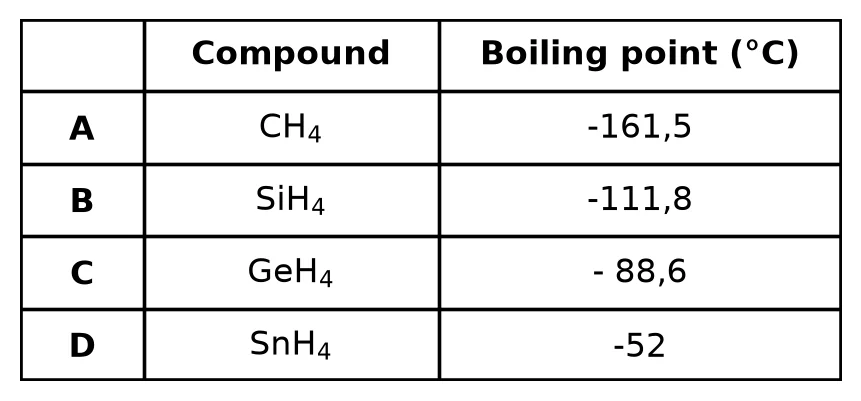
Work it out on paper first. Then mark yourself with the official memo, one tick at a time.
More past paper questions: explain properties using intermolecular forces
Work each one out first, then open the memo and check every tick.
3. Question 3.2.4 · November 2025 · Paper 2 · Provincial · 2 marks
3.2 Consider the boiling points of the hydrogen halides on group 16 as shown on the table below.
Answer the questions that follow.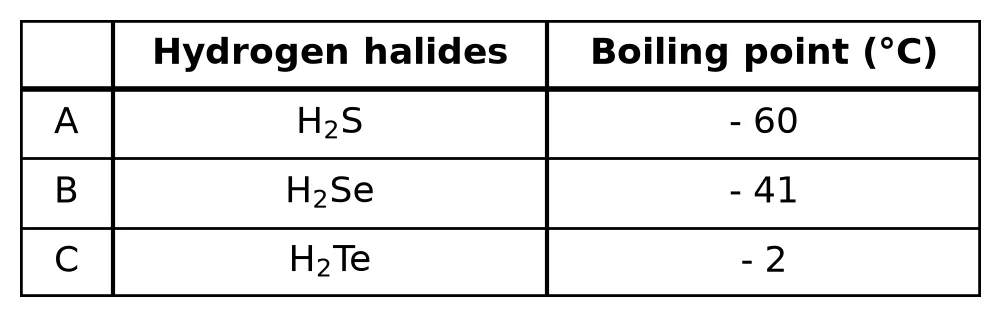 3.2.4 Which hydrogen halide (, or ) will have the lowest vapour pressure at a certain temperature?
Give a reason for the answer.(2)Show the memo (2 ticks)Memo
- ✓Lowest vapour pressure
- ✓ReasonIt has the highest boiling point.
- ✓
4. Question 3.6 · November 2023 · Paper 2 · Provincial · 3 marks
The grade 10 learners conducted an experiment to investigate the effect of the increase in temperature on ethanol over a period of time at standard pressure.
The graph below was drawn using the results obtained.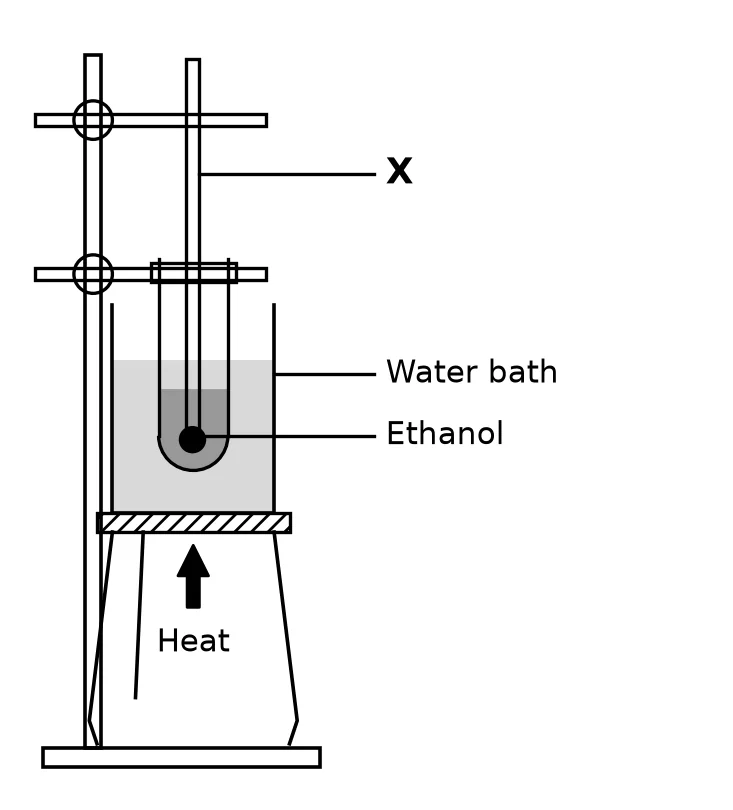
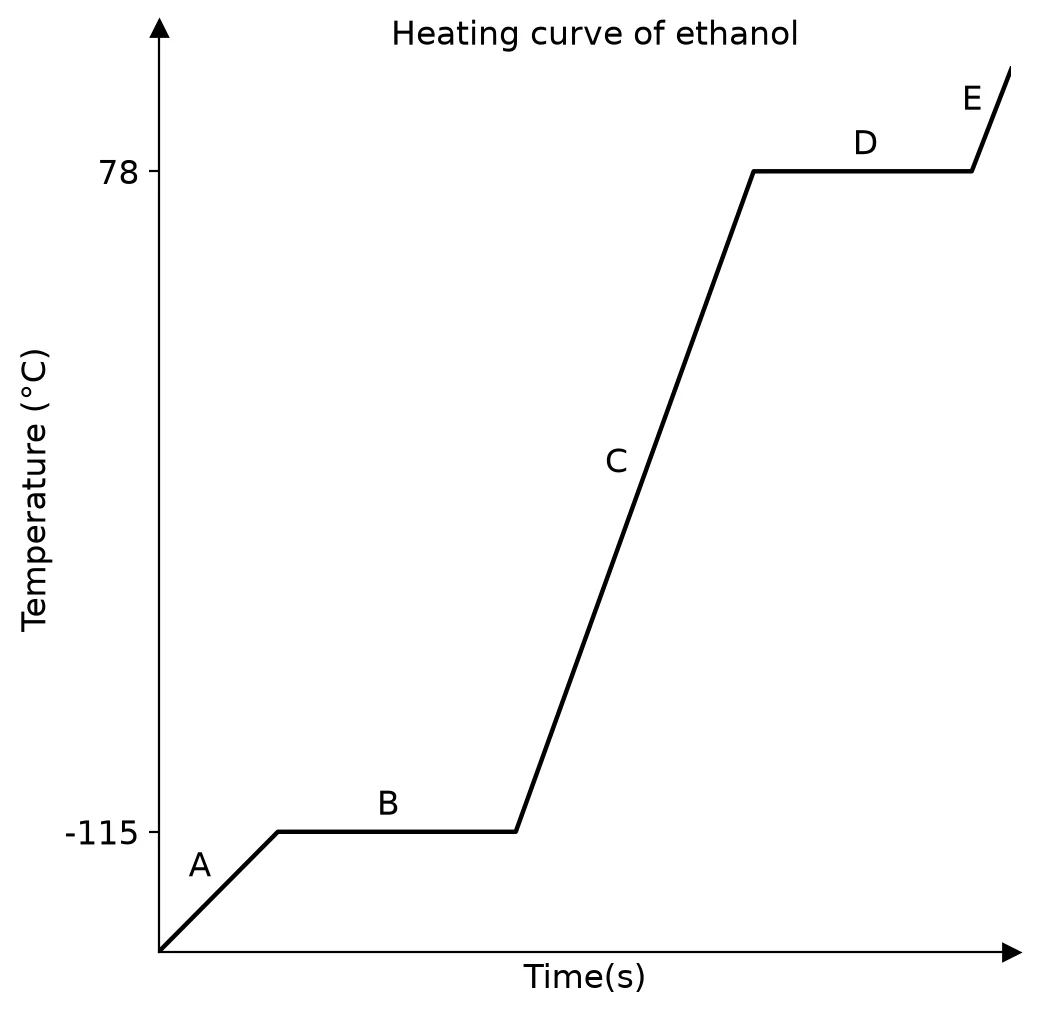 3.6 Will water or ethanol boil first at standard pressure? Explain the answer.(3)
Show the memo (3 ticks)Memo
- ✓ChoiceEthanol will boil faster than water.
- ✓Boiling points comparedEthanol boils at °C and water boils at a higher temperature, °C at standard pressure.
- ✓Stronger forces need more energyThe water molecules need more energy to overcome the stronger forces.
- ✓
5. Question WE4 · Siyavula Grade 11 Physical Sciences, 4.2 The chemistry of water, Worked example 4 · 2 marks
WE4 Explain why water takes a long time to heat up, but the pot that you are heating it in gets hot quickly.(2)Show the memo (2 ticks)Memo
- ✓PropertyThe property that applies here is the high specific heat of water.
- ✓ExplanationWater has a high specific heat, while the metal that the pot is made of does not. The metal pot needs less energy to heat it up and so it gets hotter faster. Water needs a lot of energy to change its temperature and so it takes longer to get hot.
- ✓
6. Question WE3 · Siyavula Grade 11 Physical Sciences, 4.1 Intermolecular and interatomic forces, Worked example 3 · 3 marks
WE3 Explain why the melting point of oxygen () is much lower than the melting point of hydrogen chloride ().(3)Show the memo (3 ticks)Memo
- ✓Forces and melting pointThe stronger the intermolecular force, the higher the melting point.
- ✓Forces in each substanceOxygen is non-polar and has induced dipole forces. Hydrogen chloride is polar and has dipole-dipole forces.
- ✓ConclusionOxygen has weaker intermolecular forces than hydrogen chloride (induced dipole versus dipole-dipole forces), therefore oxygen has a lower melting point.
- ✓
Free on Android
Know exactly which skill is costing you marks.
Mark past papers tick by tick in the NavyBlue app. It remembers every mark you lose, shows you the skills to fix first, and picks your next questions.
Get NavyBlue free on Google Play
