Grade 11 Physical Sciences · Matter and Materials
Determine bond and molecule polarity
Use electronegativity difference and molecular shape to decide if a bond or molecule is polar (CO₂ has polar bonds but is non-polar).
- past paper questions use it
- 9 past paper questions use it
- videos
- 4 videos
Learn it: determine bond and molecule polarity
Pick one and watch it, then try the questions below. Videos load only when you tap play.
Now try it on a real exam question
No sign-up. Takes 3 minutes.
Question 2.4 · November 2025 · Paper 2 · Provincial · 4 marks
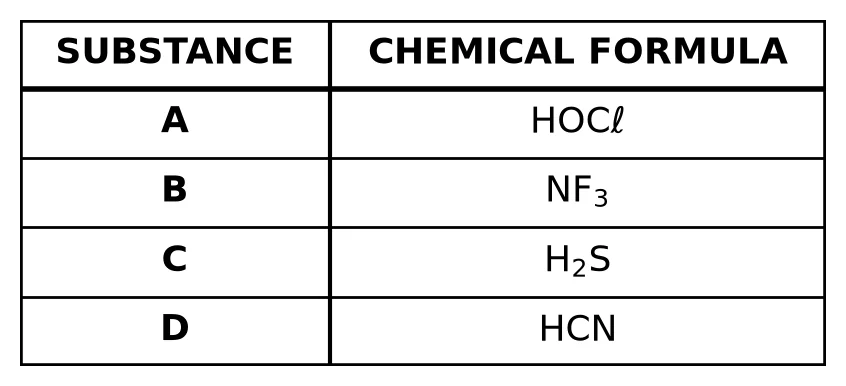
Fully explain the answer.(4)
Work it out on paper first. Then mark yourself with the official memo, one tick at a time.
More past paper questions: determine bond and molecule polarity
Work each one out first, then open the memo and check every tick.
3. Question WE11 · Siyavula Grade 11 Physical Sciences, 3.3 Electronegativity, Worked example 11 · 4 marks
WE11 State whether methane () is polar or non-polar.(4)Show the memo (4 ticks)Memo
- ✓ShapeThe molecule is tetrahedral. There are four bonding pairs of electrons and no lone pairs.
1 mark · Predict molecular shape
- ✓Electronegativity differenceThere are four C–H bonds, so only one difference is needed:
1 mark · Determine bond and molecule polarity
- ✓Bond polarityEach bond is polar.
1 mark · Determine bond and molecule polarity
- ✓Molecule polarityThe molecule is symmetrical and so is non-polar.
1 mark · Determine bond and molecule polarity
- ✓
4. Question WE12 · Siyavula Grade 11 Physical Sciences, 3.3 Electronegativity, Worked example 12 · 3 marks
WE12 State whether hydrogen cyanide () is polar or non-polar.(3)Show the memo (3 ticks)Memo
- ✓ShapeThe molecule is linear. There are four bonding pairs, three of which form a triple bond and so are counted as . There is one lone pair on the nitrogen atom.
1 mark · Predict molecular shape
- ✓Bond polaritiesThe electronegativity difference between carbon and hydrogen is and between carbon and nitrogen is . Both of the bonds are polar.
1 mark · Determine bond and molecule polarity
- ✓Molecule polarityThe molecule is not symmetrical and so is polar.
1 mark · Determine bond and molecule polarity
- ✓
5. Question WE2 · Siyavula Grade 11 Physical Sciences, 4.1 Intermolecular and interatomic forces, Worked example 2 · 3 marks
WE2 Which intermolecular forces are found in the following solution: sodium chloride in water?(3)Show the memo (3 ticks)Memo
- ✓Sodium chlorideSodium chloride is ionic (the electronegativity difference is ).
1 mark · Determine bond and molecule polarity
- ✓WaterWater has polar bonds (the electronegativity difference is ) and is a polar molecule (its shape is bent or angular).
1 mark · Determine bond and molecule polarity
- ✓Type of forceThis is an ionic substance interacting with a polar substance. This interaction is an ion-dipole force.
1 mark · Identify the intermolecular forces
- ✓
6. Question WE10 · Siyavula Grade 11 Physical Sciences, 3.3 Electronegativity, Worked example 10 · 3 marks
WE10 State whether hydrogen () is polar or non-polar.(3)Show the memo (3 ticks)Memo
- ✓ShapeThe molecule is linear. There is one bonding pair of electrons and no lone pairs.
1 mark · Predict molecular shape
- ✓Bond polarityHydrogen: . There is only one bond and the electronegativity difference is .
The bond is non-polar.1 mark · Determine bond and molecule polarity
- ✓Molecule polarityThe molecule is non-polar.
1 mark · Determine bond and molecule polarity
- ✓
Free on Android
Know exactly which skill is costing you marks.
Mark past papers tick by tick in the NavyBlue app. It remembers every mark you lose, shows you the skills to fix first, and picks your next questions.
Get NavyBlue free on Google Play
