Grade 11 Physical Sciences · Chemical Change
Calculate percentage yield or purity
Calculate percentage yield or purity, for example actual mass ÷ expected mass × 100 (8 g made out of an expected 10 g is 80%).
- past paper questions use it
- 10 past paper questions use it
- videos
- 3 videos
Learn it: calculate percentage yield or purity
Pick one and watch it, then try the questions below. Videos load only when you tap play.
Now try it on a real exam question
No sign-up. Takes 3 minutes.
Question 7.3 · November 2025 · Paper 2 · Provincial · 2 marks
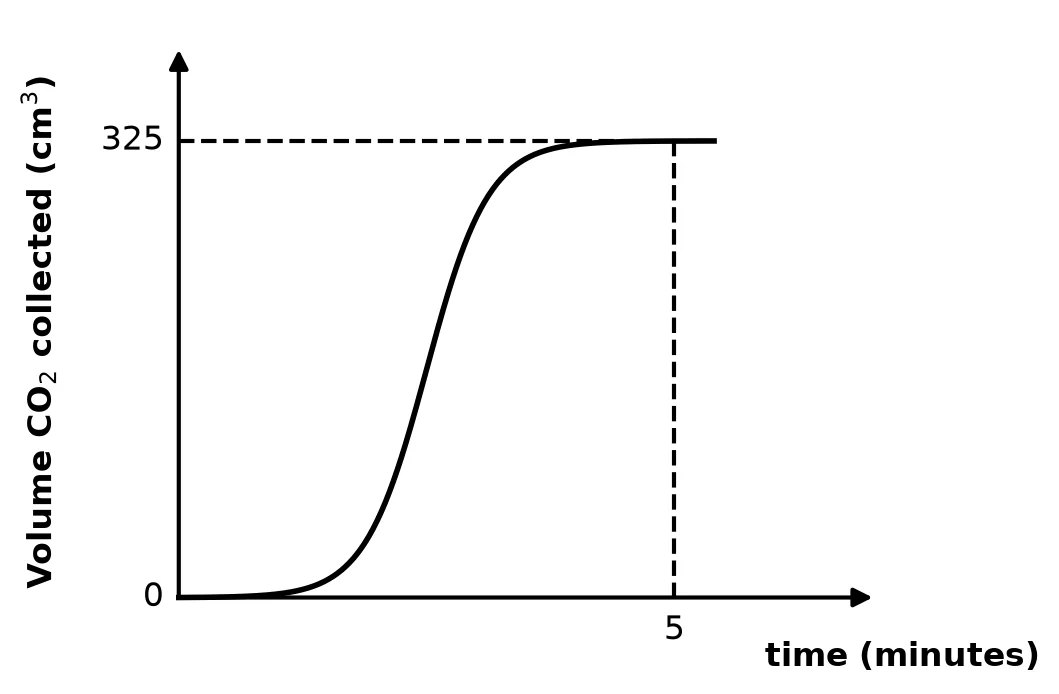
The calcium carbonate reacted completely in 5 minutes. The graph below shows the carbon dioxide gas that was collected at STP.
Calculate the:
Work it out on paper first. Then mark yourself with the official memo, one tick at a time.
More past paper questions: calculate percentage yield or purity
Work each one out first, then open the memo and check every tick.
3. Question 5.3.3 · May/June 2024 · Paper 2 · National (DBE) · 6 marks
The reaction between aluminium and EXCESS sulphuric acid is used to investigate factors affecting rates of reactions.5.3 INVESTIGATION III
In this investigation, 5 g of the same sample of IMPURE aluminium powder reacts with an EXCESS diluted at °C in each of three runs. The table below summarises the conditions and the results obtained. (Assume that the impurities do not react.)
Answer the questions that follow.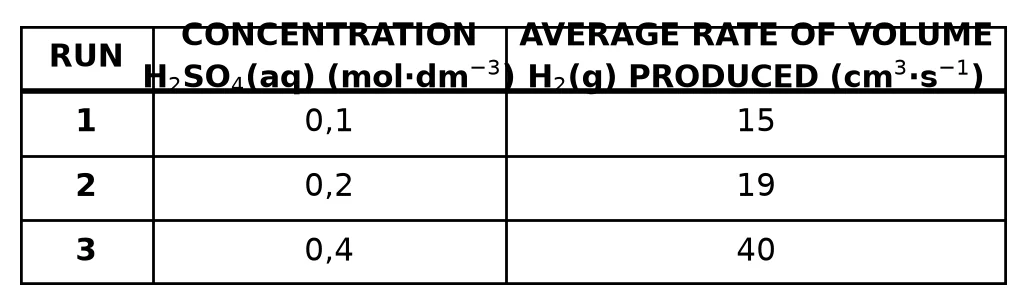 5.3.3 Calculate the percentage purity of the aluminium. Take the molar gas volume at °C to be cm·mol.(6)
Show the memo (6 ticks)Memo
- ✓Substitute into the rate formulaRate
cm1 mark · Calculate reaction rate
- ✓Moles of H mol
1 mark · Calculate number of moles
- ✓Mole ratio mol
1 mark · Use the mole ratio
- ✓Mass of Aℓ that reacted
g1 mark · Calculate number of moles
- ✓Percentage purity substitution% purity
1 mark · Calculate percentage yield or purity
- ✓Final answer %
1 mark · Calculate percentage yield or purity
- ✓
4. Question 6.2.4 · November 2024 · Paper 2 · Provincial · 4 marks
6.2 5 g of sodium carbonate () reacts with cm of hydrochloric acid (HC).
The percentage of hydrochloric acid (HC) that reacted with sodium carbonate () is %.6.2.4 The hydrochloric acid that was used in the reaction was obtained by diluting cm HC to cm hydrochloric acid (HC) solution.
Calculate the concentration of the concentrated hydrochloric acid (HC).(4)Show the memo (4 ticks)Memo
- ✓Initial moles of HC mol
1 mark · Calculate percentage yield or purity
- ✓Formula
- ✓Substitution
- ✓Answer with unit mol·dm
- ✓
5. Question WE8 · Siyavula Grade 11 Physical Sciences, 8.2 Stoichiometric calculations, Worked example 8 · 4 marks
WE8 Sulfuric acid () reacts with ammonia () to produce the fertiliser ammonium sulfate () according to the following equation:
A factory worker carries out the above reaction (using kg of sulfuric acid and kg of ammonia) and gets kg of ammonium sulfate. What is the percentage yield of the reaction?(4)Show the memo (4 ticks)Memo
- ✓Limiting reagentSulfuric acid is the limiting reagent ( mol can give only mol product, while mol could give mol). The number of moles of ammonium sulfate that can be produced is mol.
1 mark · Identify the limiting reagent
- ✓Theoretical yield g kg
1 mark · Calculate number of moles
- ✓Percentage yield substitution
1 mark · Calculate percentage yield or purity
- ✓Answer
1 mark · Calculate percentage yield or purity
- ✓
6. Question WE11 · Siyavula Grade 11 Physical Sciences, 8.2 Stoichiometric calculations, Worked example 11 · 4 marks
WE11 Limestone is mostly calcium carbonate (). Jake wants to know how much calcium carbonate is in a sample of limestone. He finds that the sample weighs g. He then adds concentrated hydrochloric acid () to the sample. The equation for this reaction is:
If the mass of calcium chloride produced is g, what is the percent purity of the limestone sample?(4)Show the memo (4 ticks)Memo
- ✓Moles of calcium chloride mol
1 mark · Calculate number of moles
- ✓Moles of calcium carbonateThe mole ratio of calcium chloride to calcium carbonate is , so mol
1 mark · Use the mole ratio
- ✓Mass of calcium carbonate g
1 mark · Calculate number of moles
- ✓Percent purity
1 mark · Calculate percentage yield or purity
- ✓
Free on Android
Know exactly which skill is costing you marks.
Mark past papers tick by tick in the NavyBlue app. It remembers every mark you lose, shows you the skills to fix first, and picks your next questions.
Get NavyBlue free on Google Play
