Grade 10 Physical Sciences · Chemical Change
Calculate number of moles
Calculate number of moles from mass, particles or gas volume using n = m/M (36 g of water is 2 mol).
- past paper questions use it
- 56 past paper questions use it
- videos
- 4 videos
Learn it: calculate number of moles
Pick one and watch it, then try the questions below. Videos load only when you tap play.
Now try it on a real exam question
No sign-up. Takes 3 minutes.
Question 9.4 · May/June 2025 · Paper 2 · National (DBE) · 4 marks
X and Y are carbon electrodes.
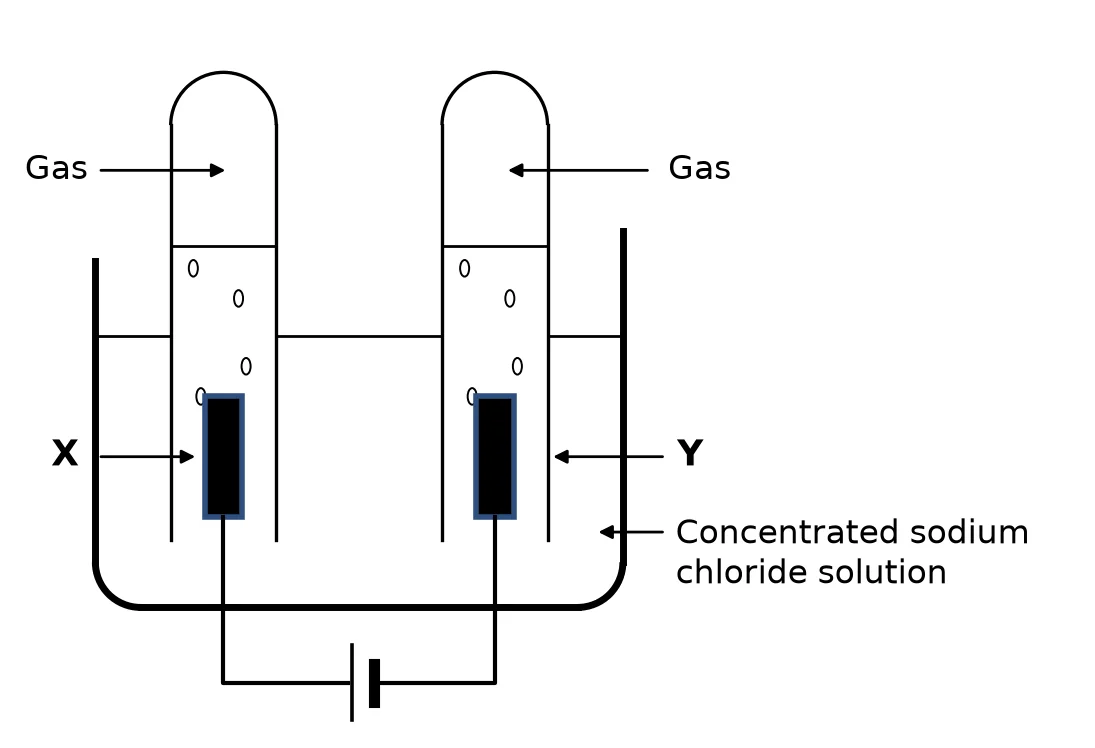
Take the molar gas volume as dm·mol.(4)
Work it out on paper first. Then mark yourself with the official memo, one tick at a time.
More past paper questions: calculate number of moles
Work each one out first, then open the memo and check every tick.
3. Question 5.4.2 · May/June 2022 · Paper 2 · National (DBE) · 2 marks
Learners use the reaction of (s) with EXCESS dilute HC(aq) to investigate the relationship between temperature and the rate of a chemical reaction.
The balanced equation for the reaction is:
The results obtained are represented in the graph below.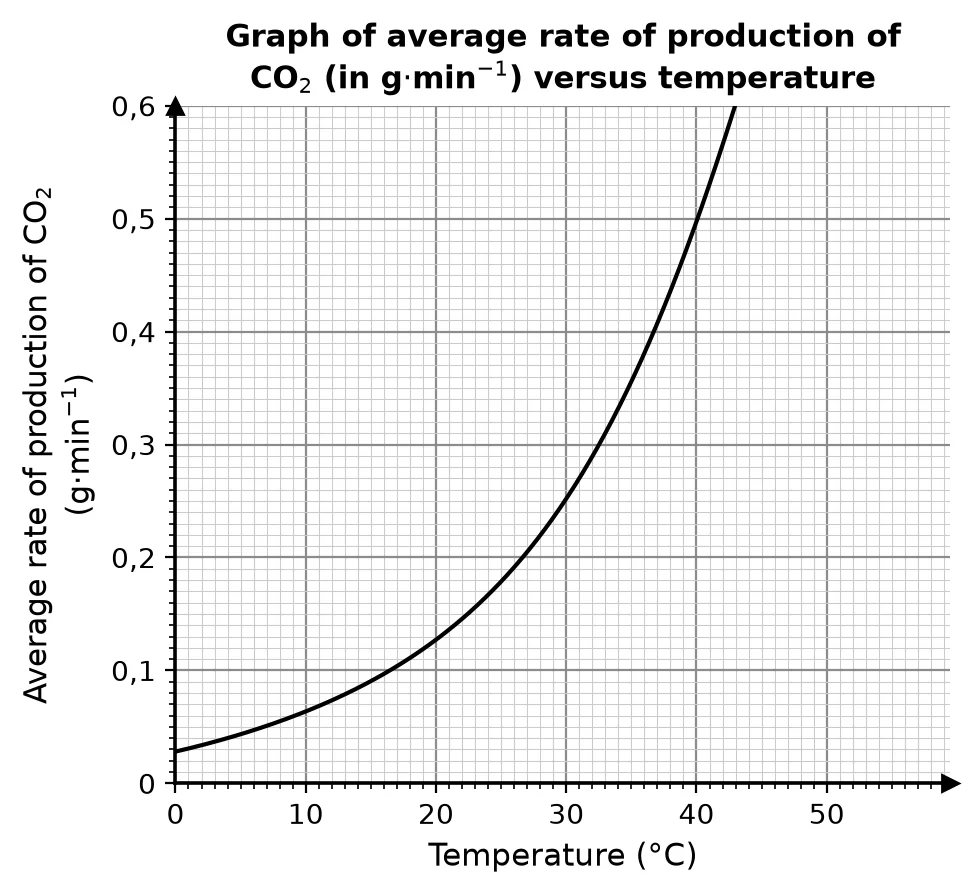 5.4 The learners obtained the graph above using g (s) with EXCESS HC at °C.
Calculate the:5.4.2 Molar gas volume at °C if dm is collected in a syringe(2)Show the memo (2 ticks)Memo
- ✓Substitution of n(CO2) and 1,5 dm³
1 mark · Calculate number of moles
- ✓Final answer dm·mol ( dm·mol)
1 mark · Calculate number of moles
- ✓
4. Question 9.2.3 · November 2025 · Paper 2 · National (DBE) · 6 marks
The diagram below represents a cell used for the refining of copper.
The unrefined copper contains zinc as the only impurity.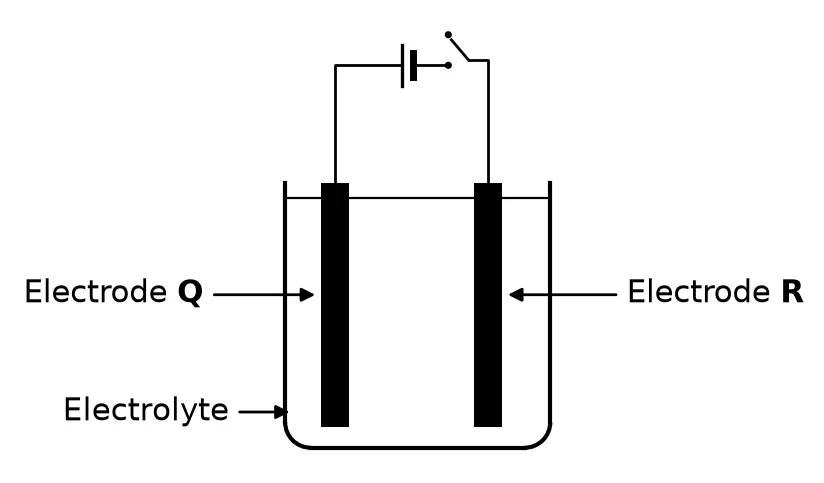 9.2 When the switch is closed, it is found after T hours that the amount of (aq) ions in the electrolyte changed by moles and moles of Cu(s) were deposited on electrode Q.
Answer the questions that follow.9.2.3 Calculate the change in mass of electrode R after T hours.(6)Show the memo (6 ticks)Memo
- ✓(a) Using ratio n(Cu2+) : n(Zn2+) = 1 : 1 mol
1 mark · Use the mole ratio
- ✓(b) Formula n = m/M
1 mark · Calculate number of moles
- ✓(c) Substitute 65 and n(Zn2+) g Zn from R
1 mark · Calculate number of moles
- ✓(d) Subtraction of moles mol Cu (oxidised at R)
1 mark · Describe an electrolytic cell
- ✓(e) Substitute 63,5 and n(Cu) g Cu from R
1 mark · Calculate number of moles
- ✓(f) Final answerChange in mass g (decrease in mass)
1 mark · Calculate number of moles
- ✓
5. Question 5.3.2 · November 2022 · Paper 2 · National (DBE) · 4 marks
Three experiments, A, B and C, are carried out to investigate some of the factors that affect the rate of decomposition of hydrogen peroxide, .
The balanced equation for the reaction is:
Identical samples of hydrogen peroxide are used in each experiment.
The conditions used in each experiment are summarised in the table below.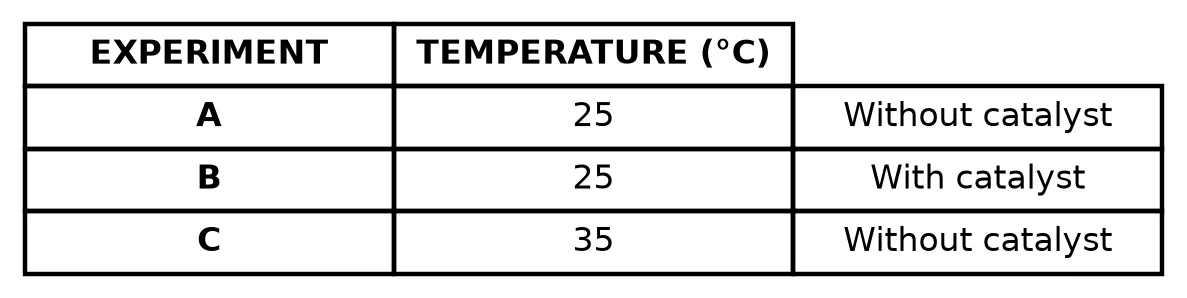 5.3 The volume of oxygen gas, (g), produced in experiment B during the first s is collected in a syringe, as shown below.
 5.3.2 Calculate the mass of water, , that was produced during the first s. Take the molar gas volume to be cm·mol at °C.(4)
Show the memo (4 ticks)Memo
- ✓Substitute into n = V/Vm mol
1 mark · Calculate number of moles
- ✓Mole ratio mol
1 mark · Use the mole ratio
- ✓Substitute into m = nM
1 mark · Calculate number of moles
- ✓Final answer g
1 mark · Calculate number of moles
- ✓
6. Question 5.4 · May/June 2025 · Paper 2 · National (DBE) · 6 marks
The reaction between magnesium carbonate pellets, (s), and EXCESS dilute hydrochloric acid, HCℓ(aq), is used to investigate the effect of concentration on the rate of a reaction.
The apparatus used for this investigation is shown below.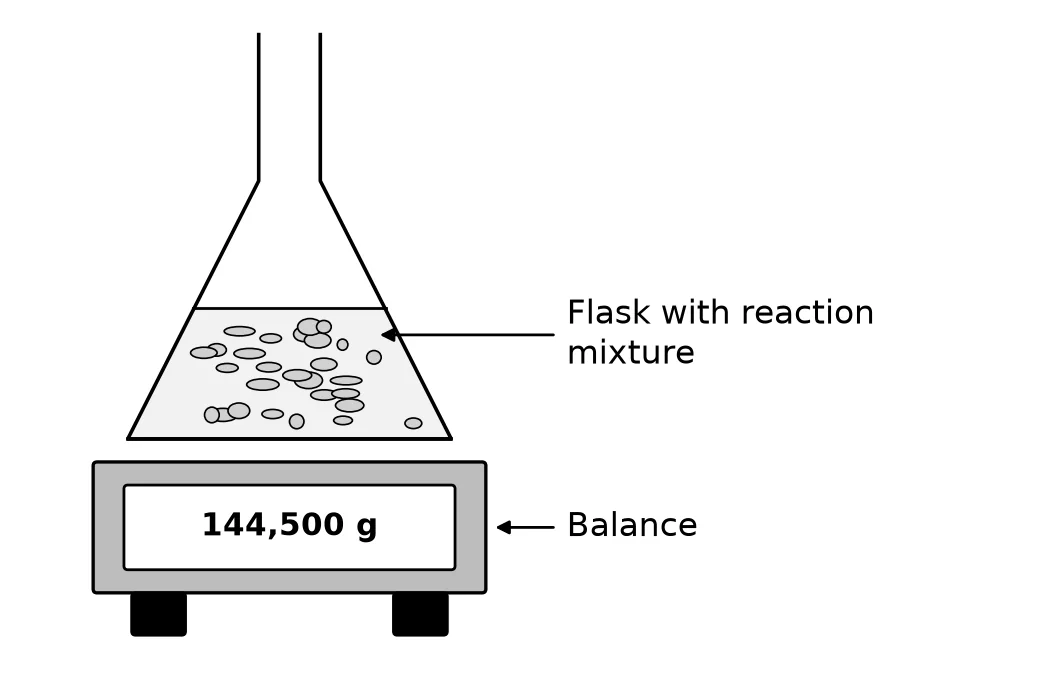 5.4 For curve B, calculate the average rate at which (g) is produced for the first s in dm·s. The molar gas volume is dm·mol.(6)
Show the memo (6 ticks)Memo
- ✓Mass subtraction g
1 mark · Use conservation of mass
- ✓Formula
1 mark · Calculate number of moles
- ✓Substitute M = 44 mol
1 mark · Calculate number of moles
- ✓Substitute 24,5 dm3 in V = nVm dm
1 mark · Calculate number of moles
- ✓Substitute into rate formulaAve rate
1 mark · Calculate reaction rate
- ✓Final answer dm·s
1 mark · Calculate reaction rate
- ✓
Free on Android
Know exactly which skill is costing you marks.
Mark past papers tick by tick in the NavyBlue app. It remembers every mark you lose, shows you the skills to fix first, and picks your next questions.
Get NavyBlue free on Google Play
