Grade 12 Physical Sciences · Chemical Change
Compare oxidising and reducing agent strength
Use the table of standard reduction potentials to decide which substance is oxidised or reduced, and whether a reaction will happen.
- past paper questions use it
- 21 past paper questions use it
- videos
- 3 videos
Learn it: compare oxidising and reducing agent strength
Pick one and watch it, then try the questions below. Videos load only when you tap play.
Now try it on a real exam question
No sign-up. Takes 3 minutes.
Question 8.4 · May/June 2025 · Paper 2 · National (DBE) · 3 marks
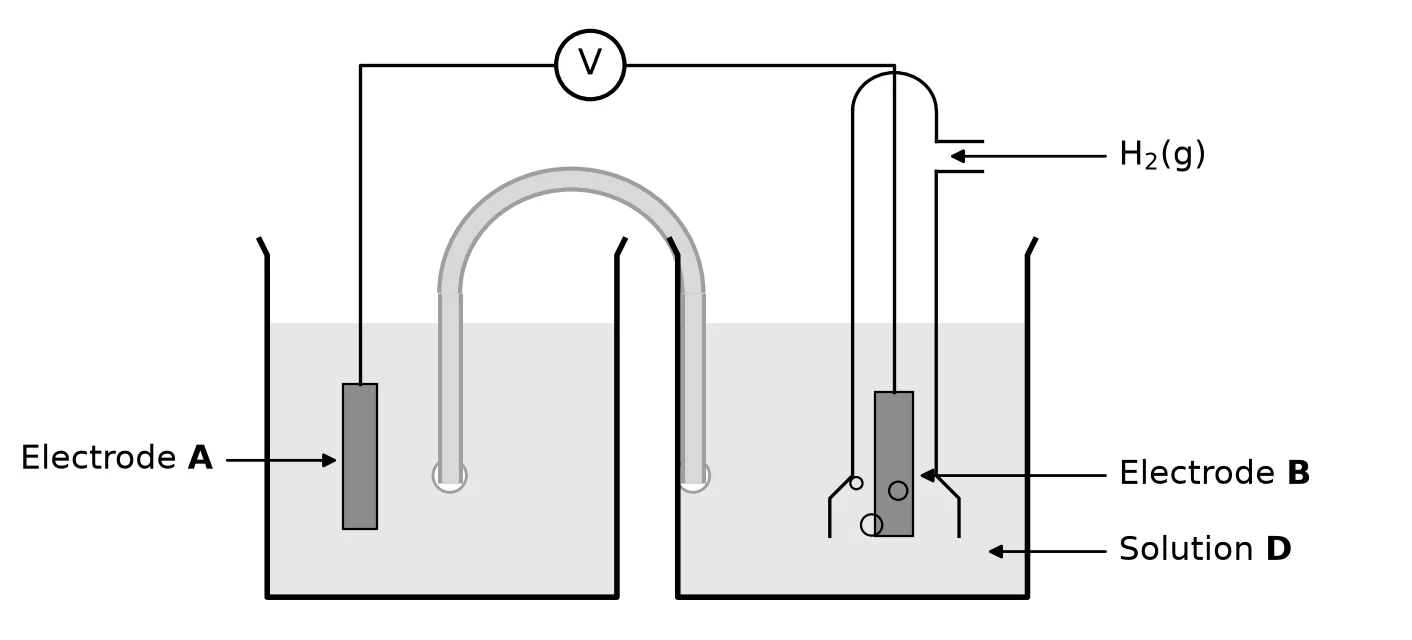
Work it out on paper first. Then mark yourself with the official memo, one tick at a time.
More past paper questions: compare oxidising and reducing agent strength
Work each one out first, then open the memo and check every tick.
3. Question 8.2 · November 2025 · Paper 2 · National (DBE) · 2 marks
The diagram below represents a cell that operates initially under standard conditions.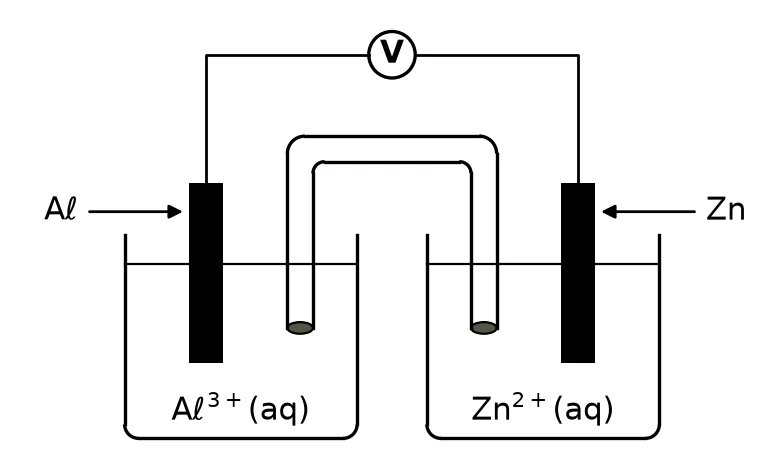 8.2 Which ion concentration, (aq) or (aq), will increase? Give a reason for the answer.(2)
Show the memo (2 ticks)Memo
- ✓Ion that increases / Aluminium ion
- ✓ReasonA is oxidised OR A is a stronger reducing agent.
- ✓
4. Question 8.1.4 · November 2024 · Paper 2 · National (DBE) · 3 marks
8.1 Dilute hydrochloric acid, HCℓ(aq), reacts with magnesium, Mg(s), at °C according to the following balanced equation:
Answer the questions that follow.8.1.4 Will dilute nitric acid, (aq), react with copper, Cu(s), at °C? Choose from YES or NO.
Explain the answer in terms of the relative strengths of the oxidising agents.(3)Show the memo (3 ticks)Memo
- ✓YesYes
- ✓NO is a stronger oxidising agent / nitrate ion / nitric acid is a stronger oxidising agent
- ✓than Cuthan / copper(II) ion (therefore Cu/copper will be oxidised to / copper(II) ion).
- ✓
5. Question 1.10 · May/June 2024 · Paper 2 · National (DBE) · 2 marks
1.10 Which ONE of the following redox reactions is SPONTANEOUS under standard conditions?(2)Show the memo (1 tick)Memo
- ✓Choose the correct optionA reaction is spontaneous when the oxidising agent is stronger (higher on Table 4A) than the oxidised form of the reducing agent. B: ( V) is a stronger oxidising agent than ( V), so oxidises . In A, C and D the oxidising agent (, , ) is weaker than the one it would have to form.
Answer: B
- ✓
6. Question 9.2.4 · November 2024 · Paper 2 · National (DBE) · 2 marks
9.2 The simplified diagram below represents an electrolytic cell. The electrodes are made of carbon.
Answer the questions that follow.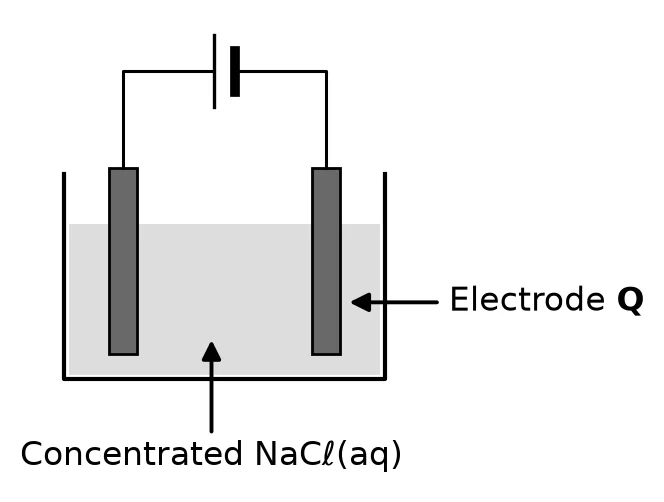 9.2.4 Explain the answer to QUESTION 9.2.3 by referring to the relative strengths of the oxidising agents involved.(2)
Show the memo (2 ticks)Memo
- ✓Water is a stronger oxidising agentWater/ is a stronger oxidising agent (than /sodium ion)
OR: /sodium ion is a weaker oxidising agent than water/ - ✓Water will be reducedand water/ will be reduced.
- ✓
Free on Android
Know exactly which skill is costing you marks.
Mark past papers tick by tick in the NavyBlue app. It remembers every mark you lose, shows you the skills to fix first, and picks your next questions.
Get NavyBlue free on Google Play
