Grade 12 Physical Sciences · Chemical Change · Paper 2 (Chemistry)
Electrochemistry Grade 12
Real Electrochemistry past paper questions and answers from 2023 to 2025, with each memo split into the ticks examiners give. Try one, mark yourself, and see exactly which skill cost you marks.
- past paper questions
- 204 past paper questions
- skills
- 9 skills
- videos
- 9 videos
Try a Electrochemistry exam question
No sign-up. Takes 3 minutes.
Question 1.9 · November 2025 · Paper 2 · National (DBE) · 2 marks
Which ONE of the following statements is CORRECT for this cell?(2)
Work it out on paper first. Then mark yourself with the official memo, one tick at a time.
Electrochemistry skills
Each skill is one thing a memo gives a tick for. Tap one for its own questions, notes and videos.
- Calculate current or voltage from chargeCalculate current with I = Q/Δt or potential difference with V = W/Q (5 C passing in 2 s is a current of 2,5 A).18 past paper questions · 3 videos
- Define redox and cell termsGive the exact meaning of redox words like oxidation, reduction, oxidising agent, anode and cathode.24 past paper questions · 3 videos
- Identify oxidising and reducing agentsSay which substance is oxidised or reduced, or which is the oxidising or reducing agent, and why (zinc loses electrons, so it is oxidised).23 past paper questions · 3 videos
- Write half-reactionsWrite the oxidation or reduction half-reaction for a substance, with electrons on the correct side (Cu²⁺ + 2e⁻ → Cu).34 past paper questions · 3 videos
- Combine half-reactions into net equationCombine two half-reactions so the electrons cancel to give the balanced overall reaction (Zn + Cu²⁺ → Zn²⁺ + Cu).14 past paper questions · 3 videos
- Compare oxidising and reducing agent strengthUse the table of standard reduction potentials to decide which substance is oxidised or reduced, and whether a reaction will happen.36 past paper questions · 3 videos
- Calculate the emf of a cellCalculate a cell's emf using E°cell = E°cathode − E°anode, and use a positive value to show the reaction is spontaneous.16 past paper questions · 3 videos
- Describe a galvanic cellDescribe how a galvanic cell makes electricity, including electron flow, the salt bridge and cell notation (chemical energy changes to electrical energy).49 past paper questions · 3 videos
- Describe an electrolytic cellDescribe how an electrolytic cell uses electricity to cause a reaction, including what forms at each electrode (electroplating a spoon with silver).52 past paper questions · 4 videos
More Electrochemistry Grade 12 questions and answers
Try each one on paper before you open the memo.
4. Question 8.5.3 · May/June 2025 · Paper 2 · National (DBE) · 3 marks
The simplified diagram below shows a cell that can be used to measure the standard electrode potential of the half-reaction represented by the equation below.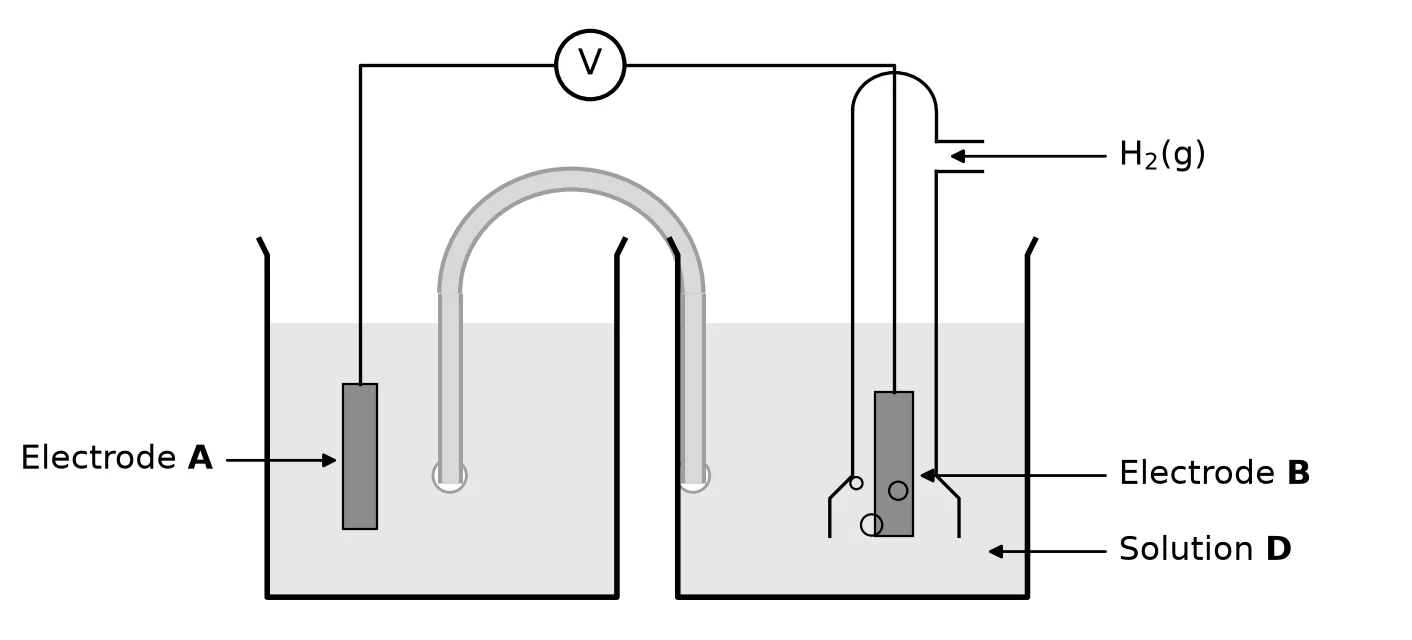 8.5 Write down the:8.5.3 Cell notation for this cell(3)
Show the memo (3 ticks)Memo
- ✓Anode half-cell
1 mark · Describe a galvanic cell
- ✓Salt bridge
1 mark · Describe a galvanic cell
- ✓Cathode half-cell
1 mark · Describe a galvanic cell
- ✓
5. Question 8.6.2 · May/June 2024 · Paper 2 · National (DBE) · 2 marks
The relationship between the concentration of the electrolyte and the cell potential is investigated using the following electrochemical cell represented by the cell notation:
Aℓ(s) | (aq) || (aq) | M(s)
The concentration of is changed and the corresponding emf is measured. The concentration of (aq) and the temperature are at standard conditions. The graph below shows the results of this investigation.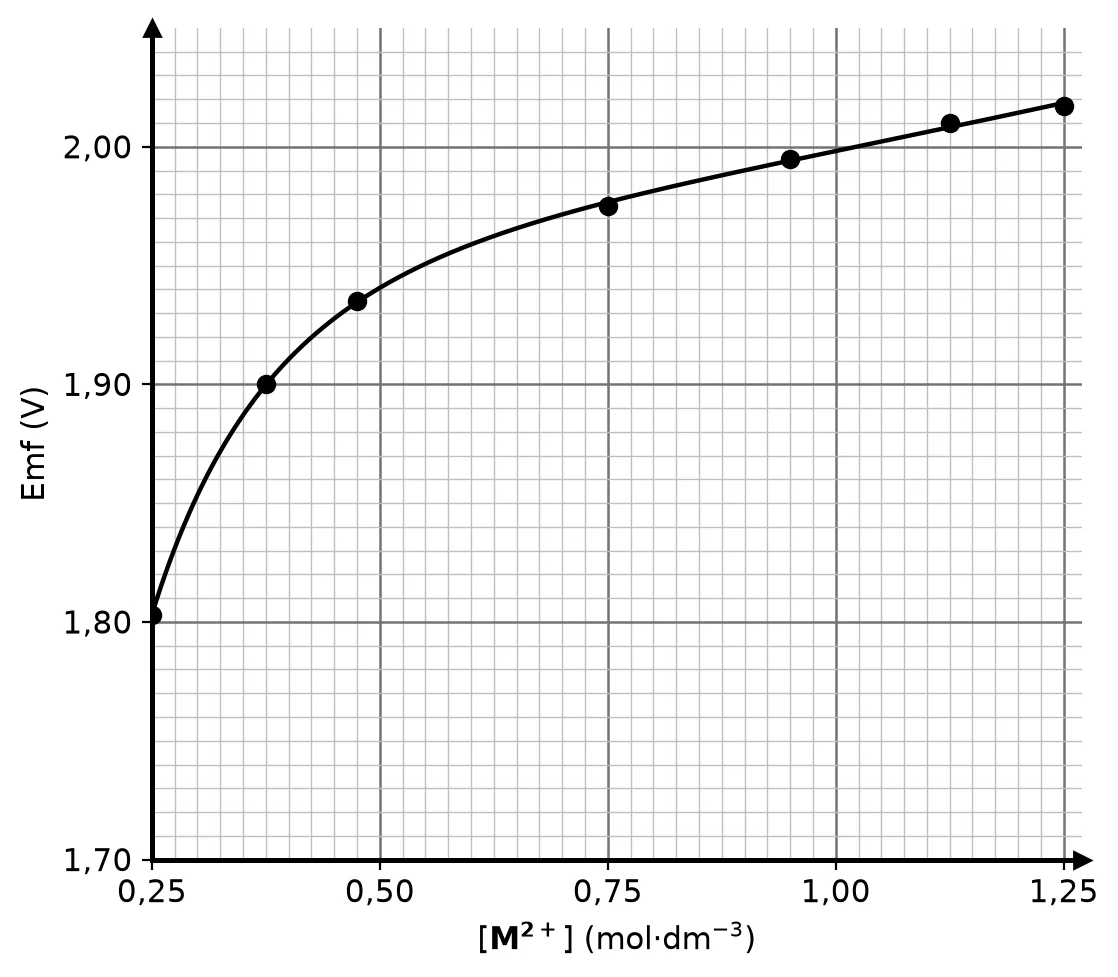 8.6 Metal M is now replaced with magnesium, Mg.8.6.2 Refer to the relative strengths of the oxidising agents to explain the answer.(2)
Show the memo (2 ticks)Memo
- ✓Compare oxidising agents is a stronger oxidising agent than
- ✓Conclusiontherefore, Mg will be oxidised (to ).
- ✓
6. Question 9.3 · May/June 2024 · Paper 2 · National (DBE) · 2 marks
The simplified diagram below represents the cell used for electroplating ornaments with silver, Ag. P and Q are the two terminals of the battery.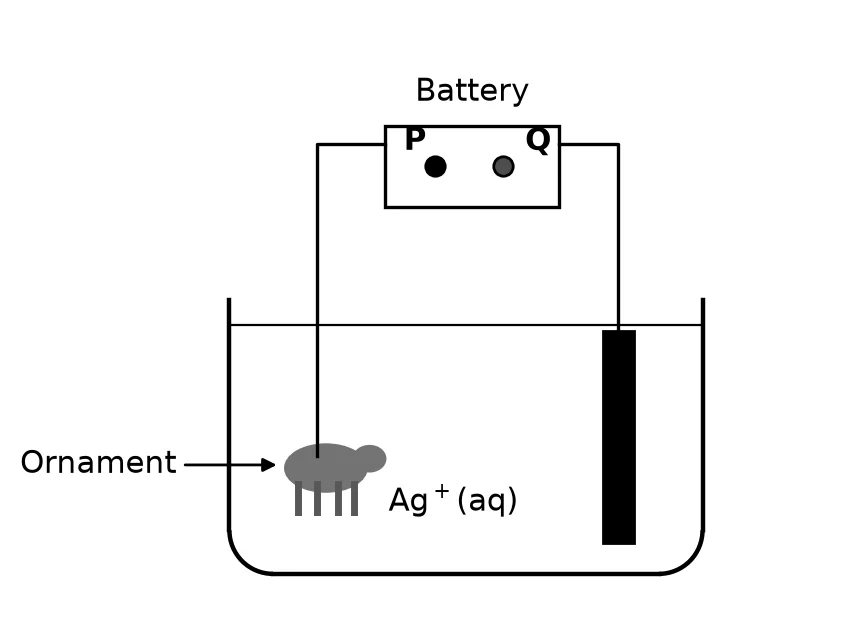 9.3 Write down the equation for the half-cell reaction that takes place at the cathode.(2)
Show the memo (1 tick)Memo
- ✓Reduction half-reaction
2 marks · Write half-reactions
- ✓
7. Question 1.9 · November 2024 · Paper 2 · National (DBE) · 2 marks
Various options are provided as possible answers to the following questions. Each question has only ONE correct answer. Choose the answer and write only the letter (A–D) next to the question numbers (1.1 to 1.10) in the ANSWER BOOK, e.g. 1.11 E.1.9 A standard galvanic cell is set up, as shown below.
Which ONE of the following combinations of the metal used as cathode and the electron flow direction is CORRECT?(2)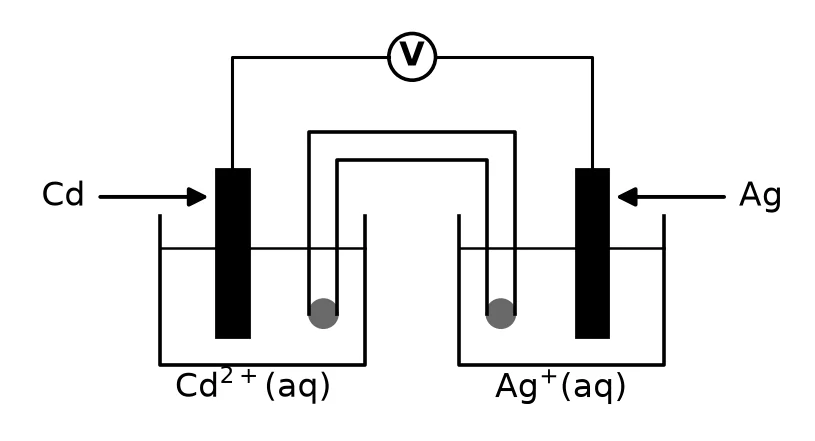
Show the memo (1 tick)Memo
- ✓Correct option ( V) is a stronger oxidising agent than ( V), so is reduced and Ag is the cathode. Cd is oxidised at the anode.
Electrons are released at the anode and flow through the external circuit to the cathode: from Cd to Ag.
Answer: B2 marks · Describe a galvanic cell
- ✓
8. Question 9.2.4 · November 2024 · Paper 2 · National (DBE) · 2 marks
9.2 The simplified diagram below represents an electrolytic cell. The electrodes are made of carbon.
Answer the questions that follow.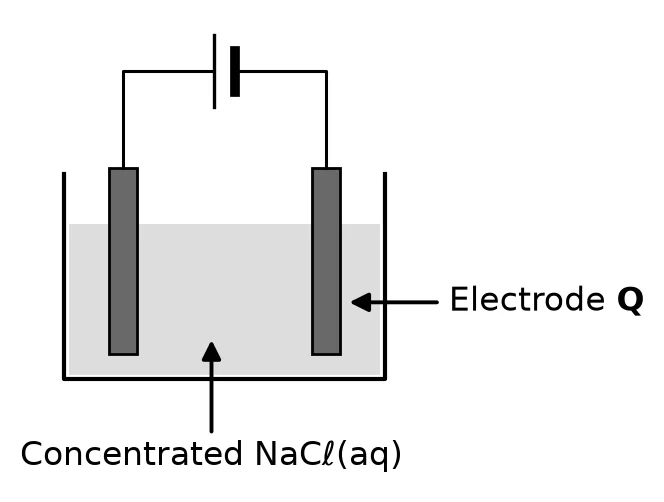 9.2.4 Explain the answer to QUESTION 9.2.3 by referring to the relative strengths of the oxidising agents involved.(2)
Show the memo (2 ticks)Memo
- ✓Water is a stronger oxidising agentWater/ is a stronger oxidising agent (than /sodium ion)
OR: /sodium ion is a weaker oxidising agent than water/ - ✓Water will be reducedand water/ will be reduced.
- ✓
9. Question 9.4 · May/June 2023 · Paper 2 · National (DBE) · 2 marks
The simplified electrolytic cell below is used to electroplate a metal spring. Zinc nitrate, (aq), is used as an electrolyte and R is an electrode.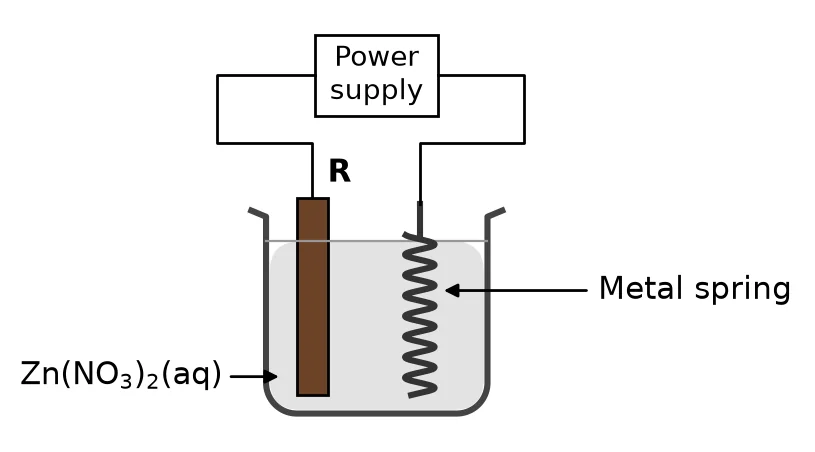 9.4 Explain the answer to QUESTION 9.3.2.(2)
Show the memo (2 ticks)Memo
- ✓Zn2+ ions are used up ions are reduced / decreases.
1 mark · Describe an electrolytic cell
- ✓Replaced by oxidation of the Zn anode ions must be replaced by oxidation of the Zn electrode.
1 mark · Describe an electrolytic cell
- ✓
10. Question 8.4 · November 2023 · Paper 2 · National (DBE) · 2 marks
A cleaned pure copper strip, Cu(s), is placed in a beaker containing a colourless silver nitrate solution, (aq), at °C, as shown below.
After a while, it is observed that the solution in the beaker becomes blue.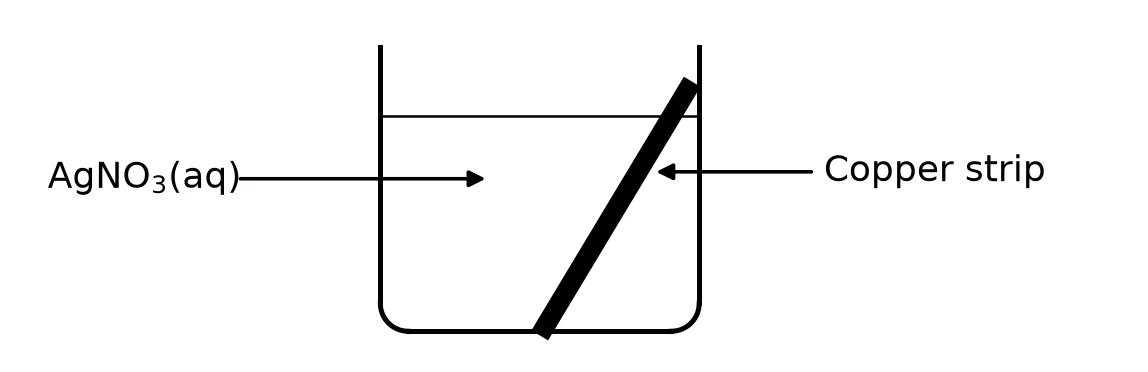 8.4 The salt bridge contains potassium nitrate, (aq).
Write down the FORMULA of the ion in the salt bridge that will move into the silver ion solution. Choose from (aq) or (aq).
Give a reason for the answer.(2)Show the memo (2 ticks)Memo
- ✓Ion that moves into the silver half-cell
1 mark · Describe a galvanic cell
- ✓Reason decreases.
OR In the silver half-cell the concentration of positive ions decreases.
OR The silver half-cell becomes negative.1 mark · Describe a galvanic cell
- ✓
Electrochemistry Grade 12 videos
Short lessons from South African teachers first. Videos load only when you tap play, to save your data.
Free on Android
Know exactly which skill is costing you marks.
Mark past papers tick by tick in the NavyBlue app. It remembers every mark you lose, shows you the skills to fix first, and picks your next questions.
Get NavyBlue free on Google Play
