Grade 12 Physical Sciences · Chemical Change · Paper 2 (Chemistry)
Chemical Equilibrium Grade 12
Real Chemical Equilibrium past paper questions and answers from 2024 to 2025, with each memo split into the ticks examiners give. Try one, mark yourself, and see exactly which skill cost you marks.
- past paper questions
- 164 past paper questions
- skills
- 8 skills
- videos
- 8 videos
Try a Chemical Equilibrium exam question
No sign-up. Takes 3 minutes.
Question 1.5 · November 2025 · Paper 2 · National (DBE) · 2 marks
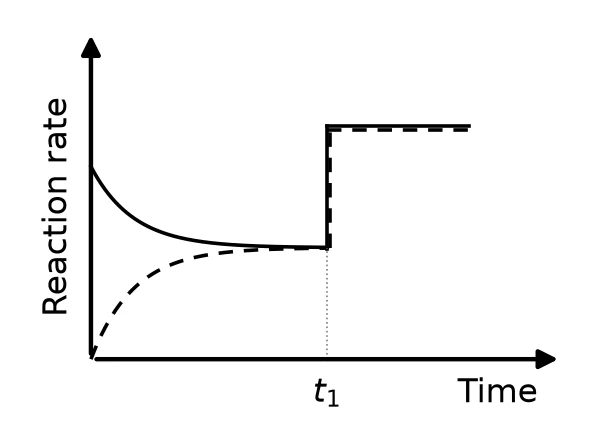
The reaction rate versus time graph for the reaction is given below.
What change was made to the system at time ?(2)
Work it out on paper first. Then mark yourself with the official memo, one tick at a time.
Chemical Equilibrium skills
Each skill is one thing a memo gives a tick for. Tap one for its own questions, notes and videos.
- State equilibrium principle and termsState Le Chatelier's principle in full, or define dynamic equilibrium, a closed system or a reversible reaction.22 past paper questions · 3 videos
- Write the Kc expressionWrite the Kc expression as products over reactants with powers from the balanced equation, leaving out solids and pure liquids.18 past paper questions · 2 videos
- Complete an equilibrium tableFill in a table of initial, change and equilibrium amounts using the mole ratio (if 1 mol N₂ reacts, 3 mol H₂ also reacts).19 past paper questions · 3 videos
- Calculate KcSubstitute equilibrium concentrations into the Kc expression to calculate Kc, or use Kc to find an unknown concentration.20 past paper questions · 3 videos
- Apply Le Chatelier's principlePredict and explain how an equilibrium shifts when concentration, pressure or temperature changes (adding more reactant pushes it towards products).65 past paper questions · 4 videos
- Interpret equilibrium graphsRead concentration-time or rate-time graphs to find when equilibrium is reached and which change was made at a given time.18 past paper questions · 3 videos
- Describe and evaluate an experimentName apparatus, describe or explain steps of a method, and give safety precautions (repeat readings and work out an average).18 past paper questions · 3 videos
- Read a graph of resultsRead values from a graph or table of results, or calculate a gradient (finding resistance from the gradient of a V-I graph).38 past paper questions · 3 videos
More Chemical Equilibrium Grade 12 questions and answers
Try each one on paper before you open the memo.
4. Question 4.2.1 · November 2025 · Paper 1 · National (DBE) · 3 marks
Cricketers at an academy conduct an experiment to determine the relationship between the contact time and the final momentum of a ball for a constant average net force.
A cricket ball of mass g is thrown horizontally with a certain initial velocity and is struck by a bat so that the ball moves in the opposite direction, as shown in the diagram below. The average net force acting on the ball is horizontal.
The experiment is repeated using the same ball. The average net force and the initial velocity of the ball are kept constant. The contact time between the bat and the ball is changed EACH time. The results obtained are shown in the sketch graph below.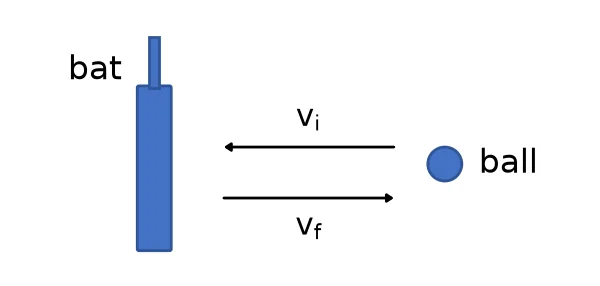
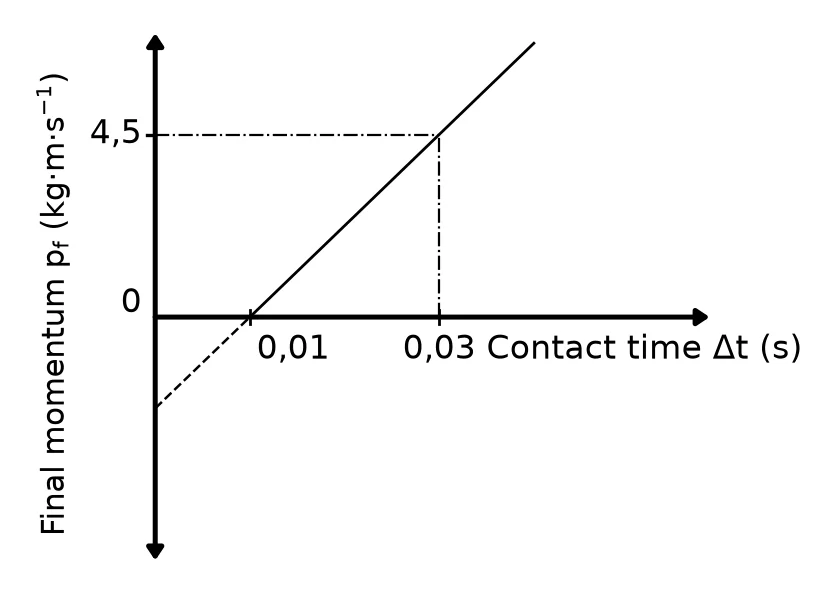 4.2 Calculate the:4.2.1 Average net force acting on the ball(3)
Show the memo (3 ticks)Memo
- ✓METHOD 1: Change in final momentum (numerator)Gradient
1 mark · Read a graph of results
- ✓METHOD 1: Change in contact time (denominator) N
1 mark · Read a graph of results
- ✓METHOD 1: Answer with direction N to the right / opposite to the original direction of the ball
1 mark · Read a graph of results
- ✓
5. Question 6.1.1 · November 2025 · Paper 2 · National (DBE) · 2 marks
6.1 Equilibrium is established at °C in a saturated calcium hydroxide solution according to the reaction:
Answer the questions that follow.6.1.1 State Le Chatelier's principle.(2)Show the memo (1 tick)Memo
- ✓Le Chatelier's principleWhen the equilibrium in a closed system is disturbed, the system will re-instate a new equilibrium by favouring the reaction that will cancel/oppose the disturbance.
2 marks · State equilibrium principle and terms
- ✓
6. Question 10.3.2 · May/June 2025 · Paper 1 · National (DBE) · 4 marks
Light of different frequencies is incident on a metal plate. The sketch graph below shows the relationship between the maximum kinetic energy, , of the photoelectrons and the energy of the incident photons.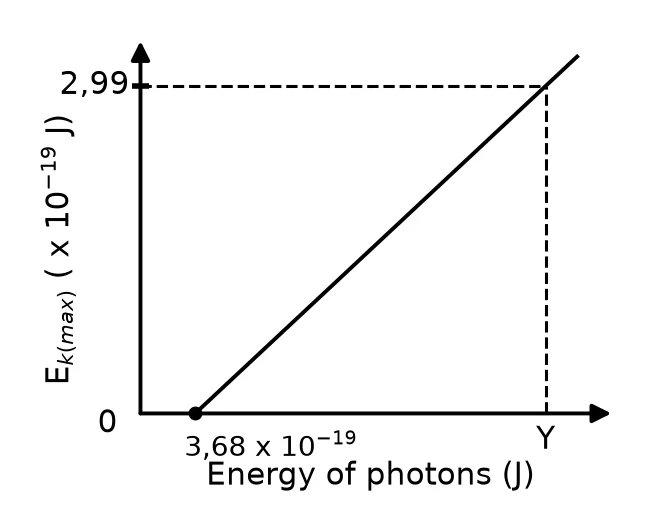 10.3 Calculate the:10.3.2 Value of Y(4)
Show the memo (4 ticks)Memo
- ✓METHOD 1: Formula (or )
1 mark · Use the photoelectric equation
- ✓METHOD 1: Work function
1 mark · Use the photoelectric equation
- ✓METHOD 1: Kinetic energy
1 mark · Use the photoelectric equation
- ✓METHOD 1: Answer (J)
1 mark · Use the photoelectric equation
- ✓
7. Question 1.5 · November 2024 · Paper 2 · National (DBE) · 2 marks
Various options are provided as possible answers to the following questions. Each question has only ONE correct answer. Choose the answer and write only the letter (A–D) next to the question numbers (1.1 to 1.10) in the ANSWER BOOK, e.g. 1.11 E.1.5 Initially, an equal number of moles of hydrogen gas, (g), and iodine gas, (g), are mixed in a closed container. The reaction reaches equilibrium at a constant temperature according to the balanced equation.
Which ONE of the following is ALWAYS TRUE at equilibrium?(2)Show the memo (1 tick)Memo
- ✓Correct option and start with equal amounts and react in a ratio, so the same amount of each is used. At equilibrium both are : always.
How much HI forms depends on , so B, C and D are true only for particular values of .
Answer: A2 marks · Complete an equilibrium table
- ✓
8. Question 6.1.1 · November 2024 · Paper 2 · National (DBE) · 2 marks
6.1 The reaction of carbon monoxide gas, CO(g), with oxygen gas, (g), is investigated. The reaction reaches equilibrium in a closed container at constant temperature T °C, according to the balanced equation:
Changes to the conditions of equilibrium are made at different times. The graph shows the results obtained. X, Y and Z represent the gases in the above reaction.
Answer the questions that follow.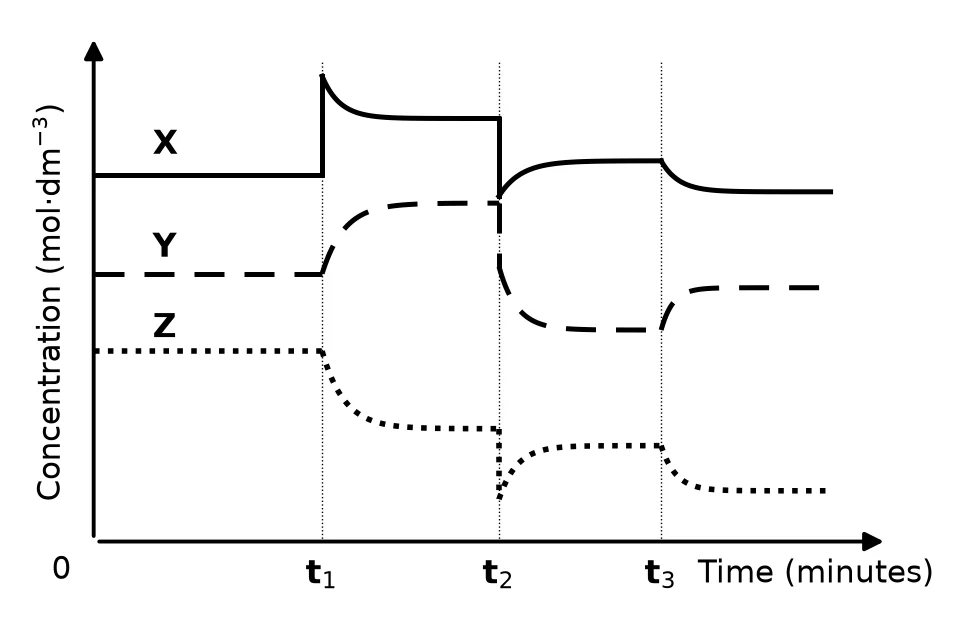 6.1.1 Define the term chemical equilibrium.(2)
Show the memo (1 tick)Memo
- ✓Definition of chemical equilibrium(The dynamic equilibrium when) the rate of the forward reaction equals the rate of the reverse reaction.
OR: The stage in a chemical reaction when the concentrations of the reactants and products remain constant.2 marks · State equilibrium principle and terms
- ✓
9. Question 1.5 · May/June 2024 · Paper 2 · National (DBE) · 2 marks
1.5 The balanced equation below represents a reaction at equilibrium.
( is yellow; is orange.)
Which statement(s) is/are TRUE when a few drops of concentrated hydrochloric acid, HCℓ(conc), are added to the mixture?
(i) The reverse reaction will be favoured.
(ii) The concentration of (aq) increases.
(iii) The colour of the solution changes from yellow to orange.(2)Show the memo (1 tick)Memo
- ✓Choose the correct optionAdding HCℓ increases , a reactant. The system uses up some of the added by favouring the FORWARD reaction. So (i) is false, increases (ii) and the solution turns from yellow to orange (iii).
Answer: D2 marks · Apply Le Chatelier's principle
- ✓
10. Question 4.1.3 · May/June 2024 · Paper 2 · National (DBE) · 2 marks
4.1 In an experiment, a test tube containing methanol, propanoic acid and a catalyst is heated in a water bath, as shown below.
Write down: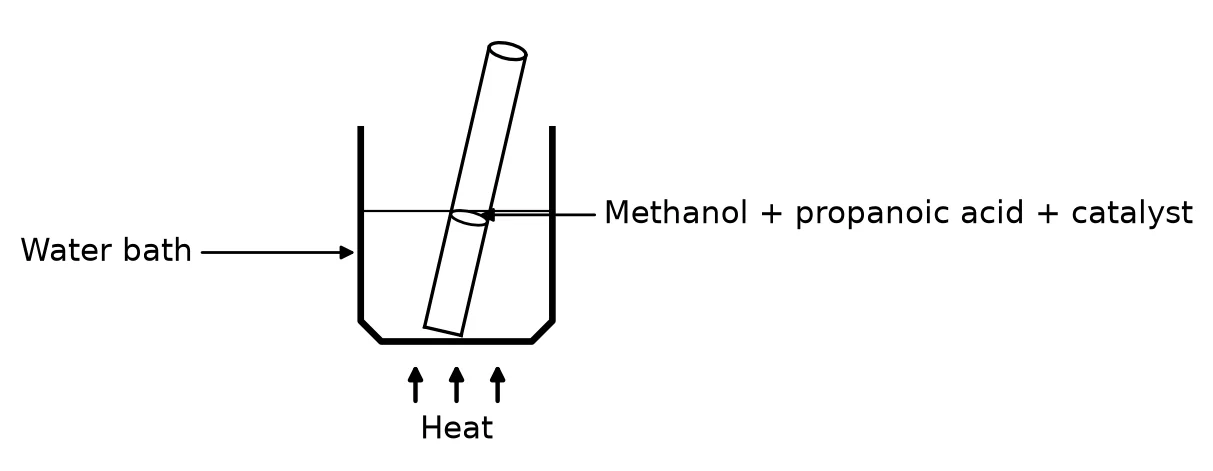 4.1.3 TWO reasons why the use of a water bath is preferred in this experiment(2)
Show the memo (2 ticks)Memo
- ✓First reasonAlcohol/methanol/reactant is flammable/catches fire easily.
1 mark · Describe and evaluate an experiment
- ✓Second reasonTo heat evenly / a steady, controlled, gradual increase in temperature. (OR: Alcohol/methanol will evaporate too quickly/is volatile.)
1 mark · Describe and evaluate an experiment
- ✓
Chemical Equilibrium Grade 12 videos
Short lessons from South African teachers first. Videos load only when you tap play, to save your data.
Free on Android
Know exactly which skill is costing you marks.
Mark past papers tick by tick in the NavyBlue app. It remembers every mark you lose, shows you the skills to fix first, and picks your next questions.
Get NavyBlue free on Google Play
