Grade 12 Physical Sciences · Chemical Change · Paper 2 (Chemistry)
Acids and Bases Grade 12
Real Acids and Bases past paper questions and answers from 2023 to 2025, with each memo split into the ticks examiners give. Try one, mark yourself, and see exactly which skill cost you marks.
- past paper questions
- 151 past paper questions
- skills
- 10 skills
- videos
- 10 videos
Try a Acids and Bases exam question
No sign-up. Takes 3 minutes.
Question 1.7 · November 2025 · Paper 2 · National (DBE) · 2 marks
Work it out on paper first. Then mark yourself with the official memo, one tick at a time.
Acids and Bases skills
Each skill is one thing a memo gives a tick for. Tap one for its own questions, notes and videos.
- Calculate concentration of a solutionCalculate the concentration of a solution with c = n/V, volume in dm³, or work out a dilution (2 mol in 4 dm³ is 0,5 mol/dm³).69 past paper questions · 3 videos
- Define acid and base termsGive the exact meaning of acid-base words like Lowry-Brønsted acid, strong acid, ampholyte and equivalence point.22 past paper questions · 3 videos
- Identify conjugate acid-base pairsFind the acid, the base and their conjugates in a proton-transfer reaction (in NH₃ + H₂O, NH₄⁺ is the conjugate acid).28 past paper questions · 3 videos
- Write acid-base reaction equationsWrite equations for acids reacting with bases, oxides or carbonates, or with water (HCl + NaOH → NaCl + H₂O).20 past paper questions · 3 videos
- Use acid-base indicatorsExplain what an indicator is and give its colour in acids or bases (phenolphthalein turns pink in a base).5 past paper questions · 2 videos
- Compare strong and weak acidsTell strong from weak acids and concentrated from dilute solutions, and give the reason (HCl ionises fully, so it is a strong acid).28 past paper questions · 3 videos
- Calculate and interpret pHCalculate pH with pH = −log[H₃O⁺], or use Kw to find a concentration (a [H₃O⁺] of 0,01 mol/dm³ gives pH 2).28 past paper questions · 3 videos
- Do titration calculationsUse titration results to find an unknown concentration or volume with the mole ratio, for example cₐVₐ/c_bV_b = nₐ/n_b.14 past paper questions · 3 videos
- Predict salt pH and choose indicatorPredict whether a salt solution is acidic, basic or neutral, and choose a suitable indicator for a titration (sodium ethanoate solution is basic).23 past paper questions · 3 videos
- Describe and evaluate an experimentName apparatus, describe or explain steps of a method, and give safety precautions (repeat readings and work out an average).18 past paper questions · 3 videos
More Acids and Bases Grade 12 questions and answers
Try each one on paper before you open the memo.
4. Question 5.2.2 · November 2025 · Paper 2 · National (DBE) · 5 marks
5.2 Carbon monoxide, CO(g), reacts with oxygen, (g), to form carbon dioxide, (g), in a sealed container according to the balanced equation:
The graph below shows the concentration of (g) versus time.
Answer the questions that follow.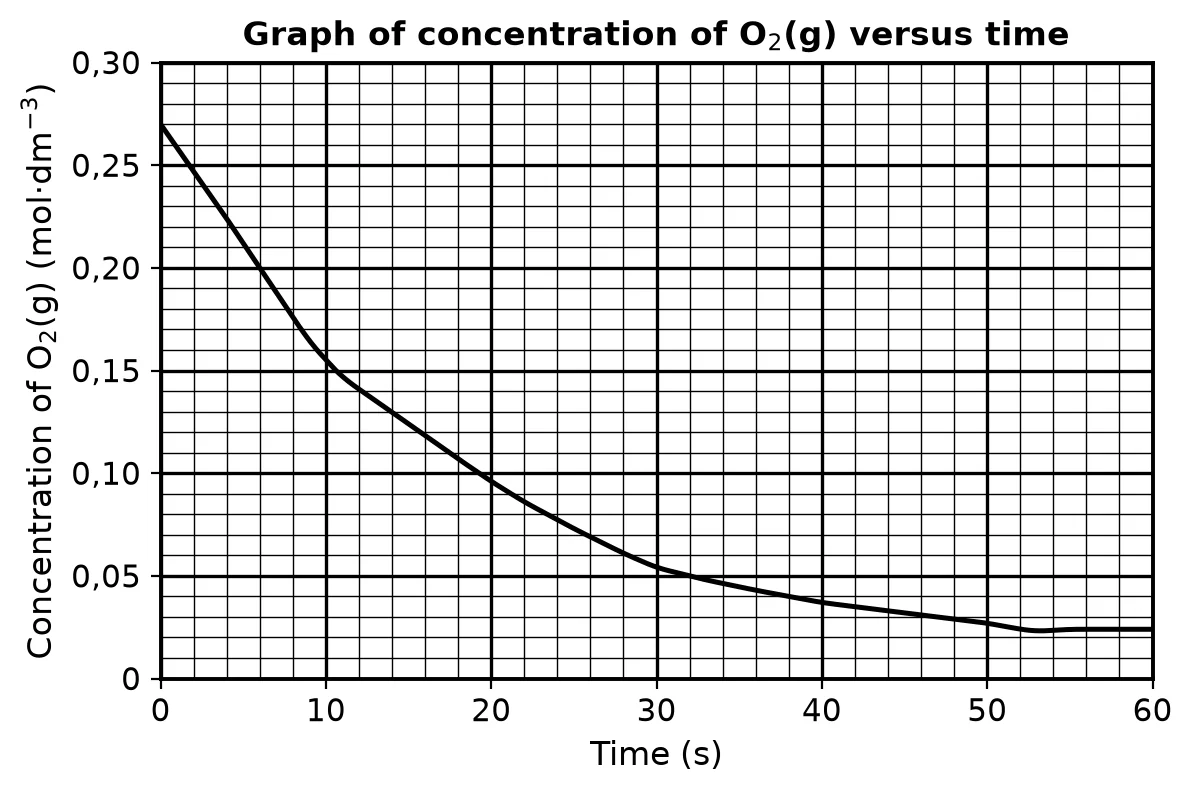 5.2.2 The reaction takes place in a dm container. Calculate the average rate (in mol·s) at which (g) is formed in the first 10 s.(5)
Show the memo (5 ticks)Memo
- ✓(a) Calculate the change in concentrationRate
1 mark · Calculate reaction rate
- ✓(b) Substitute 10 s
mol·dm·s1 mark · Calculate reaction rate
- ✓(c) Multiply by 3 dm3Rate () in mol·s mol·s
- ✓(d) Use the mol ratioRate () rate ()
1 mark · Use the mole ratio
- ✓(e) Final answer (mol·s)
1 mark · Use the mole ratio
- ✓
5. Question 1.7 · November 2024 · Paper 2 · National (DBE) · 2 marks
Various options are provided as possible answers to the following questions. Each question has only ONE correct answer. Choose the answer and write only the letter (A–D) next to the question numbers (1.1 to 1.10) in the ANSWER BOOK, e.g. 1.11 E.1.7 The table below shows the ionisation constants, , for two acids at °C.
Consider the following statements for these two acids when they have equal concentration at °C:
(i) Both are weak acids.
(ii) Butanoic acid is a stronger acid than ethanoic acid.
(iii) The butanoic acid solution has a lower concentration of hydronium ion, (aq), than the ethanoic acid solution.
Which of the above statements are TRUE?(2)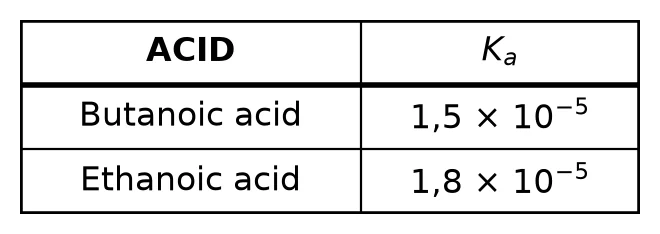
Show the memo (1 tick)Memo
- ✓Correct option(i) Both values are much smaller than 1, so both acids are weak. TRUE.
(ii) Ethanoic acid has the larger ( against ), so ethanoic acid is the stronger acid. FALSE.
(iii) Butanoic acid ionises less, so at equal concentration it produces fewer ions. TRUE.
Answer: B2 marks · Compare strong and weak acids
- ✓
6. Question 7.1 · November 2024 · Paper 2 · National (DBE) · 2 marks
Hydrated potassium carbonate, , is a WEAK BASE. A solution is prepared by dissolving some of this solid in water.7.1 Define the term weak base.(2)Show the memo (2 ticks)Memo
- ✓Ionises incompletely in waterWeak bases dissociate/ionise incompletely/partially in water
1 mark · Define acid and base terms
- ✓Low concentration of OH ionsto form a low concentration of hydroxide/ ions.
1 mark · Define acid and base terms
- ✓
7. Question 1.7 · May/June 2024 · Paper 2 · National (DBE) · 2 marks
1.7 Which ONE of the following shows the PRODUCTS for the reaction of oxalic acid with sodium hydroxide?(2)Show the memo (1 tick)Memo
- ✓Choose the correct optionOxalic acid, , is neutralised by a hydroxide: acid + base salt + water. The salt is sodium oxalate, . No forms because there is no carbonate.
Answer: B2 marks · Write acid-base reaction equations
- ✓
8. Question 4.1.3 · May/June 2024 · Paper 2 · National (DBE) · 2 marks
4.1 In an experiment, a test tube containing methanol, propanoic acid and a catalyst is heated in a water bath, as shown below.
Write down: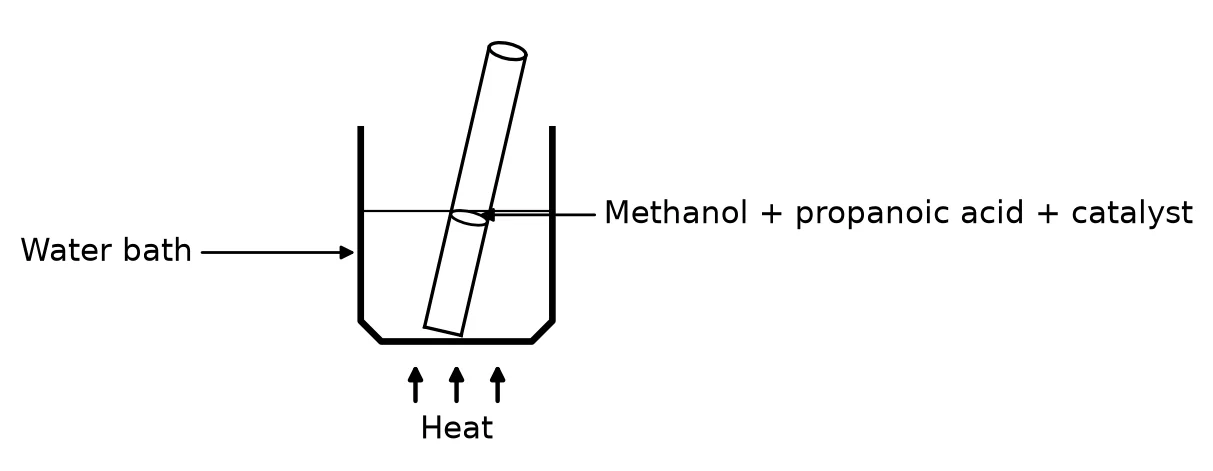 4.1.3 TWO reasons why the use of a water bath is preferred in this experiment(2)
Show the memo (2 ticks)Memo
- ✓First reasonAlcohol/methanol/reactant is flammable/catches fire easily.
1 mark · Describe and evaluate an experiment
- ✓Second reasonTo heat evenly / a steady, controlled, gradual increase in temperature. (OR: Alcohol/methanol will evaporate too quickly/is volatile.)
1 mark · Describe and evaluate an experiment
- ✓
9. Question 1.7 · November 2023 · Paper 2 · National (DBE) · 2 marks
Various options are provided as possible answers to the following questions. Each question has only ONE correct answer. Choose the answer and write only the letter (A–D) next to the question numbers (1.1 to 1.10).1.7 Nitric acid, (aq), and ethanoic acid, (aq), of equal volumes and concentrations are compared.
Consider the following statements regarding these solutions:
(i) They have different pH values.
(ii) Both have the same electrical conductivity.
(iii) Both solutions require the same number of moles of KOH(aq) for complete neutralisation.
Which of the above statement(s) is/are TRUE?(2)Show the memo (1 tick)Memo
- ✓Correct option(i) is a strong acid (ionises completely) and is weak (ionises partly), so has a higher and a lower pH. TRUE.
(ii) forms more ions, so it conducts better. FALSE.
(iii) Both are monoprotic and have the same number of moles of acid, so they need the same number of moles of KOH. TRUE.
Answer: (i) and (iii)
Answer: C2 marks · Compare strong and weak acids
- ✓
10. Question 5.3 · November 2023 · Paper 2 · National (DBE) · 3 marks
The reaction between EXCESS dilute hydrochloric acid and sodium thiosulphate is used to investigate factors that influence reaction rate.
The concentration of HCl(aq) used is mol·dm. The same volume of HCl(aq) is used in each run.
The time taken for the cross on the paper under the flask to become invisible is measured.
The table below summarises the reaction conditions and results of the experiment.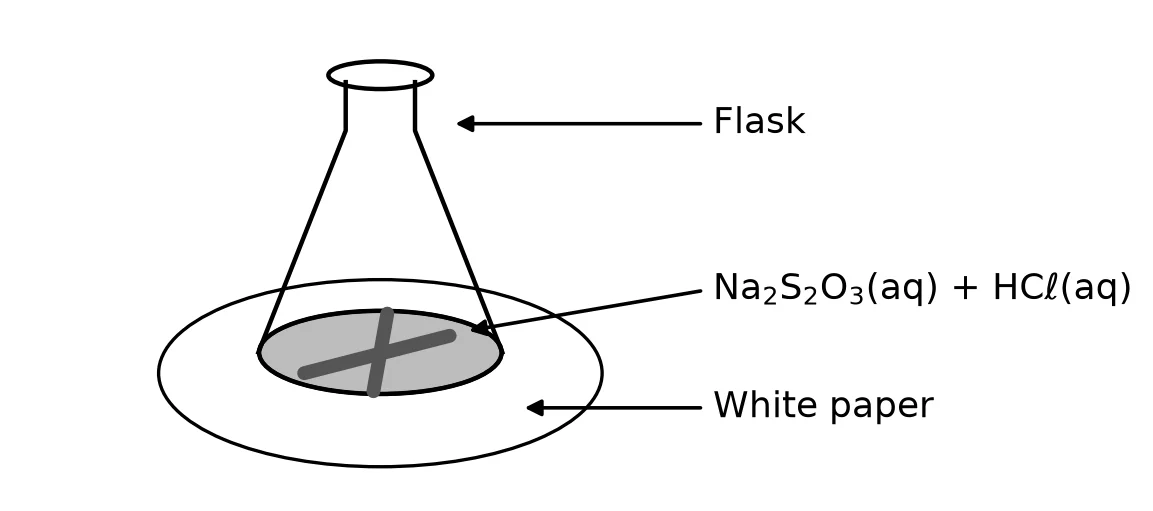
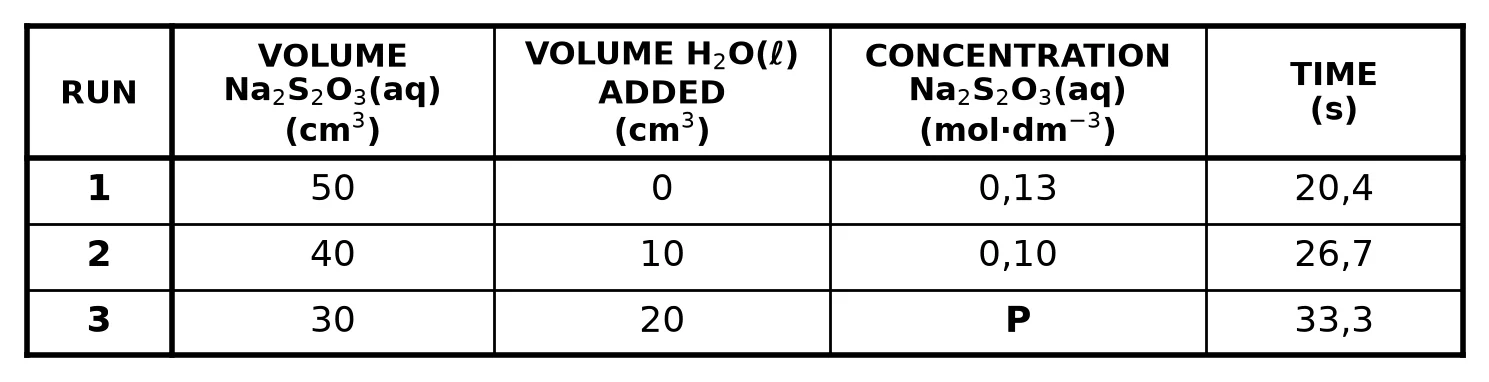 5.3 Calculate the value of P in the table.(3)
Show the memo (3 ticks)Memo
- ✓Substitute 0,03 and 0,13
mol - ✓Substitute 0,05
- ✓Final answer mol·dm
- ✓
Acids and Bases Grade 12 videos
Short lessons from South African teachers first. Videos load only when you tap play, to save your data.
Free on Android
Know exactly which skill is costing you marks.
Mark past papers tick by tick in the NavyBlue app. It remembers every mark you lose, shows you the skills to fix first, and picks your next questions.
Get NavyBlue free on Google Play
