Grade 12 Physical Sciences · Matter and Materials
Use the photoelectric equation
Use E = W₀ + Ek(max) to find the frequency of light, the work function or the speed of electrons released from a metal.
- past paper questions use it
- 14 past paper questions use it
- videos
- 3 videos
Learn it: use the photoelectric equation
Pick one and watch it, then try the questions below. Videos load only when you tap play.
Now try it on a real exam question
No sign-up. Takes 3 minutes.
Question 1.10 · November 2025 · Paper 1 · National (DBE) · 2 marks
Which ONE of the following graphs shows the CORRECT relationship between the maximum kinetic energy of the photoelectrons, , and the inverse of the wavelength of the incident light, ?(2)
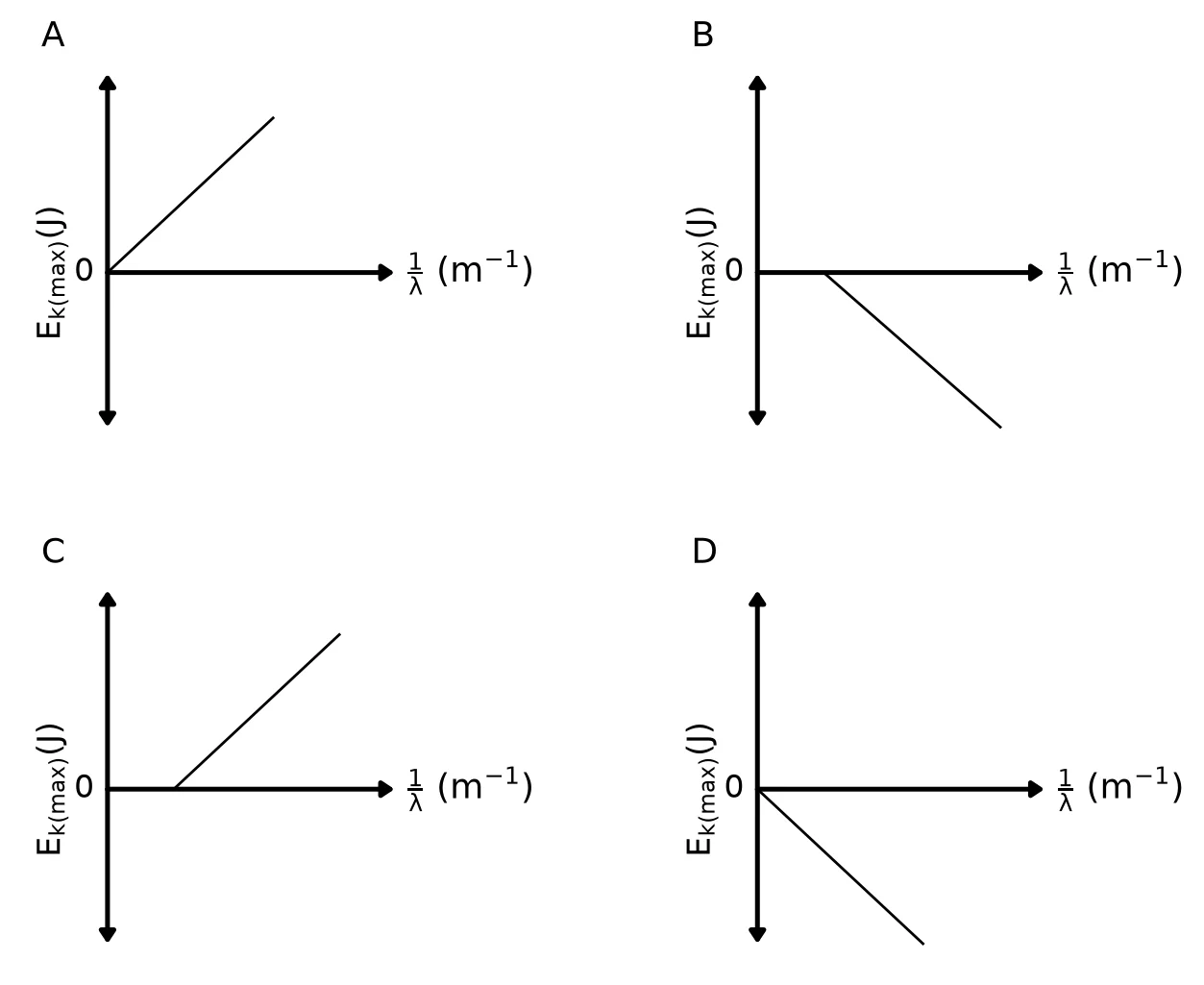
Work it out on paper first. Then mark yourself with the official memo, one tick at a time.
More past paper questions: use the photoelectric equation
Work each one out first, then open the memo and check every tick.
3. Question 10.3.1 · May/June 2025 · Paper 1 · National (DBE) · 3 marks
Light of different frequencies is incident on a metal plate. The sketch graph below shows the relationship between the maximum kinetic energy, , of the photoelectrons and the energy of the incident photons.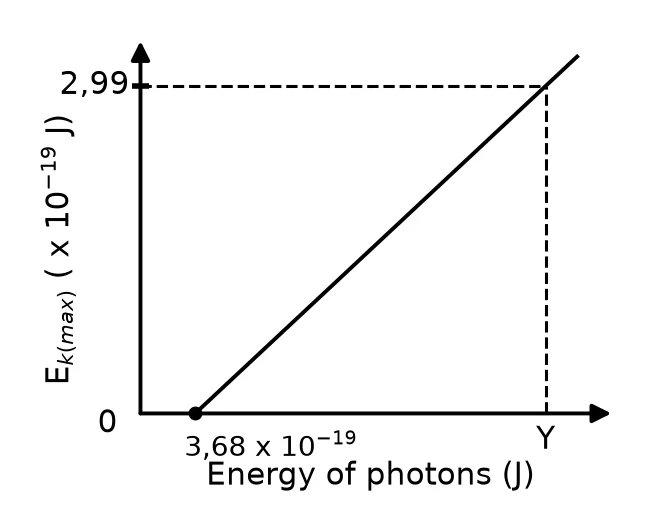 10.3 Calculate the:10.3.1 Maximum speed of the photoelectrons when photons with energy Y, as shown on the graph, strike the metal plate(3)
Show the memo (3 ticks)Memo
- ✓Formula
1 mark · Use the photoelectric equation
- ✓Substitution
1 mark · Use the photoelectric equation
- ✓Answer m·s
1 mark · Use the photoelectric equation
- ✓
4. Question 10.2.3 · November 2024 · Paper 1 · National (DBE) · 5 marks
10.2 Red light, blue light and green light are shone simultaneously on a sheet of potassium, as shown in the diagram below. Each colour of light consists of a single frequency.
Two maximum kinetic energies of the ejected electrons are possible, namely J and J. Each ejected electron has only one of these maximum kinetic energies.
Answer the questions that follow.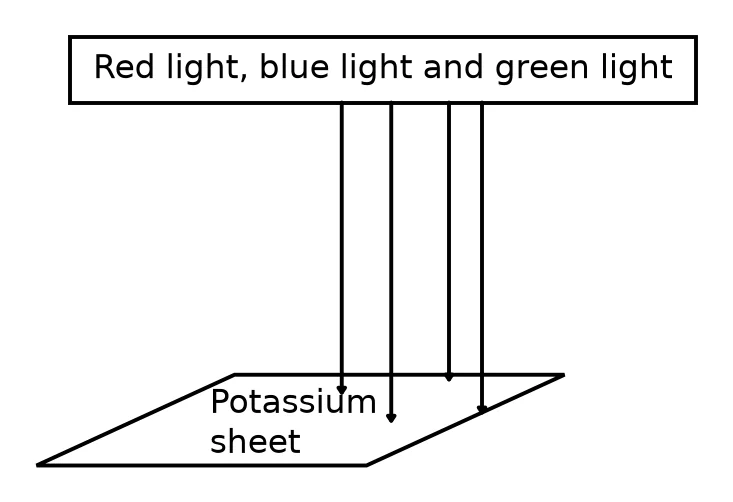 10.2.3 Calculate the frequency of the light that ejected electrons with a maximum kinetic energy of J.(5)
Show the memo (5 ticks)Memo
- ✓Formula (any one)
1 mark · Use the photoelectric equation
- ✓Photon energy of green light
1 mark · Use the photoelectric equation
- ✓Kinetic energy for green light
J1 mark · Use the photoelectric equation
- ✓Substitution for the second light
1 mark · Use the photoelectric equation
- ✓Answer Hz
1 mark · Use the photoelectric equation
- ✓
5. Question 10.5 · May/June 2023 · Paper 1 · National (DBE) · 2 marks
In a photoelectric investigation, light of different frequencies was radiated on each of two metals, A and B. The graph of maximum kinetic energy of the ejected electrons from metal A and the frequency of the incident photons is shown below.
Point X on the graph represents an unknown maximum kinetic energy.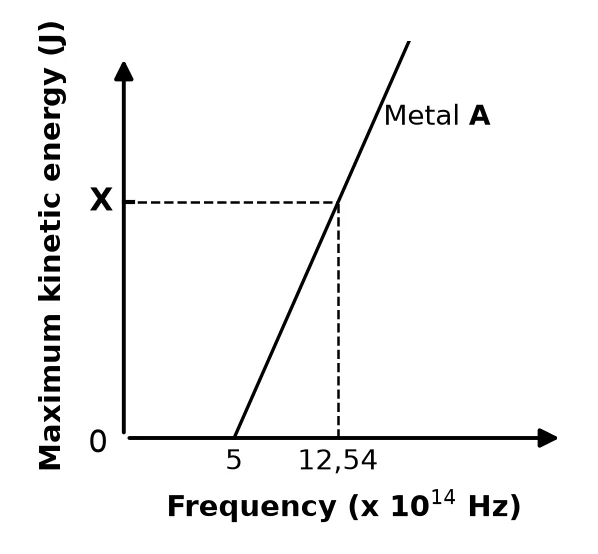 Metal B has a larger work function than metal A.10.5 Redraw the graph above in your ANSWER BOOK. (Do NOT include values on the axes.) Label this graph as A.
On the SAME set of axes, sketch the graph for metal B. Label this graph as B.(2)Show the memo (2 ticks)Memo
- ✓Graph B to the right of graph AGraph B starts on the frequency axis to the RIGHT of graph A.
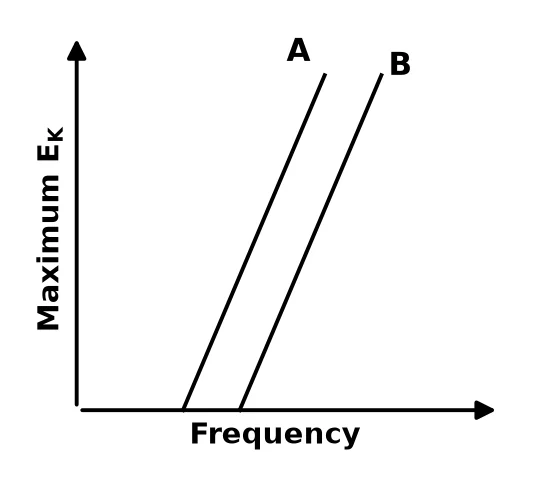
1 mark · Use the photoelectric equation
- ✓Lines are parallelGraph B is parallel to graph A.
1 mark · Use the photoelectric equation
- ✓
6. Question 1.10 · November 2023 · Paper 1 · National (DBE) · 2 marks
Various options are provided as possible answers to the following questions. Each question has only ONE correct answer.1.10 Light of a suitable frequency is shone on the surface of a metal and electrons are ejected from the metal.
Which ONE of the following is equal to the ratio of the work function to the threshold frequency of the metal?(2)Show the memo (1 tick)Memo
- ✓Correct option, so , Planck's constant.
Answer: A2 marks · Use the photoelectric equation
- ✓
Free on Android
Know exactly which skill is costing you marks.
Mark past papers tick by tick in the NavyBlue app. It remembers every mark you lose, shows you the skills to fix first, and picks your next questions.
Get NavyBlue free on Google Play
