Grade 12 Physical Sciences · Matter and Materials
Explain the photoelectric effect
Explain how the brightness and frequency of light change the number and energy of released electrons, and why this shows light acts as particles.
- past paper questions use it
- 17 past paper questions use it
- videos
- 3 videos
Learn it: explain the photoelectric effect
Pick one and watch it, then try the questions below. Videos load only when you tap play.
Now try it on a real exam question
No sign-up. Takes 3 minutes.
Question 10.4 · May/June 2025 · Paper 1 · National (DBE) · 2 marks
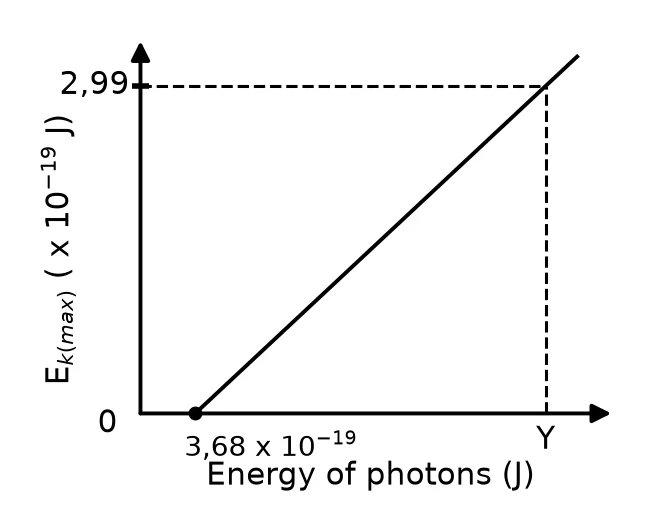
The number of photons with energy J striking the metal plate per second is now increased.
Give a reason for the answer.(2)
Work it out on paper first. Then mark yourself with the official memo, one tick at a time.
More past paper questions: explain the photoelectric effect
Work each one out first, then open the memo and check every tick.
3. Question 10.1.3 · November 2025 · Paper 1 · National (DBE) · 3 marks
10.1 Learners conduct an experiment to determine whether electrons will be emitted from the surface of different metals when light with a single frequency is incident on the metal. The maximum kinetic energy of emitted electrons are measured when light of frequency Hz is used.
The results obtained are shown in the table below.
Answer the questions that follow.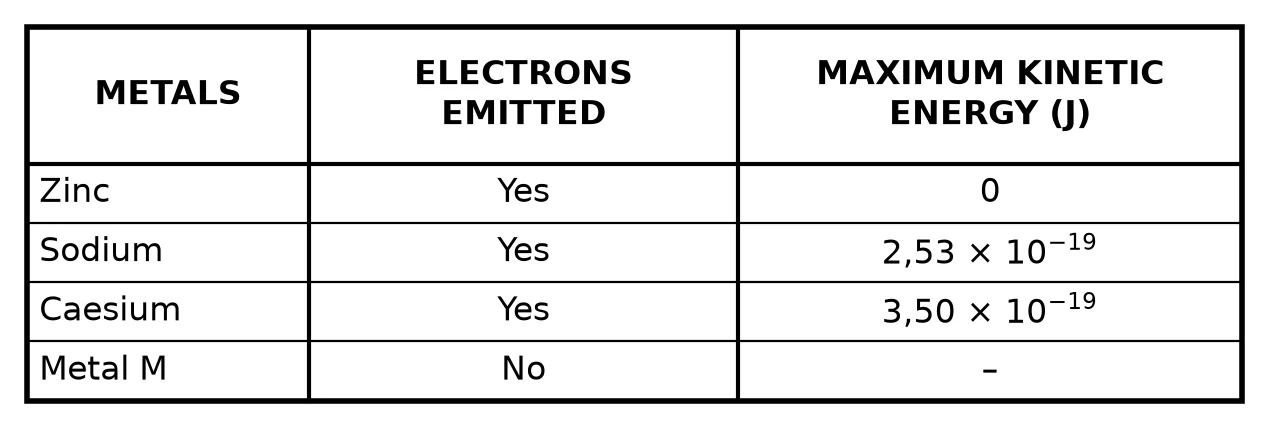 10.1.3 How does the work function of sodium compare to that of caesium? Choose from SMALLER THAN, GREATER THAN or EQUAL TO. Explain the answer.(3)
Show the memo (3 ticks)Memo
- ✓ChoiceGreater than
1 mark · Explain the photoelectric effect
- ✓Smaller kinetic energyThe maximum kinetic energy of electrons from sodium is smaller.
1 mark · Explain the photoelectric effect
- ✓Same photon energyE is constant / same frequency used / same light used ( is smaller; is larger).
1 mark · Explain the photoelectric effect
- ✓
4. Question 10.2.2 · November 2024 · Paper 1 · National (DBE) · 2 marks
10.2 Red light, blue light and green light are shone simultaneously on a sheet of potassium, as shown in the diagram below. Each colour of light consists of a single frequency.
Two maximum kinetic energies of the ejected electrons are possible, namely J and J. Each ejected electron has only one of these maximum kinetic energies.
Answer the questions that follow.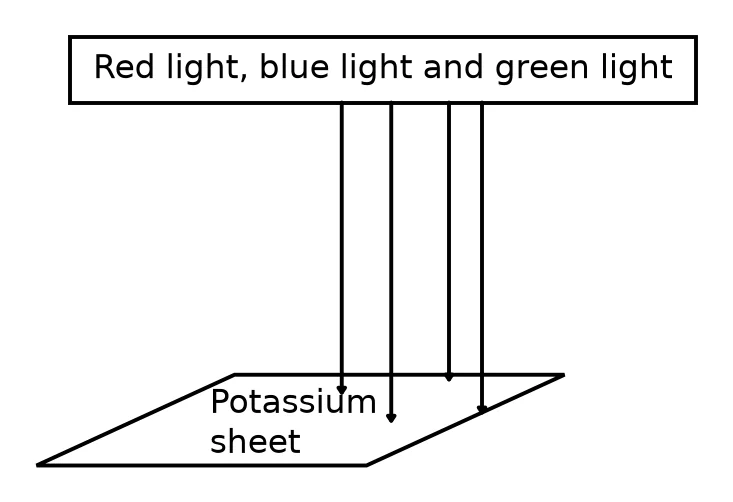 10.2.2 Explain the answer to QUESTION 10.2.1.(2)
Show the memo (2 ticks)Memo
- ✓Only green and blue eject electronsOnly green and blue light eject electrons / red light does not eject electrons.
1 mark · Explain the photoelectric effect
- ✓Green has the lower frequencyGreen has a lower frequency than blue / Green has longer wavelength than blue / Photons of blue light have more energy than photons of green light (and therefore green ejects electrons with the lower kinetic energy) /
1 mark · Explain the photoelectric effect
- ✓
5. Question 10.3.3 · May/June 2024 · Paper 1 · National (DBE) · 2 marks
10.3 A simple electroscope consists of a zinc disc, a metal stem and a thin length of gold foil. When the electroscope is neutral, the foil hangs vertically, as shown in DIAGRAM 1 below. When the electroscope is negatively charged, the foil is repelled from the stem, as shown in DIAGRAM 2 below.
When ultraviolet light is shone on the disc of the negatively charged zinc electroscope, the foil collapses towards the stem (hangs vertically).
Answer the questions that follow.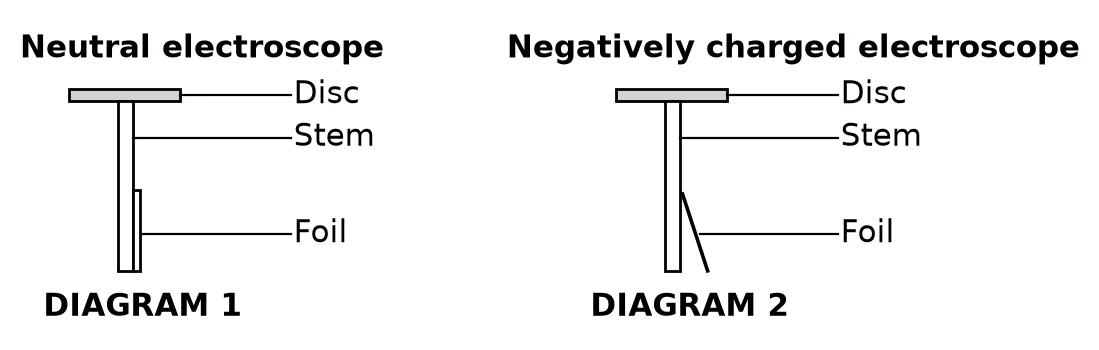 Green light is now shone on another negatively charged zinc electroscope. The foil does not collapse.10.3.3 Will the foil collapse if the intensity of the green light is increased? Write either YES or NO. Give a reason for the answer.(2)
Show the memo (2 ticks)Memo
- ✓AnswerNo
1 mark · Explain the photoelectric effect
- ✓Reason(Increasing the intensity increases the number of photons) does not increase the energy of the photon(s) OR photons will still have the same energy OR frequency stays the same/does not increase.
1 mark · Explain the photoelectric effect
- ✓
6. Question 10.5 · November 2022 · Paper 1 · National (DBE) · 3 marks
Light is incident on the cathode of a photoelectric cell connected to a battery and a sensitive ammeter, as shown below.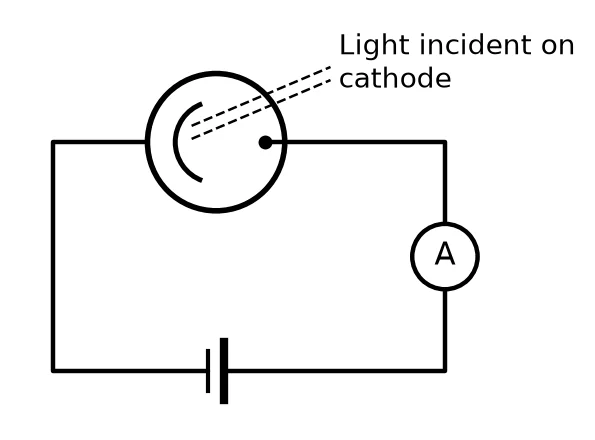 10.5 The intensity of the incident light is now INCREASED. How will this change affect the reading on the ammeter?
Choose from INCREASES, DECREASES or REMAINS THE SAME.
Explain the answer.(3)Show the memo (3 ticks)Memo
- ✓ChoiceIncreases
1 mark · Explain the photoelectric effect
- ✓More photons per unit timeMore photons strike the surface of the metal per unit time / at a higher rate
1 mark · Explain the photoelectric effect
- ✓More electrons per unit timehence more (photo)electrons ejected per unit time (resulting in increased current).
1 mark · Explain the photoelectric effect
- ✓
Free on Android
Know exactly which skill is costing you marks.
Mark past papers tick by tick in the NavyBlue app. It remembers every mark you lose, shows you the skills to fix first, and picks your next questions.
Get NavyBlue free on Google Play
