Grade 12 Physical Sciences · Mechanics · Paper 1 (Physics)
Work, Energy and Power Grade 12
Real Work, Energy and Power past paper questions and answers from 2023 to 2025, with each memo split into the ticks examiners give. Try one, mark yourself, and see exactly which skill cost you marks.
- past paper questions
- 177 past paper questions
- skills
- 11 skills
- videos
- 11 videos
Try a Work, Energy and Power exam question
No sign-up. Takes 3 minutes.
Question 1.5 · November 2025 · Paper 1 · National (DBE) · 2 marks
Which ONE of the following combinations of ACCELERATION and NET WORK DONE ON THE BLOCK is CORRECT?(2)

Work it out on paper first. Then mark yourself with the official memo, one tick at a time.
Work, Energy and Power skills
Each skill is one thing a memo gives a tick for. Tap one for its own questions, notes and videos.
- State energy laws and definitionsState energy definitions and laws in full, for example kinetic energy, gravitational potential energy or the law of conservation of mechanical energy.33 past paper questions · 3 videos
- Calculate kinetic and potential energyCalculate kinetic energy with Ek = ½mv² or gravitational potential energy with Ep = mgh (a 2 kg ball 5 m high has about 98 J of potential energy).32 past paper questions · 3 videos
- Use conservation of mechanical energyUse the idea that mechanical energy stays the same without friction to find a speed or height (a ball dropped from 5 m hits the ground at about 9,9 m/s).33 past paper questions · 4 videos
- Draw a free-body or force diagramDraw every force acting on an object as a labelled arrow, for example weight, normal force, friction and applied force on a box.45 past paper questions · 3 videos
- Calculate work done by a forceCalculate the work a force does with W = FΔx cos θ (pulling a box 5 m with 20 N along the ground does 100 J).17 past paper questions · 3 videos
- Use the work-energy theoremUse the fact that net work equals the change in kinetic energy (W_net = ΔEk) to find a speed, force or distance.24 past paper questions · 3 videos
- Solve energy problems with frictionSolve energy problems where friction or a push does work, using W_nc = ΔEk + ΔEp (a box sliding down a rough slope).15 past paper questions · 2 videos
- Calculate mechanical powerCalculate how fast work is done using P = W/Δt or P = Fv (a motor doing 600 J in 2 s has a power of 300 W).8 past paper questions · 3 videos
- Identify variables in an investigationName the independent, dependent and controlled variables in an experiment (in a test of temperature on reaction rate, temperature is independent).50 past paper questions · 3 videos
- Write investigative question or conclusionWrite an investigative question, hypothesis or conclusion that links two variables (How does the length of a wire affect its resistance?).38 past paper questions · 3 videos
- Read a graph of resultsRead values from a graph or table of results, or calculate a gradient (finding resistance from the gradient of a V-I graph).38 past paper questions · 3 videos
More Work, Energy and Power Grade 12 questions and answers
Try each one on paper before you open the memo.
4. Question 5.3.1 · May/June 2025 · Paper 1 · National (DBE) · 3 marks
Water is drawn from a water source m below the ground by an electric pump. The water is lifted vertically upwards at a constant speed, as shown in the simplified diagram below.
The pump lifts the water upwards at a rate of kg·s. Ignore ALL frictional and capillarity effects.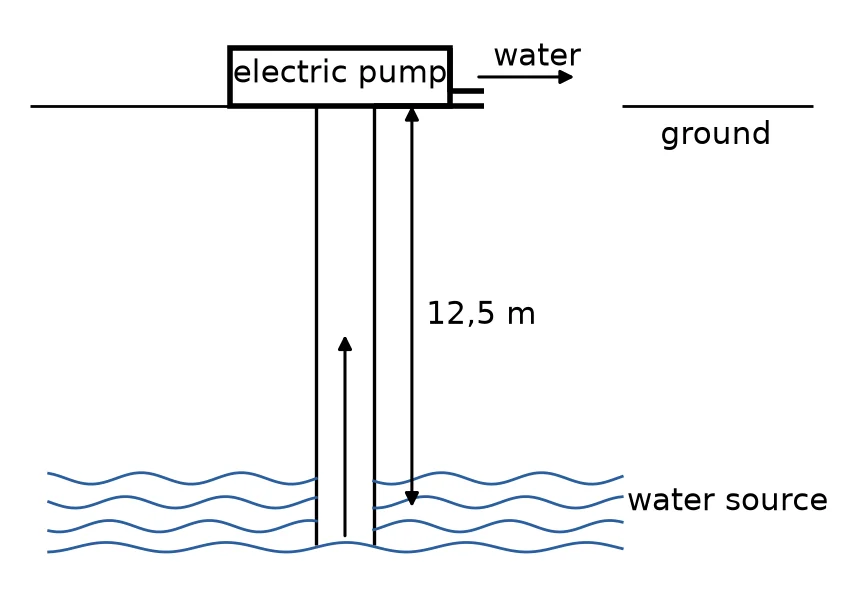 5.3 The pump lifts kg of water from the source to the ground at a constant speed. Calculate the:5.3.1 Work done by the pump(3)
Show the memo (3 ticks)Memo
- ✓METHOD 1: Formula (or / mgh)
1 mark · Solve energy problems with friction
- ✓METHOD 1: Substitution
1 mark · Solve energy problems with friction
- ✓METHOD 1: Answer J
1 mark · Solve energy problems with friction
- ✓
5. Question 7.2.2 · May/June 2025 · Paper 1 · National (DBE) · 3 marks
7.2 Sphere S is attached to the ceiling at point P by a light inextensible string. When sphere R, on an insulated stand, is brought close to sphere S they repel and sphere S comes to rest with the horizontal distance between the centres of the spheres equal to m.
Sphere R is directly below point P. The string makes an angle θ with the vertical, as shown in the diagram below.
Answer the questions that follow.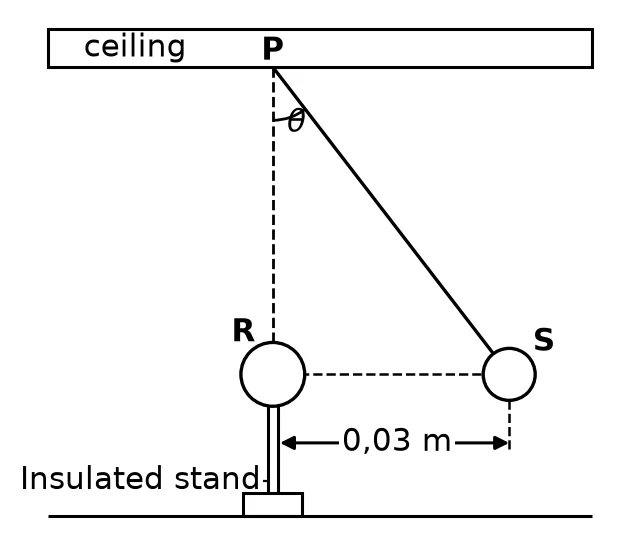 7.2.2 Draw a labelled free-body diagram showing ALL the forces acting on sphere S when it is at rest.(3)
Show the memo (3 ticks)Memo
- ✓WeightA dot with an arrow vertically downwards, labelled w.
Accepted labels: / / mg / N / gravitational force / weight.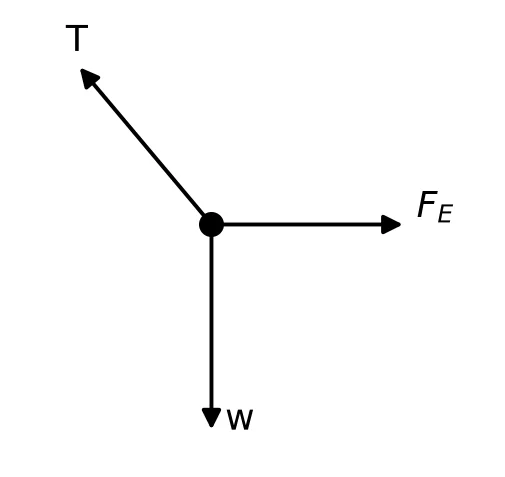
1 mark · Draw a free-body or force diagram
- ✓Electrostatic forceAn arrow from the dot horizontally to the right (away from R), labelled .
Accepted labels: F / Electrostatic force / Coulomb force / .1 mark · Draw a free-body or force diagram
- ✓TensionAn arrow from the dot along the string towards P (up and to the left), labelled T.
Accepted labels: / / tension.1 mark · Draw a free-body or force diagram
- ✓
6. Question 5.1 · November 2024 · Paper 1 · National (DBE) · 2 marks
A constant force F is applied at an angle of to the horizontal on a crate of mass kg that is initially at rest, as shown in the diagram below.
A constant frictional force of N acts on the crate as it moves from rest at point A along a horizontal surface to point B. The distance between point A and point B is m. The speed of the crate at point B is m·s.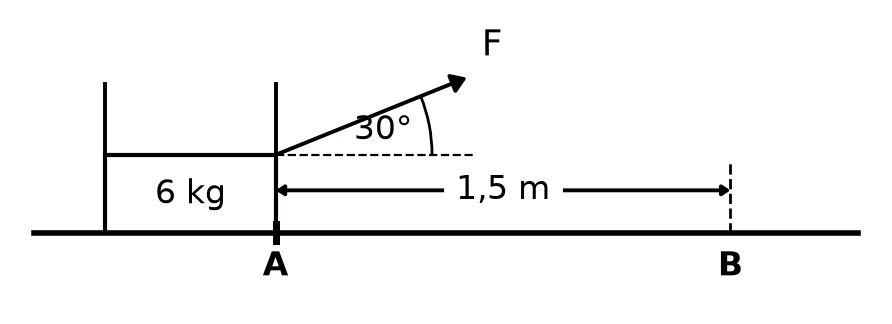 5.1 Define the term work done by a force.(2)
Show the memo (1 tick)Memo
- ✓Definition of workThe work done on an object by a constant force F is , where F is the magnitude of the force, the magnitude of the displacement and the angle between the force and the displacement.
OR
The work done on an object is the product of the force and the displacement of the object in the direction of the displacement.2 marks · State energy laws and definitions
- ✓
7. Question 5.5 · May/June 2024 · Paper 1 · National (DBE) · 3 marks
A crate of mass kg, initially at rest, slides down a frictionless slope from point A to point B. The crate then moves along a rough horizontal surface from point B towards point C. Point A is m above the horizontal surface. See the diagram below.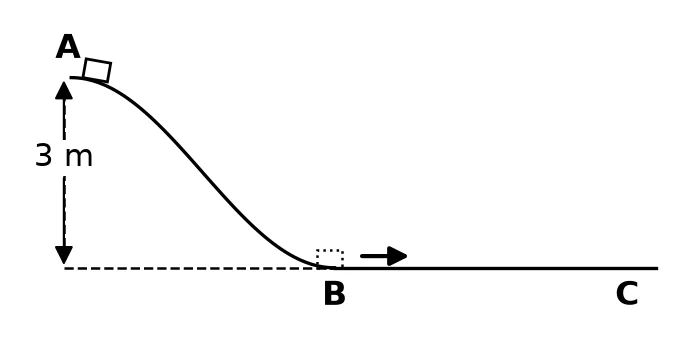 The height of the track is now lowered so that point A is at a vertical height less than m. The same crate is again released from point A.5.5 How will the distance now, travelled by the crate along the horizontal surface before it comes to rest, compare to the distance calculated in QUESTION 5.4? Write only GREATER THAN, SMALLER THAN or EQUAL TO. Explain the answer.(3)
Show the memo (3 ticks)Memo
- ✓ComparisonSmaller than
1 mark · Use the work-energy theorem
- ✓Less mechanical energy at ATotal mechanical/Gravitational potential energy (at A) is less.
1 mark · Use the work-energy theorem
- ✓Less kinetic energy at BVelocity (speed) at B is less/Kinetic energy at B/ will be less from B to C/rest.
1 mark · Use the work-energy theorem
- ✓
8. Question 1.5 · May/June 2024 · Paper 1 · National (DBE) · 2 marks
Various options are provided as possible answers to the following questions. Each question has only ONE correct answer. Choose the answer and write only the letter (A–D) next to the question numbers (1.1 to 1.10).1.5 A stone of mass m is dropped from a height h above the ground. Ignore the effects of air friction.
Which ONE of the following combinations CORRECTLY represents the kinetic energy and the total mechanical energy of the stone at the instant the stone has fallen through a distance of h?(2)Show the memo (1 tick)Memo
- ✓Choose the correct optionWith no air friction, mechanical energy is conserved: it stays equal to its starting value, .
After falling h the stone is at height h, so and .
Answer: D2 marks · Use conservation of mechanical energy
- ✓
9. Question 8.2 · May/June 2024 · Paper 2 · National (DBE) · 2 marks
The relationship between the concentration of the electrolyte and the cell potential is investigated using the following electrochemical cell represented by the cell notation:
Aℓ(s) | (aq) || (aq) | M(s)
The concentration of is changed and the corresponding emf is measured. The concentration of (aq) and the temperature are at standard conditions. The graph below shows the results of this investigation.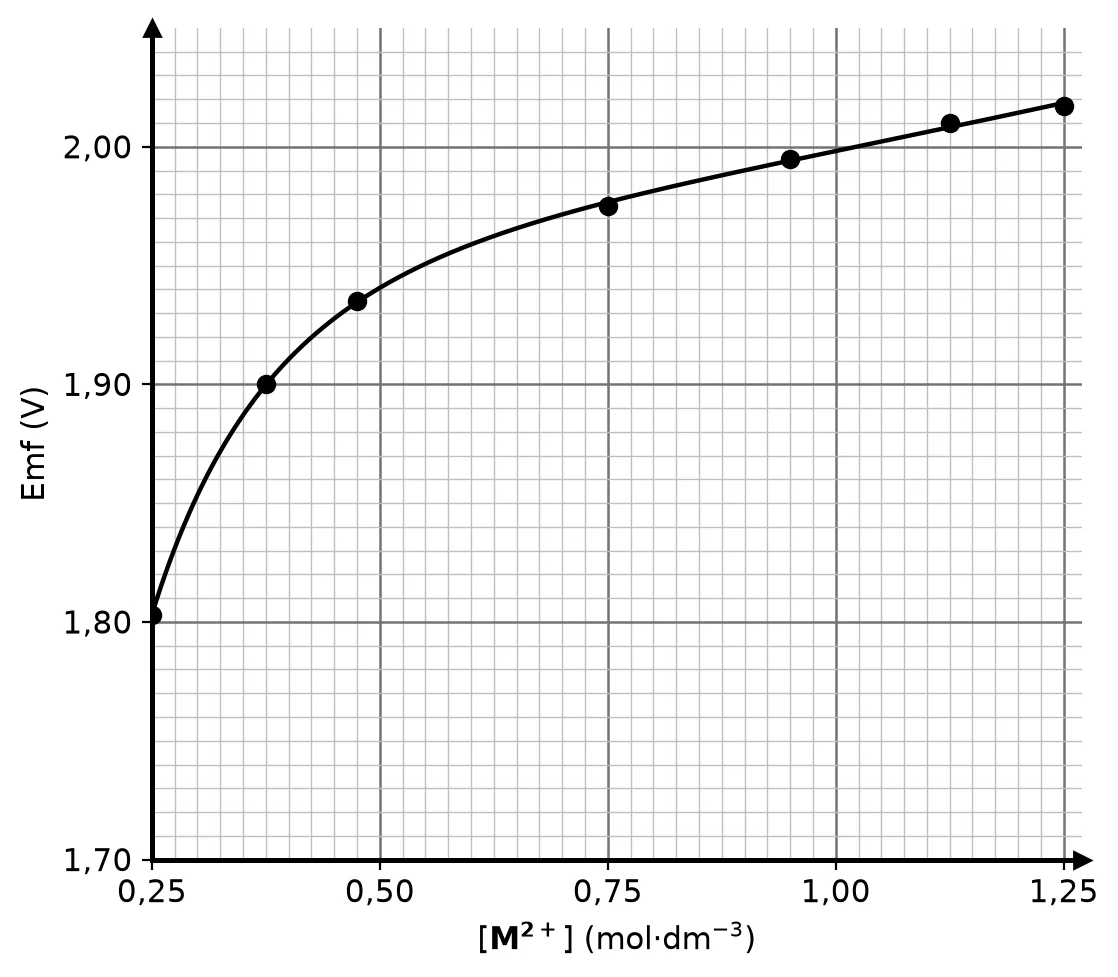 8.2 Determine the concentration of (aq) that will produce an emf of V.(2)
Show the memo (1 tick)Memo
- ✓Value read from the graph (mol·dm)
2 marks · Read a graph of results
- ✓
10. Question 10.3.2 · May/June 2023 · Paper 1 · National (DBE) · 4 marks
In a photoelectric investigation, light of different frequencies was radiated on each of two metals, A and B. The graph of maximum kinetic energy of the ejected electrons from metal A and the frequency of the incident photons is shown below.
Point X on the graph represents an unknown maximum kinetic energy.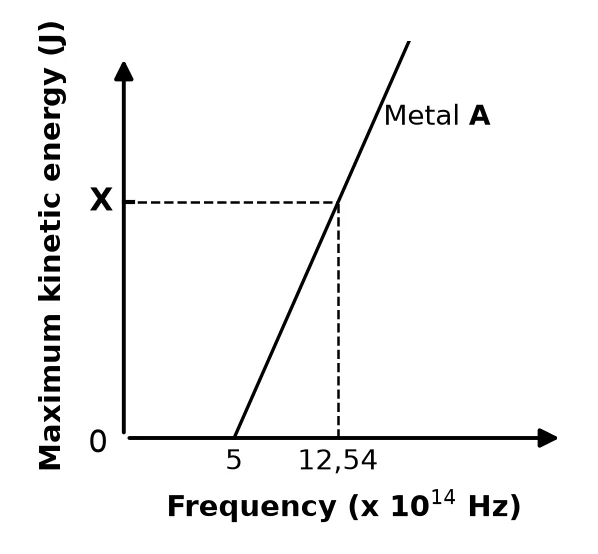 10.3 Calculate the:10.3.2 Value of X shown on the graph(4)
Show the memo (4 ticks)Memo
- ✓METHOD 1: Formula
(any one)1 mark · Use the photoelectric equation
- ✓METHOD 1: Substitution of hf
1 mark · Use the photoelectric equation
- ✓METHOD 1: Substitution of
1 mark · Use the photoelectric equation
- ✓METHOD 1: Answer with unit J
(J)1 mark · Use the photoelectric equation
- ✓
Work, Energy and Power Grade 12 videos
Short lessons from South African teachers first. Videos load only when you tap play, to save your data.
Free on Android
Know exactly which skill is costing you marks.
Mark past papers tick by tick in the NavyBlue app. It remembers every mark you lose, shows you the skills to fix first, and picks your next questions.
Get NavyBlue free on Google Play
