Grade 12 Physical Sciences · Mechanics · Paper 1 (Physics)
Momentum and Impulse Grade 12
Real Momentum and Impulse past paper questions and answers from 2023 to 2025, with each memo split into the ticks examiners give. Try one, mark yourself, and see exactly which skill cost you marks.
- past paper questions
- 97 past paper questions
- skills
- 9 skills
- videos
- 9 videos
Try a Momentum and Impulse exam question
No sign-up. Takes 3 minutes.
Question 1.4 · November 2025 · Paper 1 · National (DBE) · 2 marks
The velocity of P is ...(2)
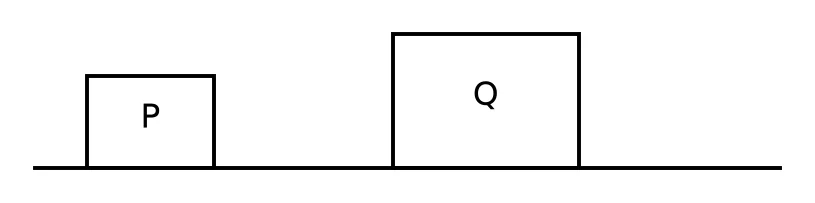
Work it out on paper first. Then mark yourself with the official memo, one tick at a time.
Momentum and Impulse skills
Each skill is one thing a memo gives a tick for. Tap one for its own questions, notes and videos.
- Use the equations of motionChoose and use an equation of motion to find an unknown, such as v_f = v_i + aΔt for a car speeding up from rest.31 past paper questions · 4 videos
- Calculate kinetic and potential energyCalculate kinetic energy with Ek = ½mv² or gravitational potential energy with Ep = mgh (a 2 kg ball 5 m high has about 98 J of potential energy).32 past paper questions · 3 videos
- State momentum laws and definitionsState momentum definitions and laws in full, for example momentum, impulse, an isolated system or conservation of linear momentum.19 past paper questions · 3 videos
- Calculate momentum and its changeCalculate momentum with p = mv, or its change Δp = m(v_f − v_i), keeping track of direction (a 1000 kg car at 20 m/s has 20 000 kg·m/s).8 past paper questions · 3 videos
- Use the impulse-momentum theoremUse F_netΔt = Δp to find a force, a time or a change in momentum (a 0,5 kg ball's momentum changes by 10 kg·m/s).19 past paper questions · 3 videos
- Apply conservation of momentumUse total momentum before equals total momentum after to find a velocity or mass when two objects collide or push apart.20 past paper questions · 3 videos
- Decide if a collision is elasticCompare total kinetic energy before and after a collision to decide if it is elastic (kinetic energy kept) or inelastic (kinetic energy lost).7 past paper questions · 3 videos
- Explain using impulse and momentumExplain how a longer contact time lowers the force for the same change in momentum, for example how airbags protect drivers.6 past paper questions · 2 videos
- Describe and evaluate an experimentName apparatus, describe or explain steps of a method, and give safety precautions (repeat readings and work out an average).18 past paper questions · 3 videos
More Momentum and Impulse Grade 12 questions and answers
Try each one on paper before you open the memo.
4. Question 4.1 · May/June 2025 · Paper 1 · National (DBE) · 2 marks
Trolley A of mass kg is at rest on a frictionless horizontal surface. A second trolley B, of mass kg, travelling horizontally at a constant speed v, collides with trolley A. The trolleys stick together and move at a constant velocity to the right, covering a distance of m in s. See the diagram below.
Ignore ALL frictional and rotational effects.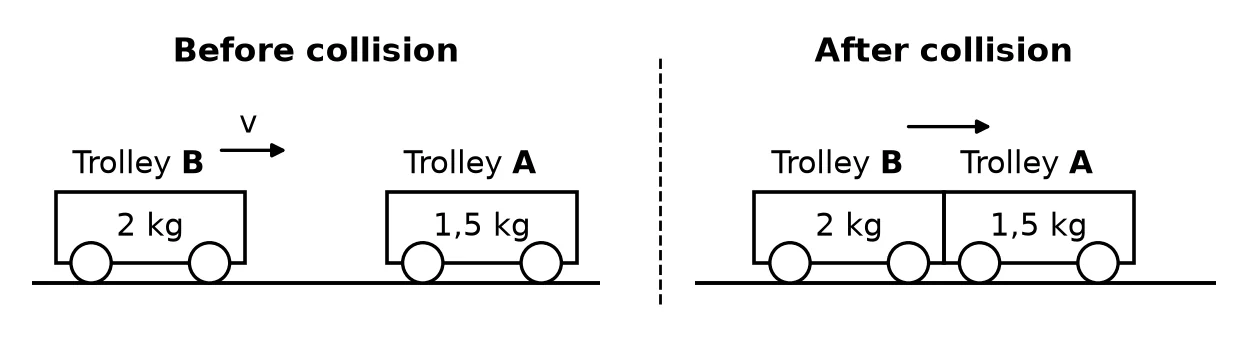 4.1 State the principle of conservation of linear momentum in words.(2)
Show the memo (1 tick)Memo
- ✓Principle of conservation of linear momentumThe total (linear) momentum in an isolated system is conserved/remains constant.
2 marks · State momentum laws and definitions
- ✓
5. Question 1.3 · November 2024 · Paper 1 · National (DBE) · 2 marks
1.3 A ball moving horizontally has constant momentum p and kinetic energy K. The ball collides with a wall and bounces back horizontally.
Immediately after the collision, the ball has momentum p.
The mass of the ball remains constant.
Which ONE of the following is the kinetic energy of the ball immediately after the collision?(2)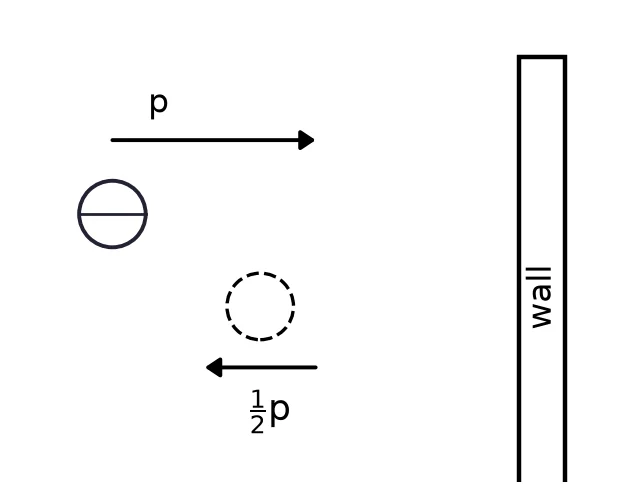
Show the memo (1 tick)Memo
- ✓Correct optionWith the same mass, halving means the speed halves: .
B is the trap: it treats kinetic energy as proportional to , but depends on .
Answer: A2 marks · Calculate kinetic and potential energy
- ✓
6. Question 4.3.1 · November 2024 · Paper 1 · National (DBE) · 3 marks
Two trolleys, A and B, of masses of kg and kg respectively, are held in a stationary position on a straight, horizontal, frictionless track, with a compressed spring between them. The trolleys are released and the spring takes t seconds to return to its natural length. The spring then falls to the ground.
Trolley A moves to the left, while trolley B moves to the right and then up a frictionless inclined plane, rising to a maximum vertical height of m, as shown in the diagram below.
Ignore the rotational effects of the wheels.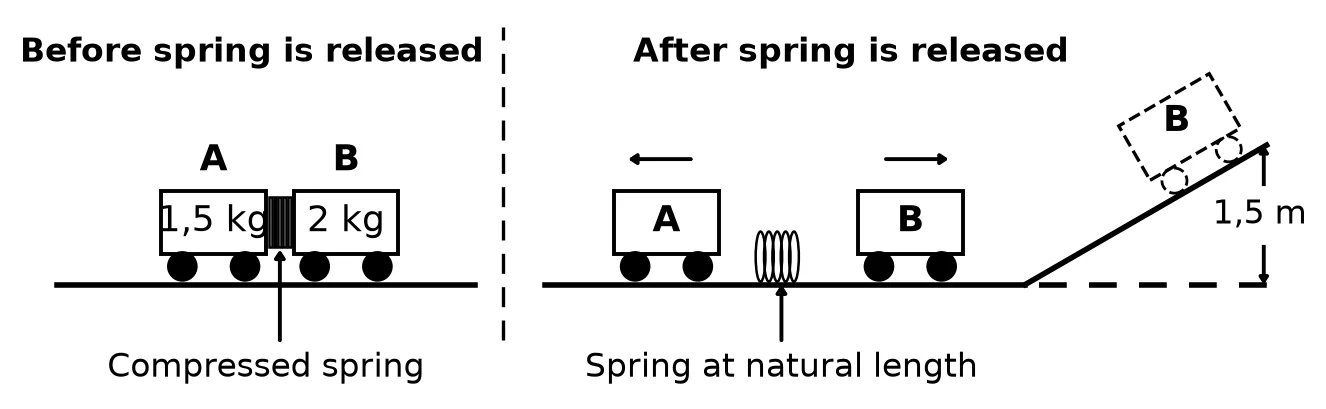 4.3 For the t seconds that the spring takes to return to its natural length:4.3.1 Calculate the change in momentum of trolley B(3)
Show the memo (3 ticks)Memo
- ✓Formula (any one) OR
1 mark · Calculate momentum and its change
- ✓Substitution
1 mark · Calculate momentum and its change
- ✓Answer with direction kg·m·s right
1 mark · Calculate momentum and its change
- ✓
7. Question 1.4 · May/June 2024 · Paper 1 · National (DBE) · 2 marks
Various options are provided as possible answers to the following questions. Each question has only ONE correct answer. Choose the answer and write only the letter (A–D) next to the question numbers (1.1 to 1.10).1.4 The vector diagram below shows the initial momentum (), the final momentum () and the change in momentum () for a car that moved on a straight horizontal road.
Which ONE of the following sketch graphs CORRECTLY shows the momentum of the car for the time the car moved on the road?(2)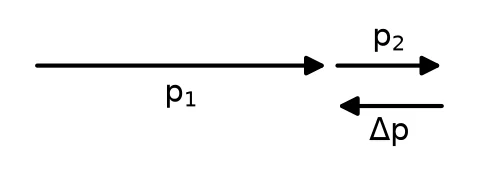
Show the memo (1 tick)Memo
- ✓Choose the correct option and both point the same way (positive), and is shorter than . points the other way, so the momentum DECREASED but stayed positive.
Graph A shows a constant positive momentum that drops to a smaller positive value. B shows an increase; C and D show a change of direction (the momentum crosses zero).
Answer: A2 marks · Calculate momentum and its change
- ✓
8. Question 3.3.2 · May/June 2024 · Paper 1 · National (DBE) · 4 marks
A hot-air balloon moves vertically downwards at a constant velocity of m·s. When the balloon is m above the ground, a small ball is dropped from the balloon. Refer to the diagram below.
The ball strikes the ground and bounces vertically upwards. The hot-air balloon continues to move downwards at the same constant velocity.
Ignore the effects of air friction acting on the ball.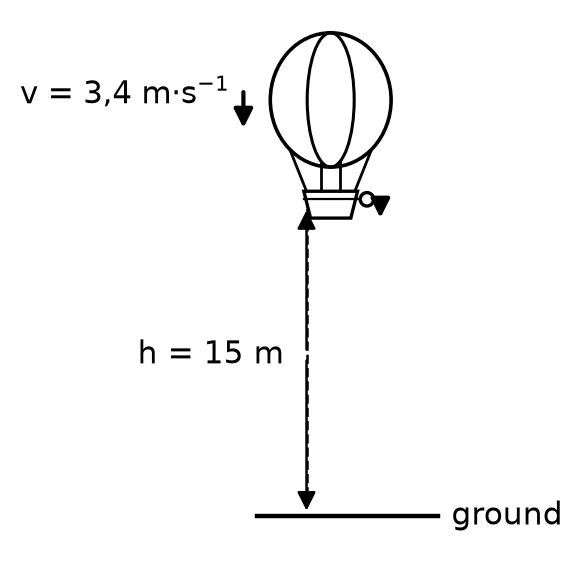 3.3 Use only EQUATIONS OF MOTION to calculate:3.3.2 The height of the hot-air balloon above the ground at the instant when the ball struck the ground(4)
Show the memo (4 ticks)Memo
- ✓FormulaUpwards as positive:
1 mark · Use the equations of motion
- ✓Substitution
m1 mark · Use the equations of motion
- ✓Subtraction from the initial heightHeight
1 mark · Use the equations of motion
- ✓Final answerHeight m
1 mark · Use the equations of motion
- ✓
9. Question 4.1.3 · May/June 2024 · Paper 2 · National (DBE) · 2 marks
4.1 In an experiment, a test tube containing methanol, propanoic acid and a catalyst is heated in a water bath, as shown below.
Write down: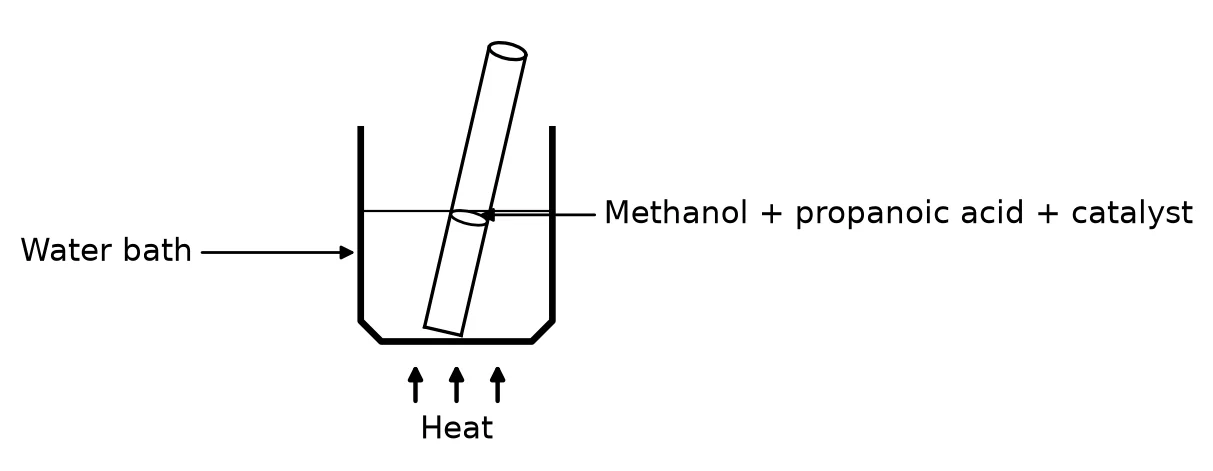 4.1.3 TWO reasons why the use of a water bath is preferred in this experiment(2)
Show the memo (2 ticks)Memo
- ✓First reasonAlcohol/methanol/reactant is flammable/catches fire easily.
1 mark · Describe and evaluate an experiment
- ✓Second reasonTo heat evenly / a steady, controlled, gradual increase in temperature. (OR: Alcohol/methanol will evaporate too quickly/is volatile.)
1 mark · Describe and evaluate an experiment
- ✓
10. Question 3.3.1 · November 2023 · Paper 1 · National (DBE) · 5 marks
A ball of mass kg is thrown vertically upwards from the top edge of a building which is m high. The ball reaches a maximum height of m above the top of the building. The ball strikes the ground and bounces vertically upwards, reaching a maximum height at point , as shown in the diagram below.
Ignore the effects of air friction.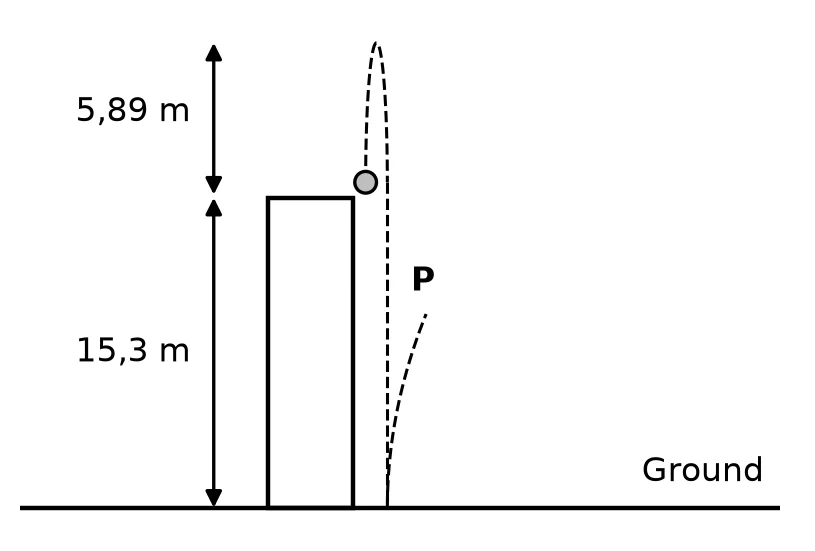 3.3 After the collision with the ground, the ball leaves the ground with a speed of m·s.
Calculate the:3.3.1 Amount of kinetic energy lost by the ball during the collision with the ground(5)Show the memo (5 ticks)Memo
- ✓Formula leading to the speed at the groundOption 1 (top of building to ground), upwards positive:
- ✓Substitution
m·s - ✓Formula for change in kinetic energy (any one)During the collision:
- ✓Substitution
OR - ✓Answer with unit J, so lost J
- ✓
Momentum and Impulse Grade 12 videos
Short lessons from South African teachers first. Videos load only when you tap play, to save your data.
Free on Android
Know exactly which skill is costing you marks.
Mark past papers tick by tick in the NavyBlue app. It remembers every mark you lose, shows you the skills to fix first, and picks your next questions.
Get NavyBlue free on Google Play
