Grade 11 Physical Sciences · Chemical Change · Paper 2 (Chemistry)
Stoichiometry Grade 11
Real Stoichiometry past paper questions and answers from 2022 to 2025, with each memo split into the ticks examiners give. Try one, mark yourself, and see exactly which skill cost you marks.
- past paper questions
- 119 past paper questions
- skills
- 9 skills
- videos
- 9 videos
Try a Stoichiometry exam question
No sign-up. Takes 3 minutes.
Question 1.3 · May/June 2025 · Paper 2 · National (DBE) · 2 marks
Which ONE of the following combinations CORRECTLY describes the type of reaction and the IUPAC name of compound R?(2)
Work it out on paper first. Then mark yourself with the official memo, one tick at a time.
Stoichiometry skills
Each skill is one thing a memo gives a tick for. Tap one for its own questions, notes and videos.
- Use conservation of massShow that the total mass or number of atoms is the same before and after a reaction (no atoms are lost or gained).21 past paper questions · 2 videos
- Use the mole ratioUse the numbers in a balanced equation to change moles of one substance into moles of another (2 mol H₂ makes 2 mol H₂O).99 past paper questions · 3 videos
- Define stoichiometry terms and lawsGive the exact meaning of words like mole, molar mass, concentration and limiting reagent, or state a law in full.33 past paper questions · 3 videos
- Calculate number of molesCalculate number of moles from mass, particles or gas volume using n = m/M (36 g of water is 2 mol).112 past paper questions · 4 videos
- Calculate concentration of a solutionCalculate the concentration of a solution with c = n/V, volume in dm³, or work out a dilution (2 mol in 4 dm³ is 0,5 mol/dm³).69 past paper questions · 3 videos
- Determine empirical and molecular formulaeFind the simplest whole-number ratio of atoms in a compound from masses or percentages, then the molecular formula (CH₂O for glucose).36 past paper questions · 4 videos
- Identify the limiting reagentWork out which reactant runs out first and use it to calculate how much product forms or how much of the other reactant is left.42 past paper questions · 3 videos
- Calculate percentage yield or purityCalculate percentage yield or purity, for example actual mass ÷ expected mass × 100 (8 g made out of an expected 10 g is 80%).23 past paper questions · 3 videos
- Convert unitsChange values into the units a formula needs (500 g → 0,5 kg, 25 °C → 298 K, 72 km/h → 20 m/s).21 past paper questions · 3 videos
More Stoichiometry Grade 11 questions and answers
Try each one on paper before you open the memo.
4. Question 2.3.2 · November 2025 · Paper 2 · National (DBE) · 5 marks
The letters A to G in the table below represent organic compounds.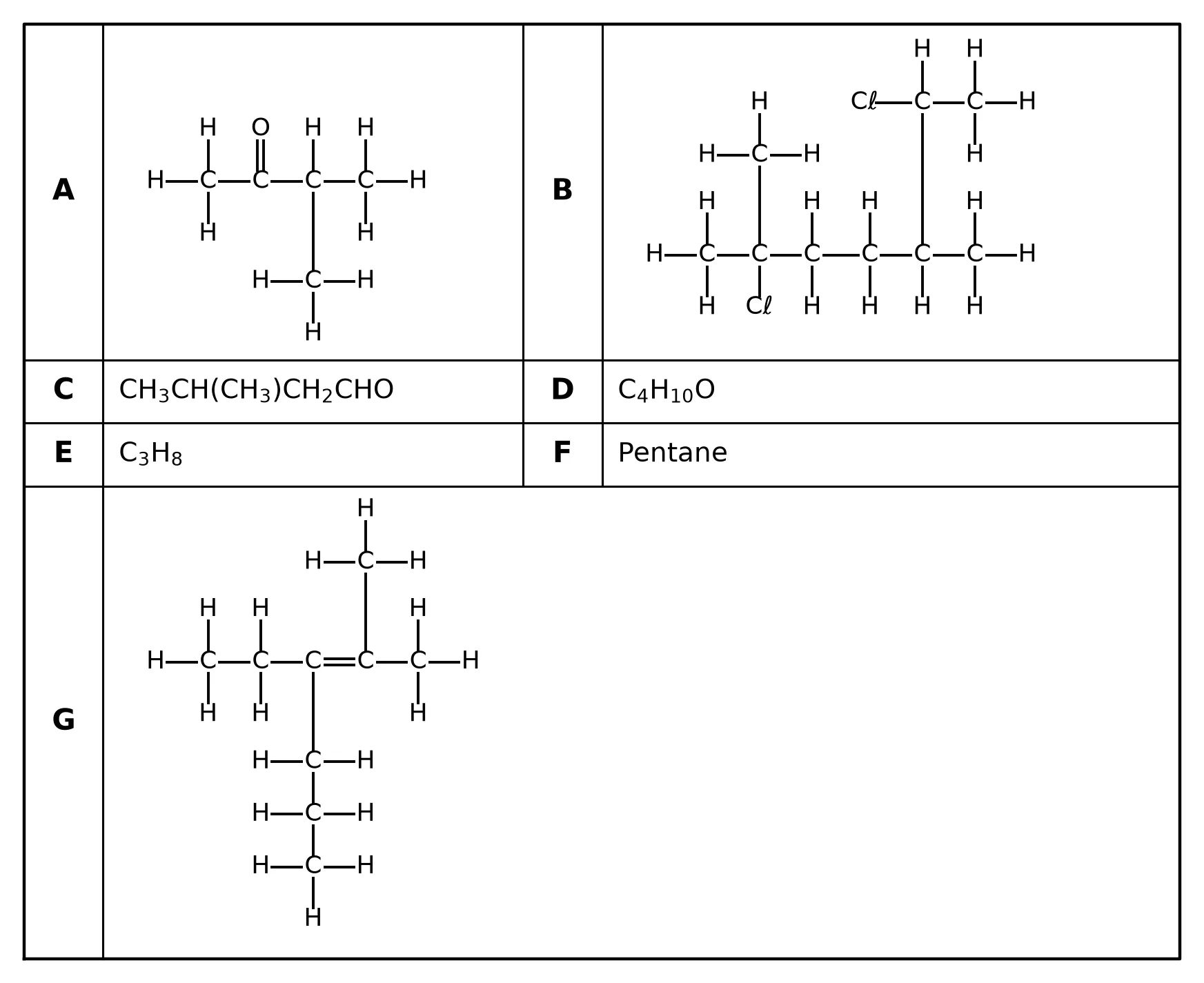 2.3 Compound E, (g), reacts with oxygen, (g), according to the balanced equation:
Initially cm of compound E and cm of oxygen were injected into a container of adjustable volume and allowed to react, as shown below.
Answer the questions that follow.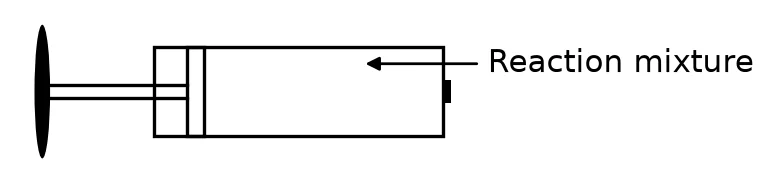 2.3.2 Calculate the TOTAL volume of the GASES present in the container at the end of the reaction.(5)
Show the memo (5 ticks)Memo
- ✓(a) Volume of O2 used (with volume of C3H8) cm
1 mark · Use the mole ratio
- ✓(b) Volumes of CO2 and H2O produced cm
cm1 mark · Use the mole ratio
- ✓(c) Volume of O2 remaining cm
1 mark · Identify the limiting reagent
- ✓(d) Addition of the three volumesVolume of gas in the container
1 mark · Identify the limiting reagent
- ✓(e) Final answerTotal volume of gas in the container cm (or dm)
1 mark · Identify the limiting reagent
- ✓
5. Question 1.4 · November 2023 · Paper 2 · National (DBE) · 2 marks
Various options are provided as possible answers to the following questions. Each question has only ONE correct answer. Choose the answer and write only the letter (A–D) next to the question numbers (1.1 to 1.10).1.4 Hydrochloric acid reacts with EXCESS zinc:
Different reaction conditions are shown in the diagrams below. The mass of zinc used is the same in both test tubes.
How will the INITIAL rate of reaction and FINAL VOLUME of (g) produced in test tube Y compare with that in test tube X?(2)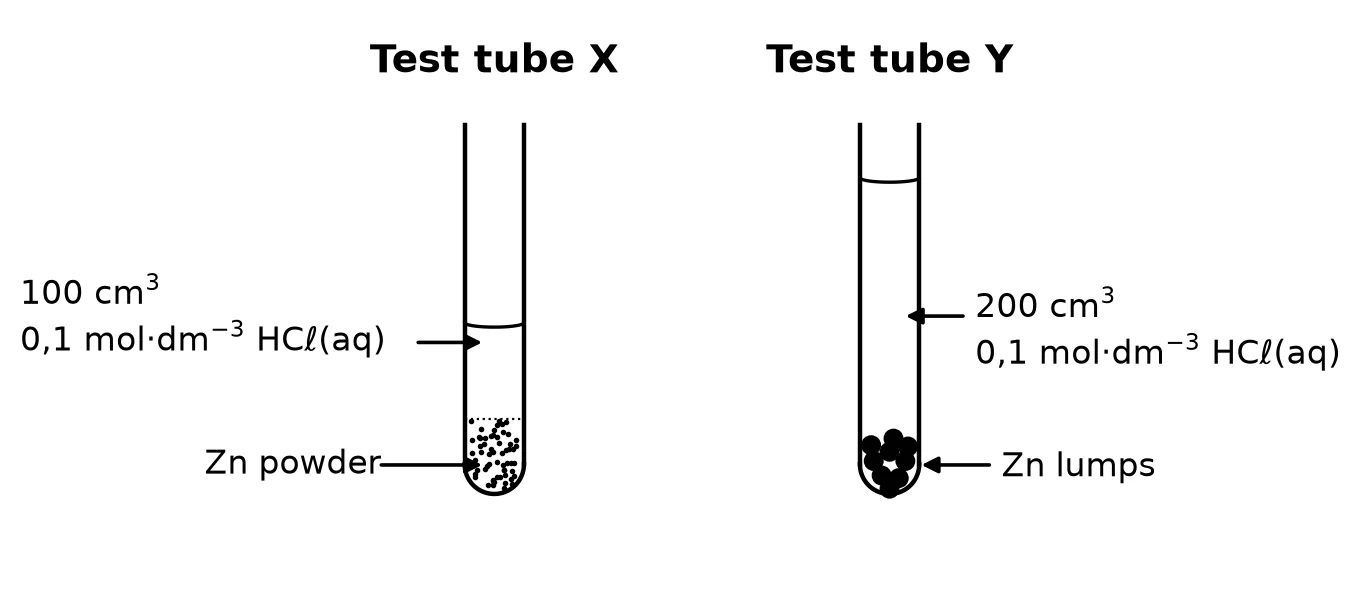
Show the memo (1 tick)Memo
- ✓Correct optionRate: both tubes have the same acid concentration ( mol·dm), but Y has zinc LUMPS (smaller surface area), so the initial rate in Y is LOWER.
Final volume: zinc is in excess, so HCl is the limiting reactant.
X: mol. Y: mol.
Y has more HCl, so it produces MORE .
Answer: B2 marks · Identify the limiting reagent
- ✓
6. Question 4.1.2 · November 2023 · Paper 2 · National (DBE) · 3 marks
4.1 Consider the cracking reaction below.4.1.2 Write down the values represented by x, y and z in the equation above.(3)Show the memo (3 ticks)Memo
- ✓Value of x
1 mark · Use conservation of mass
- ✓Value of y
1 mark · Use conservation of mass
- ✓Value of z
1 mark · Use conservation of mass
- ✓
7. Question 2.4 · May/June 2023 · Paper 2 · National (DBE) · 6 marks
Study the table below and answer the questions that follow.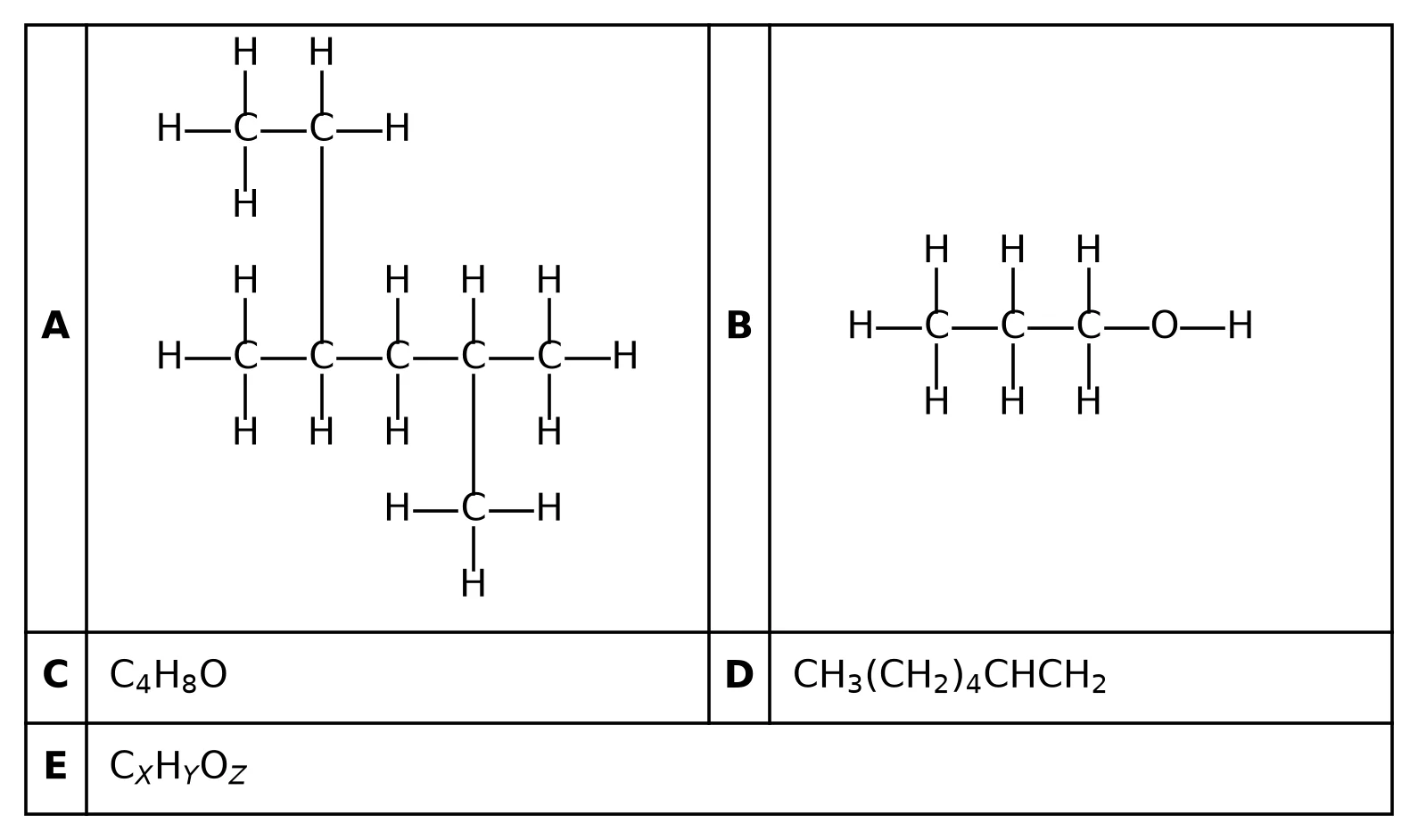 2.4 A g sample of compound E contains g carbon and g hydrogen. The molecular mass of compound E is g·mol.
Determine the molecular formula of compound E by means of a calculation.(6)Show the memo (5 ticks)Memo
- ✓Calculate the mass of oxygen g
- ✓Substitute mass and molar mass for C and H into n = m/M mol
mol - ✓Substitute mass and molar mass for O into n = m/M mol
- ✓Simplify ratioC : H : O = =
Empirical formula: - ✓Correct molecular formula
Molecular formula:
- ✓
8. Question 5.2 · May/June 2023 · Paper 2 · National (DBE) · 2 marks
Consider the following decomposition reaction that takes place in a sealed dm container:
The graph below shows how the concentrations of (g) and (g) change with time.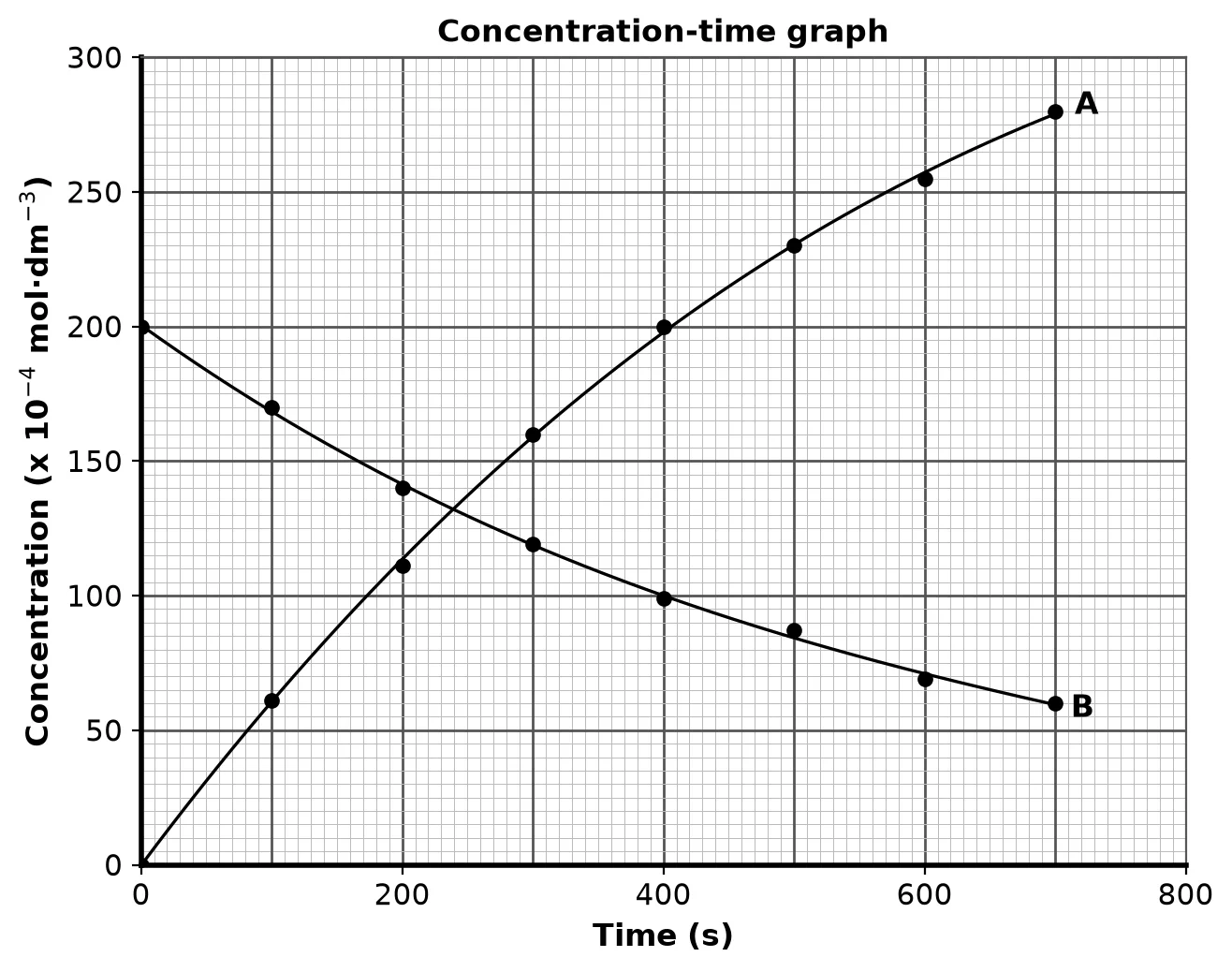 5.2 Consider the statement below:
The rate of decomposition of (g) is half the rate of formation of (g).
Is this statement TRUE or FALSE? Give a reason for the answer.(2)Show the memo (2 ticks)Memo
- ✓True or falseTrue
1 mark · Use the mole ratio
- ✓Reasonn mol of forms 2n mol of per unit time.
1 mark · Use the mole ratio
- ✓
9. Question 5.3.2 · November 2022 · Paper 2 · National (DBE) · 4 marks
Three experiments, A, B and C, are carried out to investigate some of the factors that affect the rate of decomposition of hydrogen peroxide, .
The balanced equation for the reaction is:
Identical samples of hydrogen peroxide are used in each experiment.
The conditions used in each experiment are summarised in the table below.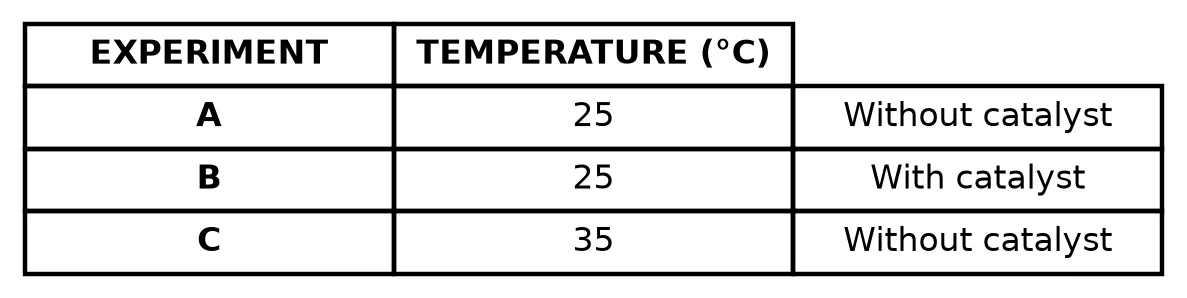 5.3 The volume of oxygen gas, (g), produced in experiment B during the first s is collected in a syringe, as shown below.
 5.3.2 Calculate the mass of water, , that was produced during the first s. Take the molar gas volume to be cm·mol at °C.(4)
Show the memo (4 ticks)Memo
- ✓Substitute into n = V/Vm mol
1 mark · Calculate number of moles
- ✓Mole ratio mol
1 mark · Use the mole ratio
- ✓Substitute into m = nM
1 mark · Calculate number of moles
- ✓Final answer g
1 mark · Calculate number of moles
- ✓
10. Question 4.2.4 · May/June 2022 · Paper 2 · National (DBE) · 3 marks
4.2 The cracking of a long chain hydrocarbon, , takes place in test tube A, as shown below.
Two STRAIGHT CHAIN organic compounds, X and Z, are produced in test tube A according to the following balanced equation:
Answer the questions that follow.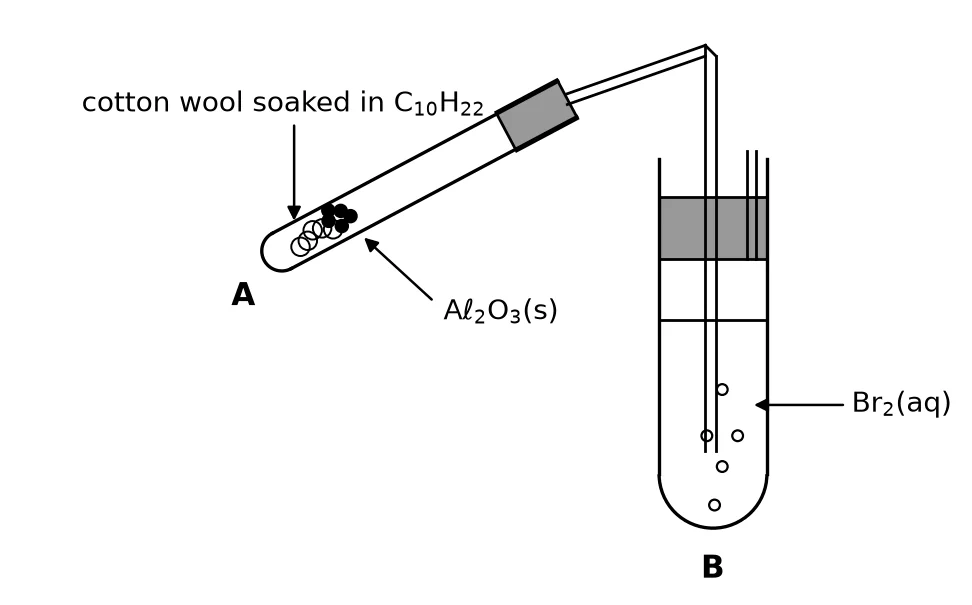 4.2.4 Write down the molecular formula of compound Z.(3)
Show the memo (1 tick)Memo
- ✓Molecular formula of Z
OR OR3 marks · Use conservation of mass
- ✓
Stoichiometry Grade 11 videos
Short lessons from South African teachers first. Videos load only when you tap play, to save your data.
Free on Android
Know exactly which skill is costing you marks.
Mark past papers tick by tick in the NavyBlue app. It remembers every mark you lose, shows you the skills to fix first, and picks your next questions.
Get NavyBlue free on Google Play
