Grade 10 Physical Sciences · Electricity and Magnetism
Calculate shared charge and electrons transferred
Find the charge on identical spheres after they touch using Q = (Q₁ + Q₂)/2, or count electrons moved with n = Q/e.
- past paper questions use it
- 18 past paper questions use it
- videos
- 4 videos
Learn it: calculate shared charge and electrons transferred
Pick one and watch it, then try the questions below. Videos load only when you tap play.
Now try it on a real exam question
No sign-up. Takes 3 minutes.
Question 1.7 · May/June 2023 · Paper 1 · National (DBE) · 2 marks
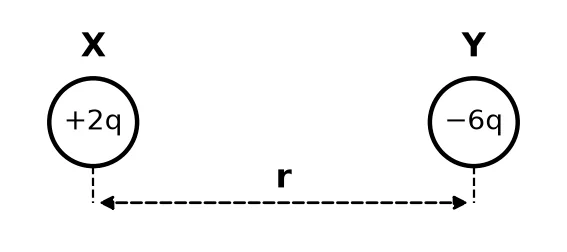
Sphere X experiences an electrostatic force F to the right when the distance between their centres is r.
The spheres are brought into contact and are then returned to their original positions.
Which ONE of the following represents the magnitude of the electrostatic force that sphere X experiences now?(2)
Work it out on paper first. Then mark yourself with the official memo, one tick at a time.
More past paper questions: calculate shared charge and electrons transferred
Work each one out first, then open the memo and check every tick.
3. Question 7.2.2 · May/June 2024 · Paper 1 · National (DBE) · 6 marks
7.2 Two identical neutral polystyrene balls A and B are suspended from a ceiling by insulated, light inextensible strings of equal length, as shown in the diagram below.
Ball B is then given an initial negative charge, , of unknown magnitude. The balls attract each other, touch and then repel each other. The balls come to rest with their centres cm apart so that each string makes an angle of with the vertical. See the diagrams below.
Answer the questions that follow.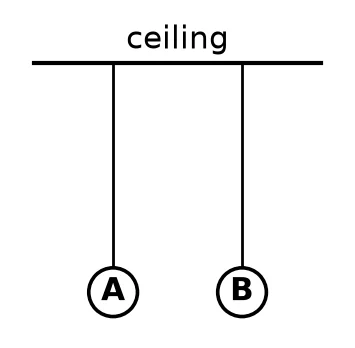
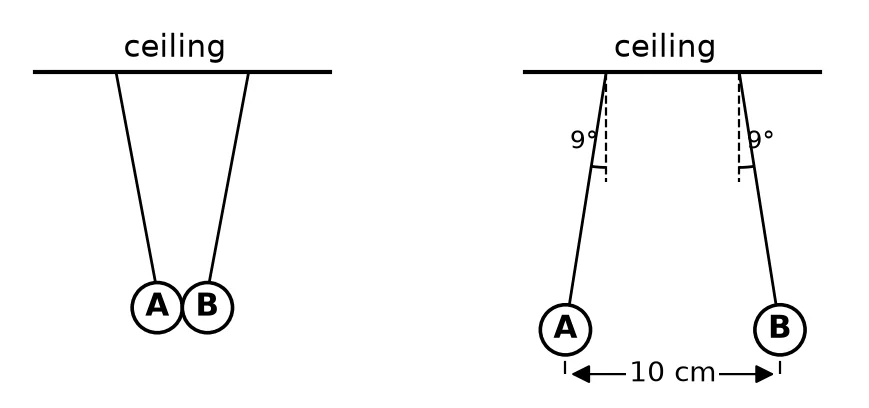 7.2.2 Calculate the magnitude of the initial charge given to ball B if the mass of each ball was kg.(6)
Show the memo (6 ticks)Memo
- ✓Correct trig expression equated to
Any one: or - ✓Substitution of mg with angle
N - ✓Coulomb's formula
1 mark · Apply Coulomb's law
- ✓Substitution into Coulomb's formula
C1 mark · Apply Coulomb's law
- ✓Calculating 2Q
- ✓Final answer C
- ✓
4. Question 6.3.3 · November 2023 · Paper 1 · Provincial · 4 marks
Two small, identical spheres A and B are suspended on long strings, as shown in the diagram below. The spheres carry charges of C and C respectively.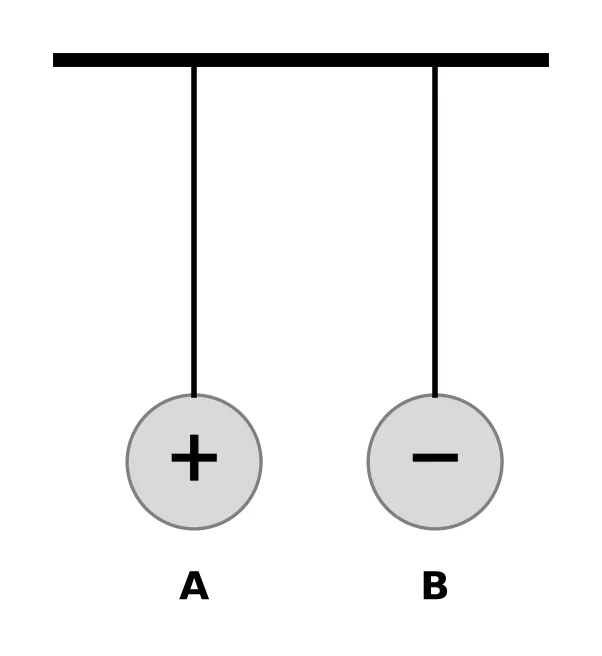 6.3 Calculate the:6.3.3 Number of electrons transferred during contact(4)
Show the memo (4 ticks)Memo
- ✓Formula
- ✓Charge transferred
- ✓Charge of an electron
- ✓Answer electrons
- ✓
5. Question 10.1.3 · November 2023 · Paper 1 · National (DBE) · 6 marks
10.1 Two small spheres, and , made of pure zinc are at rest m apart on a wooden table. Sphere is negatively charged and is free to move on the table, while sphere is uncharged and fixed to the table, as shown in the diagram below.
High-intensity ultraviolet light of frequency Hz is now shone continuously onto sphere .
The work function of zinc is J.
Answer the questions that follow.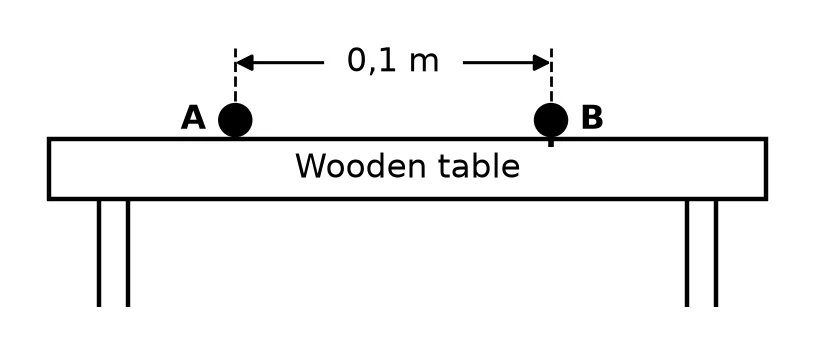 Sphere carries a charge of C and requires a minimum force of N to move from rest.10.1.3 Calculate the minimum number of photons of ultraviolet light that must strike sphere which will cause sphere to move from its rest position.(6)
Show the memo (6 ticks)Memo
- ✓Formula
1 mark · Apply Coulomb's law
- ✓Substitution of the force
1 mark · Apply Coulomb's law
- ✓Substitution of the charges and distance
C1 mark · Apply Coulomb's law
- ✓Substitution into n = Q/e
- ✓Number of electrons (electrons)
- ✓Number of photonsnumber of photons ()
1 mark · Explain the photoelectric effect
- ✓
6. Question 7.5 · November 2022 · Paper 1 · Provincial · 3 marks
Two identical insulated spheres, A and B, suspended by a light inextensible string from a ceiling, are held a distance apart, as shown below.
Sphere A carries a charge of nC, while sphere B is neutral.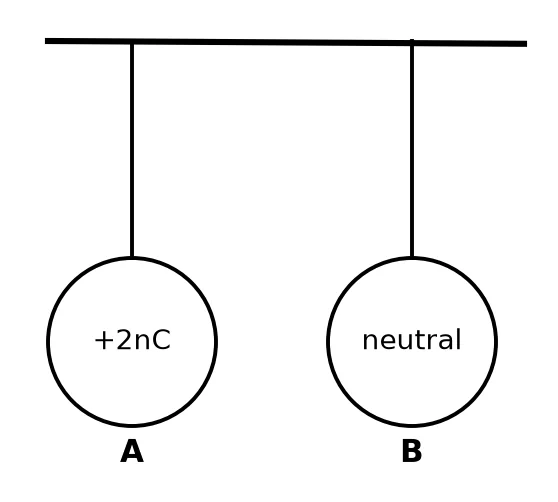 7.5 Calculate the charge on each sphere after they have separated.(3)
Show the memo (3 ticks)Memo
- ✓Formula
- ✓Substitution
- ✓Answer with unit C
- ✓
Free on Android
Know exactly which skill is costing you marks.
Mark past papers tick by tick in the NavyBlue app. It remembers every mark you lose, shows you the skills to fix first, and picks your next questions.
Get NavyBlue free on Google Play
