Grade 10 Physical Sciences · Electricity and Magnetism
State electrostatics laws and definitions
State Coulomb's law, conservation of charge or charge quantisation in full, or define an electric field.
- past paper questions use it
- 12 past paper questions use it
- videos
- 3 videos
Learn it: state electrostatics laws and definitions
Pick one and watch it, then try the questions below. Videos load only when you tap play.
Now try it on a real exam question
No sign-up. Takes 3 minutes.
Question 7.1 · November 2025 · Paper 1 · National (DBE) · 2 marks
The magnitude of the electric field at point P is N·C.
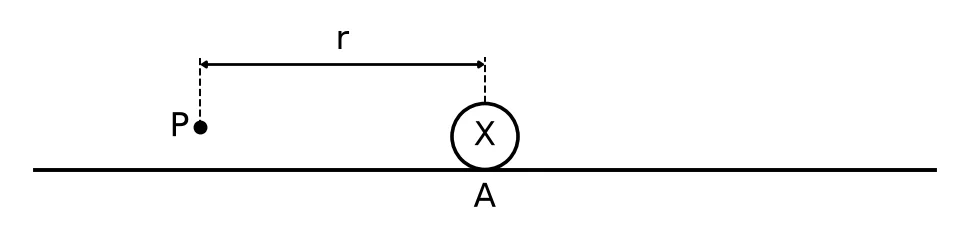
Work it out on paper first. Then mark yourself with the official memo, one tick at a time.
More past paper questions: state electrostatics laws and definitions
Work each one out first, then open the memo and check every tick.
3. Question 7.2.1 · May/June 2025 · Paper 1 · National (DBE) · 2 marks
7.2 Sphere S is attached to the ceiling at point P by a light inextensible string. When sphere R, on an insulated stand, is brought close to sphere S they repel and sphere S comes to rest with the horizontal distance between the centres of the spheres equal to m.
Sphere R is directly below point P. The string makes an angle θ with the vertical, as shown in the diagram below.
Answer the questions that follow.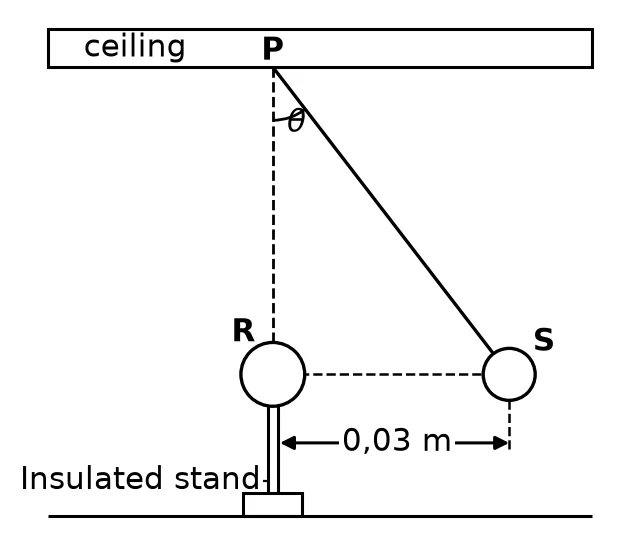 7.2.1 State Coulomb's law in words.(2)
Show the memo (2 ticks)Memo
- ✓Proportional to the product of the chargesThe magnitude of the electrostatic force exerted by one point charge () on another point charge () is directly proportional to the product of the (magnitudes) of the charges
- ✓Inversely proportional to the square of the distanceand inversely proportional to the square of the distance (r) between them.
- ✓
4. Question 7.2.1 · May/June 2024 · Paper 1 · National (DBE) · 2 marks
7.2 Two identical neutral polystyrene balls A and B are suspended from a ceiling by insulated, light inextensible strings of equal length, as shown in the diagram below.
Ball B is then given an initial negative charge, , of unknown magnitude. The balls attract each other, touch and then repel each other. The balls come to rest with their centres cm apart so that each string makes an angle of with the vertical. See the diagrams below.
Answer the questions that follow.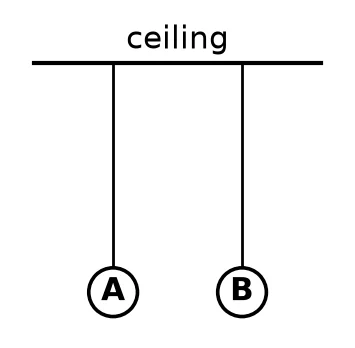
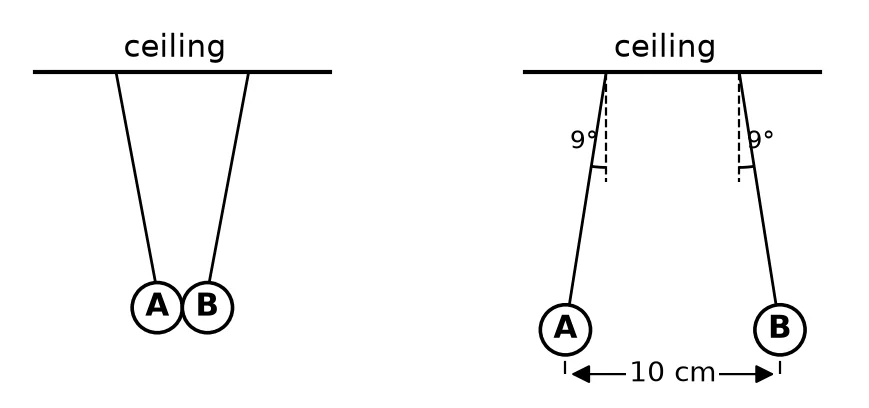 7.2.1 State Coulomb's Law in words.(2)
Show the memo (1 tick)Memo
- ✓Coulomb's lawThe magnitude of the electrostatic force exerted by one point charge on another is directly proportional to the product of the magnitudes of the charges and inversely proportional to the square of the distance between them.
- ✓
5. Question 7.3.1 · November 2024 · Paper 1 · National (DBE) · 2 marks
P is a nC point charge. X is a point cm away from charge P, as shown in the diagram below.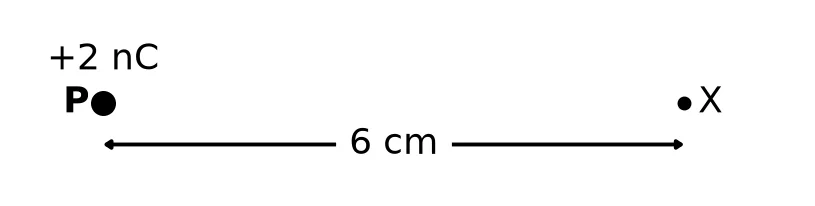 7.3 A third point charge T is placed cm to the right of S, as shown in the diagram below. Point charge T experiences a net electrostatic force of N to the left.
Answer the questions that follow.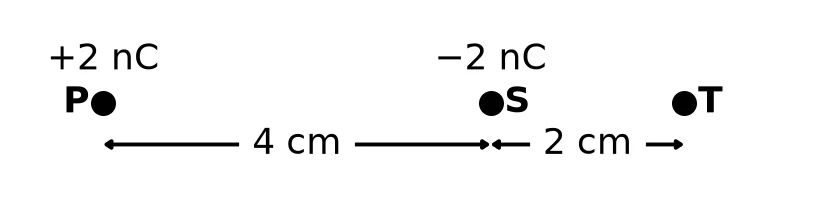 7.3.1 State Coulomb's law in words.(2)
Show the memo (1 tick)Memo
- ✓Coulomb's lawThe magnitude of the electrostatic force exerted by one point charge on another point charge is directly proportional to the product of the magnitudes of their charges and inversely proportional to the square of the distance between them.
- ✓
6. Question 7.1 · May/June 2023 · Paper 1 · National (DBE) · 2 marks
Two point charges, X and Y, are held m apart, as shown in the diagram below. The charge of X is C, while the charge of Y is C.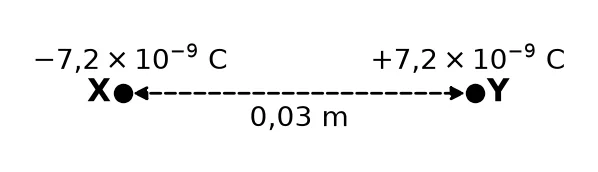 7.1 State Coulomb's law in words.(2)
Show the memo (1 tick)Memo
- ✓Coulomb's lawThe magnitude of the electrostatic force exerted by one (stationary) point charge () on another (stationary) point charge () is directly proportional to the product of the magnitudes of the charges and inversely proportional to the square of the distance (r) between them.
- ✓
Free on Android
Know exactly which skill is costing you marks.
Mark past papers tick by tick in the NavyBlue app. It remembers every mark you lose, shows you the skills to fix first, and picks your next questions.
Get NavyBlue free on Google Play
