Grade 10 Physical Sciences · Electricity and Magnetism
Explain charging and polarisation
Explain how objects become charged by gaining or losing electrons, and why a charged rod attracts small pieces of paper.
- past paper questions use it
- 8 past paper questions use it
- videos
- 3 videos
Learn it: explain charging and polarisation
Pick one and watch it, then try the questions below. Videos load only when you tap play.
Now try it on a real exam question
No sign-up. Takes 3 minutes.
Question 1.7 · November 2023 · Paper 1 · National (DBE) · 2 marks
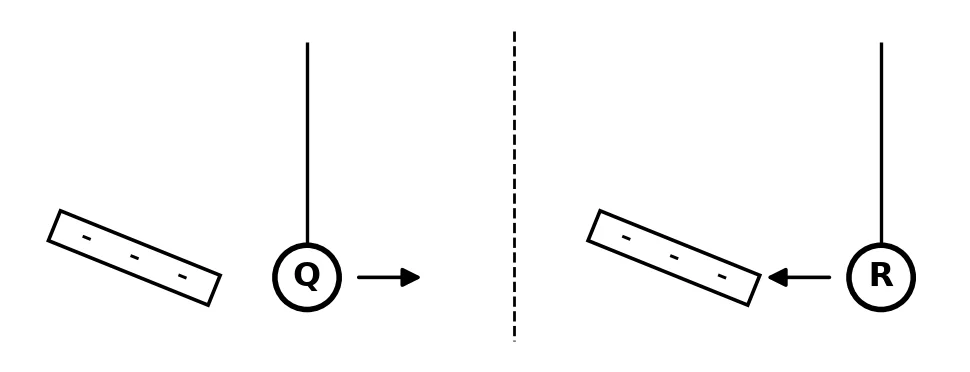
Q and R are small spheres suspended by light insulated strings.
When a negatively charged rod is brought close to sphere Q, sphere Q is repelled. When the negatively charged rod is brought close to sphere R, sphere R is attracted.
Which ONE of the combinations below can be possible for the nature of the charges on spheres Q and R?(2)
Work it out on paper first. Then mark yourself with the official memo, one tick at a time.
More past paper questions: explain charging and polarisation
Work each one out first, then open the memo and check every tick.
3. Question 7.3 · November 2022 · Paper 1 · Provincial · 2 marks
Two identical insulated spheres, A and B, suspended by a light inextensible string from a ceiling, are held a distance apart, as shown below.
Sphere A carries a charge of nC, while sphere B is neutral.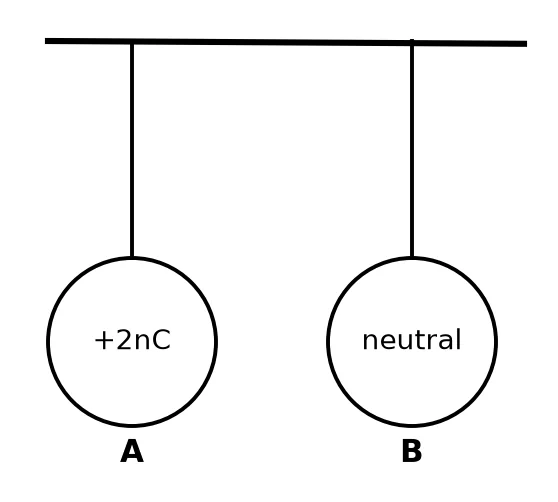 7.3 Briefly explain how the neutral sphere B is attracted to sphere A.(2)
Show the memo (2 ticks)Memo
- ✓PolarisationDue to polarisation, a negative charge is developed on the side of sphere B near sphere A and a positive charge is developed on the side of sphere B that is away from sphere A.
1 mark · Explain charging and polarisation
- ✓AttractionSphere B moves towards sphere A (attraction) as opposite charges attract.
1 mark · Explain charging and polarisation
- ✓
4. Question a · Siyavula Grade 10 Physical Sciences, 16.2 Two kinds of charge, Worked example 2 · 2 marks
Two charged metal spheres hang from strings and are free to move as shown in the picture below. The right hand sphere is positively charged. The charge on the left hand sphere is unknown.
The left sphere is now brought close to the right sphere.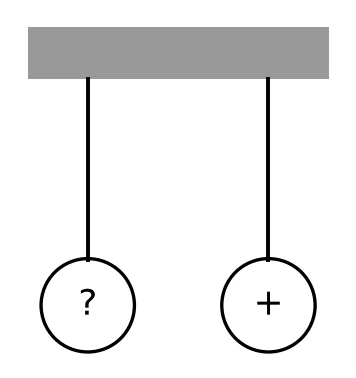 a If the left hand sphere swings towards the right hand sphere, what can you say about the charge on the left sphere and why?(2)
Show the memo (2 ticks)Memo
- ✓PrincipleLike charges repel each other and opposite charges attract each other.
1 mark · Explain charging and polarisation
- ✓AnswerThe positive sphere attracts the left sphere. The force between unlike charges is attractive, so the left sphere must be negatively charged.
1 mark · Explain charging and polarisation
- ✓
5. Question WE1 · Siyavula Grade 10 Physical Sciences, 16.2 Two kinds of charge, Worked example 1 · 3 marks
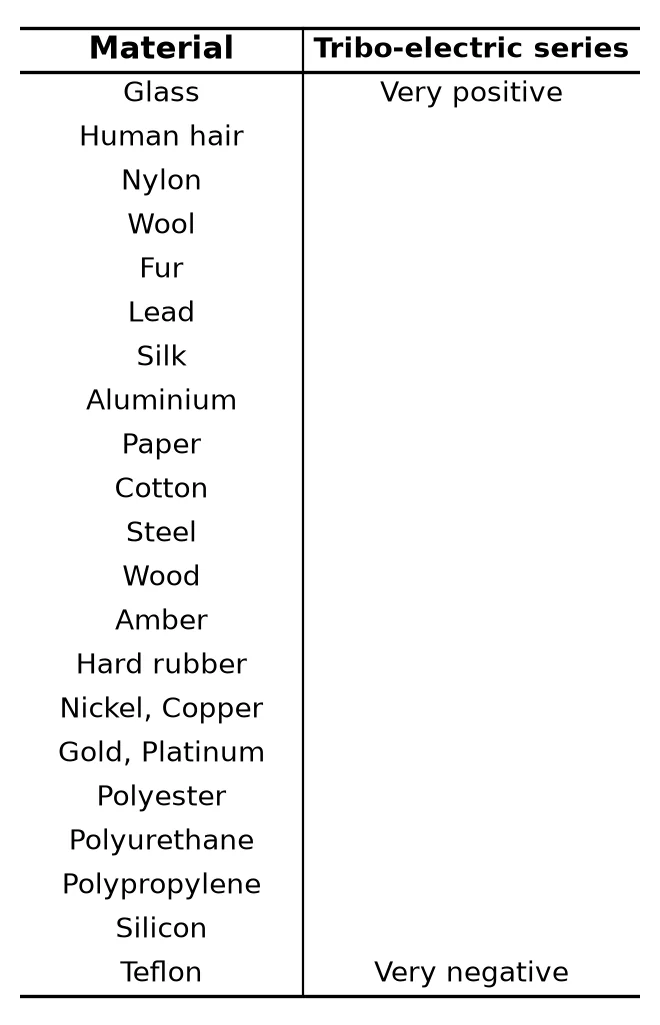 WE1 If you have a cotton cloth and a silk cloth and you rub them together, which becomes negatively charged? Use the tribo-electric series below.(3)
Show the memo (3 ticks)Memo
- ✓Position in the seriesSilk is above cotton in the tribo-electric series, so silk is more positive in the series than cotton.
1 mark · Explain charging and polarisation
- ✓Electron transferWhen two materials are rubbed, the more negative one in the series gains electrons and the more positive one loses electrons: silk loses electrons and cotton gains electrons.
1 mark · Explain charging and polarisation
- ✓AnswerThe cotton gains electrons, so it has an excess of electrons and becomes negatively charged.
1 mark · Explain charging and polarisation
- ✓
6. Question 7.2 · November 2022 · Paper 1 · National (DBE) · 1 mark
A charged sphere M is suspended from a ceiling by a light inextensible, insulated string.
Another charged sphere N, of mass kg and carrying a charge of C, hangs STATIONARY vertically below sphere M. The centres of the spheres are m apart, as shown in the diagram below.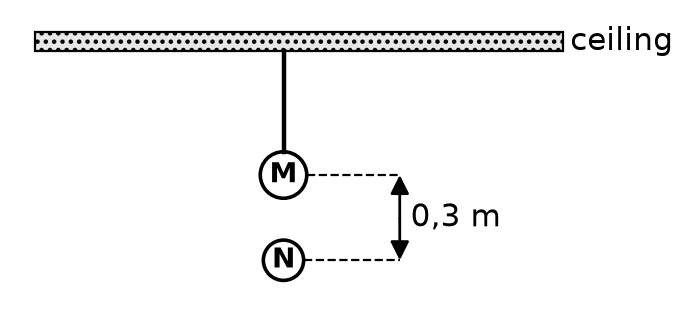 7.2 State whether the charge on sphere M is POSITIVE or NEGATIVE.(1)
Show the memo (1 tick)Memo
- ✓Polarity of MNegative
1 mark · Explain charging and polarisation
- ✓
Free on Android
Know exactly which skill is costing you marks.
Mark past papers tick by tick in the NavyBlue app. It remembers every mark you lose, shows you the skills to fix first, and picks your next questions.
Get NavyBlue free on Google Play
