Grade 11 Physical Sciences · Electricity and Magnetism · Paper 1 (Physics)
Electrostatics Grade 11
Real Electrostatics past paper questions and answers from 2023 to 2025, with each memo split into the ticks examiners give. Try one, mark yourself, and see exactly which skill cost you marks.
- past paper questions
- 152 past paper questions
- skills
- 8 skills
- videos
- 8 videos
Try a Electrostatics exam question
No sign-up. Takes 3 minutes.
Question 1.7 · November 2025 · Paper 1 · National (DBE) · 2 marks
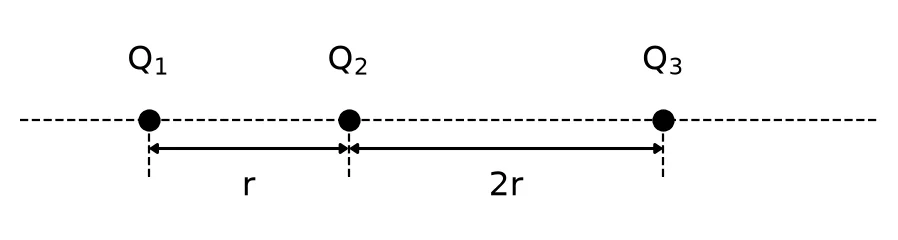
The magnitude of the charge on is q. The net electrostatic force on charge is zero.
What is the magnitude of charge in terms of q?(2)
Work it out on paper first. Then mark yourself with the official memo, one tick at a time.
Electrostatics skills
Each skill is one thing a memo gives a tick for. Tap one for its own questions, notes and videos.
- Draw a free-body or force diagramDraw every force acting on an object as a labelled arrow, for example weight, normal force, friction and applied force on a box.45 past paper questions · 3 videos
- State electrostatics laws and definitionsState Coulomb's law, conservation of charge or charge quantisation in full, or define an electric field.37 past paper questions · 3 videos
- Calculate shared charge and electrons transferredFind the charge on identical spheres after they touch using Q = (Q₁ + Q₂)/2, or count electrons moved with n = Q/e.52 past paper questions · 4 videos
- Apply Coulomb's lawCalculate the force between two charges using F = kQ₁Q₂/r², and say how the force changes when the distance changes.38 past paper questions · 3 videos
- Calculate electric field strengthCalculate electric field strength using E = F/q or E = kQ/r², or the force on a charge in a field.29 past paper questions · 2 videos
- Find net electrostatic force or fieldAdd the forces or fields from two or more charges at one point to find the net force or field and its direction.32 past paper questions · 3 videos
- Draw electric field patternsDraw electric field lines around one or two charges, with arrows pointing away from positive and towards negative charges.18 past paper questions · 2 videos
- Convert unitsChange values into the units a formula needs (500 g → 0,5 kg, 25 °C → 298 K, 72 km/h → 20 m/s).21 past paper questions · 3 videos
More Electrostatics Grade 11 questions and answers
Try each one on paper before you open the memo.
4. Question 7.1 · May/June 2025 · Paper 1 · National (DBE) · 3 marks
A small negative charge q placed at a fixed distance from charged sphere Q, experiences a force F, as shown in the diagram below.
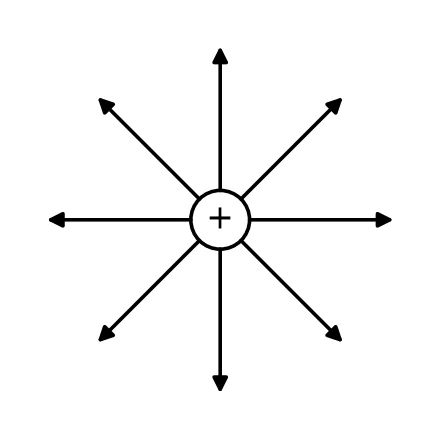
The charge q is now removed.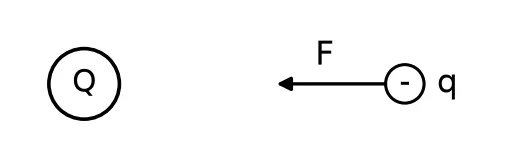 7.1 Draw the electric field pattern for the charged sphere Q.(3)
Show the memo (2 ticks)Memo
- ✓Correct shapeStraight (radial) field lines spreading out from the charge, starting on the sphere.
1 mark · Draw electric field patterns
- ✓Correct directionArrows on the field lines pointing away from the charge (Q is positive).
2 marks · Draw electric field patterns
- ✓
5. Question 1.7 · November 2024 · Paper 1 · National (DBE) · 2 marks
1.7 Two small identical spheres, each with mass m and charge +Q, are placed in a vertical cylinder. The spheres remain stationary when their centres are r metres apart, as shown in the diagram below. Ignore ALL frictional effects.
Which ONE of the following expressions can be used to CORRECTLY calculate the distance r?(2)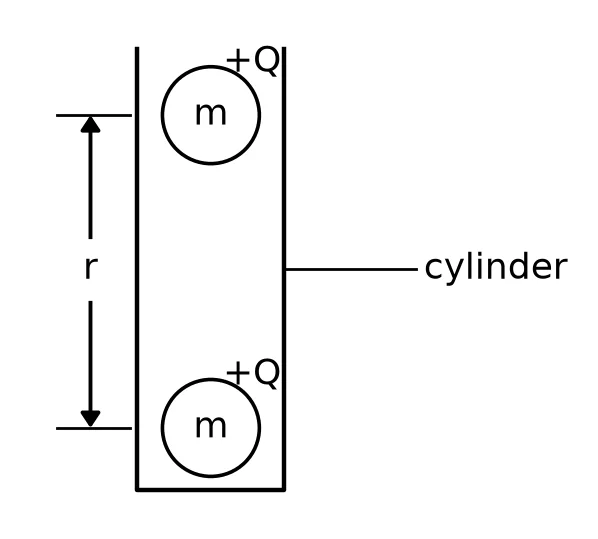
Show the memo (1 tick)Memo
- ✓Correct optionThe top sphere is stationary, so the upward electrostatic repulsion equals its weight:
, so
D is the trap: it is the same expression turned upside down.
Answer: A2 marks · Apply Coulomb's law
- ✓
6. Question 7.1 · November 2024 · Paper 1 · National (DBE) · 3 marks
P is a nC point charge. X is a point cm away from charge P, as shown in the diagram below.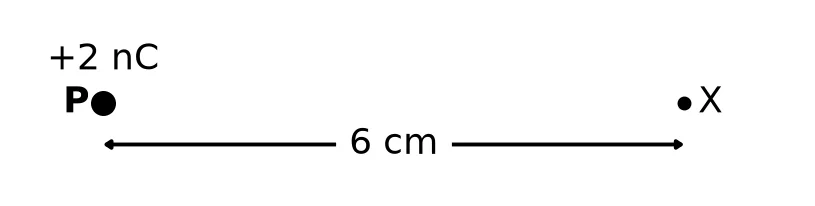 7.1 Calculate the magnitude of the electric field at X.(3)
Show the memo (3 ticks)Memo
- ✓Formula
1 mark · Calculate electric field strength
- ✓Substitution
1 mark · Calculate electric field strength
- ✓Answer N·C ( N·C)
1 mark · Calculate electric field strength
- ✓
7. Question 1.7 · May/June 2024 · Paper 1 · National (DBE) · 2 marks
Various options are provided as possible answers to the following questions. Each question has only ONE correct answer. Choose the answer and write only the letter (A–D) next to the question numbers (1.1 to 1.10).1.7 The magnitudes of electric fields generated by different point charges are measured at a fixed point. For each measurement, the distance between this fixed point and the charges are the same.
Which ONE of the following sketch graphs CORRECTLY shows the relationship between the magnitude of the electric field (E) and the magnitude of the charge (Q)?(2)Show the memo (1 tick)Memo
- ✓Choose the correct option. With r fixed, is a constant, so : a straight line through the origin.
Answer: A2 marks · Calculate electric field strength
- ✓
8. Question 7.1.1 · May/June 2024 · Paper 1 · National (DBE) · 2 marks
7.1 X is a point m away from a nC point charge. See the diagram below.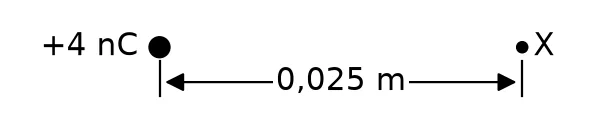 7.1.1 Draw the electric field pattern due to the nC charge.(2)
Show the memo (2 ticks)Memo
- ✓Correct shapeStraight field lines radiating out from the charge in all directions (radial pattern), evenly spaced, not crossing or touching.
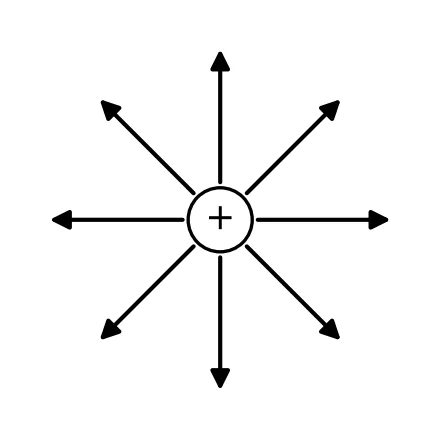
1 mark · Draw electric field patterns
- ✓Correct directionArrows point away from the charge.
1 mark · Draw electric field patterns
- ✓
9. Question 7.1 · November 2023 · Paper 1 · National (DBE) · 2 marks
Two point charges, and , each with a charge of C, are stationary on a horizontal surface. Point is r metres from charge and 2r metres from charge , as shown in the diagram below. 7.1 Describe an electric field.(2)
Show the memo (1 tick)Memo
- ✓Electric fieldElectric field is a region/space in which an electric charge experiences a force.
- ✓
10. Question 1.7 · May/June 2023 · Paper 1 · National (DBE) · 2 marks
Various options are provided as possible answers to the following questions. Each question has only ONE correct answer.1.7 Two identically charged spheres, X and Y, carry charges of +2q and −6q respectively.
Sphere X experiences an electrostatic force F to the right when the distance between their centres is r.
The spheres are brought into contact and are then returned to their original positions.
Which ONE of the following represents the magnitude of the electrostatic force that sphere X experiences now?(2)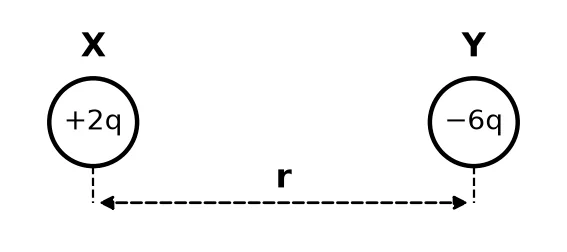
Show the memo (1 tick)Memo
- ✓Correct optionAfter contact each sphere has .
Before: . After: F\' \propto (2q)(2q) = 4q^2.
So F\' = \frac{4}{12}F = \frac{1}{3}F.
Answer: B
- ✓
Electrostatics Grade 11 videos
Short lessons from South African teachers first. Videos load only when you tap play, to save your data.
Free on Android
Know exactly which skill is costing you marks.
Mark past papers tick by tick in the NavyBlue app. It remembers every mark you lose, shows you the skills to fix first, and picks your next questions.
Get NavyBlue free on Google Play
