Grade 11 Physical Sciences · Electricity and Magnetism · Paper 1 (Physics)
Electric Circuits Grade 11
Real Electric Circuits past paper questions and answers from 2022 to 2026, with each memo split into the ticks examiners give. Try one, mark yourself, and see exactly which skill cost you marks.
- past paper questions
- 116 past paper questions
- skills
- 12 skills
- videos
- 12 videos
Try a Electric Circuits exam question
No sign-up. Takes 3 minutes.
Question 8.5 · May/June 2025 · Paper 1 · National (DBE) · 3 marks
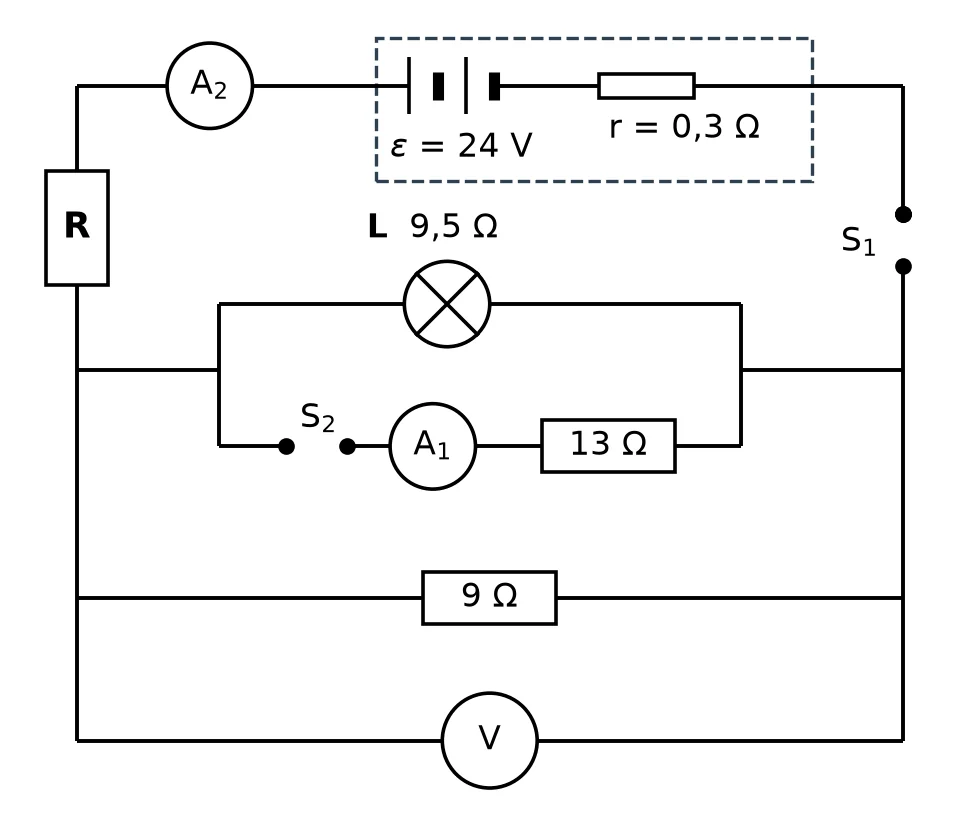
Switch is now OPENED, while switch is CLOSED.

Work it out on paper first. Then mark yourself with the official memo, one tick at a time.
Electric Circuits skills
Each skill is one thing a memo gives a tick for. Tap one for its own questions, notes and videos.
- Define circuit terms and Ohm's lawGive the exact meaning of circuit words like current, potential difference, emf and resistance, or state Ohm's law.38 past paper questions · 3 videos
- Use series and parallel circuit rulesUse how current and voltage behave in series and parallel circuits to find meter readings (current is the same everywhere in a series circuit).68 past paper questions · 3 videos
- Calculate equivalent resistanceCalculate the total resistance of resistors in series (R = R₁ + R₂) or parallel (1/R = 1/R₁ + 1/R₂), for example two 4 Ω in parallel give 2 Ω.42 past paper questions · 3 videos
- Apply Ohm's lawUse R = V/I to find current, voltage or resistance (a 12 V battery across a 4 Ω resistor gives 3 A).64 past paper questions · 3 videos
- Calculate electrical power and energyCalculate electrical power with P = VI, P = I²R or P = V²/R, or energy used and its cost in kWh (a 2 kW kettle for 1 hour).32 past paper questions · 4 videos
- Use emf and internal resistanceUse emf = I(R + r) to find a battery's emf, internal resistance, current or lost volts.38 past paper questions · 3 videos
- Explain changes in a circuitPredict and explain how meter readings change when a switch is closed or a resistor is added (adding a parallel resistor lowers total resistance).32 past paper questions · 3 videos
- Identify variables in an investigationName the independent, dependent and controlled variables in an experiment (in a test of temperature on reaction rate, temperature is independent).50 past paper questions · 3 videos
- Write investigative question or conclusionWrite an investigative question, hypothesis or conclusion that links two variables (How does the length of a wire affect its resistance?).38 past paper questions · 3 videos
- Describe and evaluate an experimentName apparatus, describe or explain steps of a method, and give safety precautions (repeat readings and work out an average).18 past paper questions · 3 videos
- Plot a graph from dataPlot results on a graph with labelled axes, units and a good scale, and draw the line or curve of best fit.7 past paper questions · 3 videos
- Read a graph of resultsRead values from a graph or table of results, or calculate a gradient (finding resistance from the gradient of a V-I graph).38 past paper questions · 3 videos
More Electric Circuits Grade 11 questions and answers
Try each one on paper before you open the memo.
4. Question 1.8 · November 2022 · Paper 1 · National (DBE) · 2 marks
Various options are provided as possible answers to the following questions. Each question has only ONE correct answer.1.8 The emf of a battery is and its internal resistance is . The battery is connected to three resistors and four voltmeters, as shown below. The resistance of the conducting wires is negligible, while the voltmeters have very high resistances.
Which ONE of the following equations represents the reading on voltmeter in terms of the readings on the other voltmeters?(2)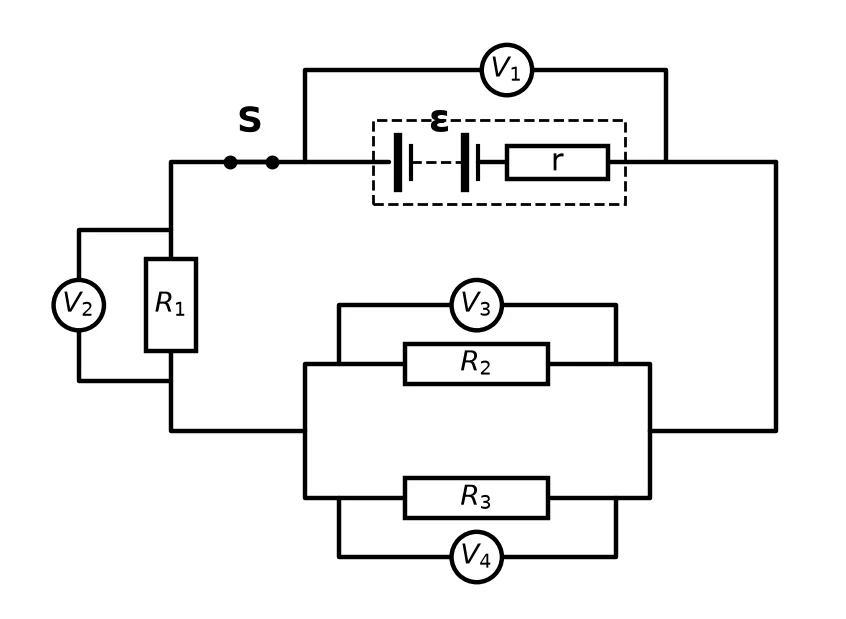
Show the memo (1 tick)Memo
- ✓Voltage in series and parallel measures the potential difference across the battery terminals, i.e. across the whole external circuit.
and are in parallel, so (the potential difference across the parallel combination).
is in series with the parallel combination, so .
Answer: A2 marks · Use series and parallel circuit rules
- ✓
5. Question 1.8 · September 2026 · Paper 1 · Provincial · 2 marks
Various options are provided as possible answers to the following questions. Choose the answer and write only the letter (A–D) next to the question numbers (1.1 to 1.10) in the ANSWER BOOK, for example 1.11 B.1.8 A battery of emf and negligible internal resistance is connected in a circuit, as shown in the diagram below. The resistances of and are high.
Which ONE of the following combinations about the ammeter readings will be CORRECT when switch S is open and when switch S is closed?(2)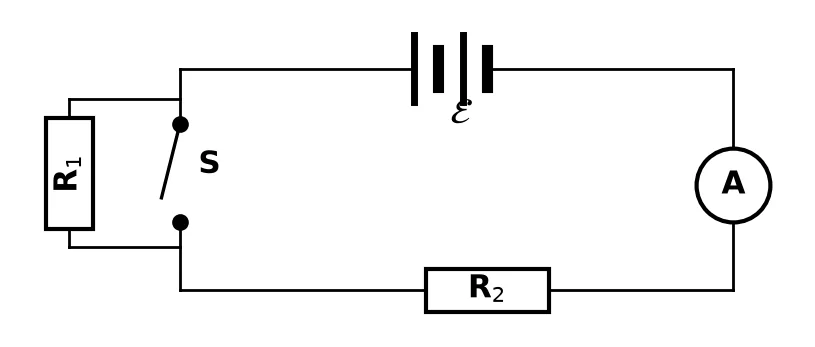
Show the memo (1 tick)Memo
- ✓Choose the correct optionSwitch open: , and the ammeter are in series, so the same current flows through and and the ammeter reads it.
Switch closed: the switch is connected across and has (almost) no resistance, so it short-circuits . The current takes the switch path, no current flows in , and the ammeter reads only the current through .
C is the trap: it forgets that a closed switch across a resistor bypasses it.
Answer: D2 marks · Use series and parallel circuit rules
- ✓
6. Question 8.1 · September 2026 · Paper 1 · Provincial · 2 marks
Grade 12 learners conducted an experiment to determine the emf, and the internal resistance of a battery by connecting three resistors one after the other in the circuit diagram below. Each time they read and recorded the reading of the voltmeter and ammeter.
The readings obtained are recorded in the table below.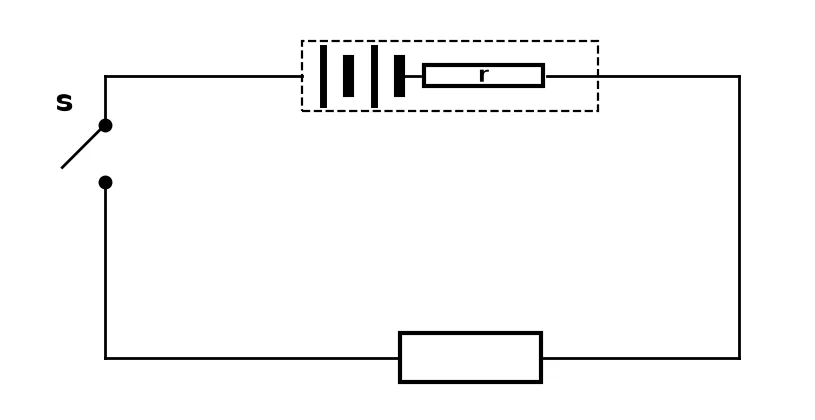
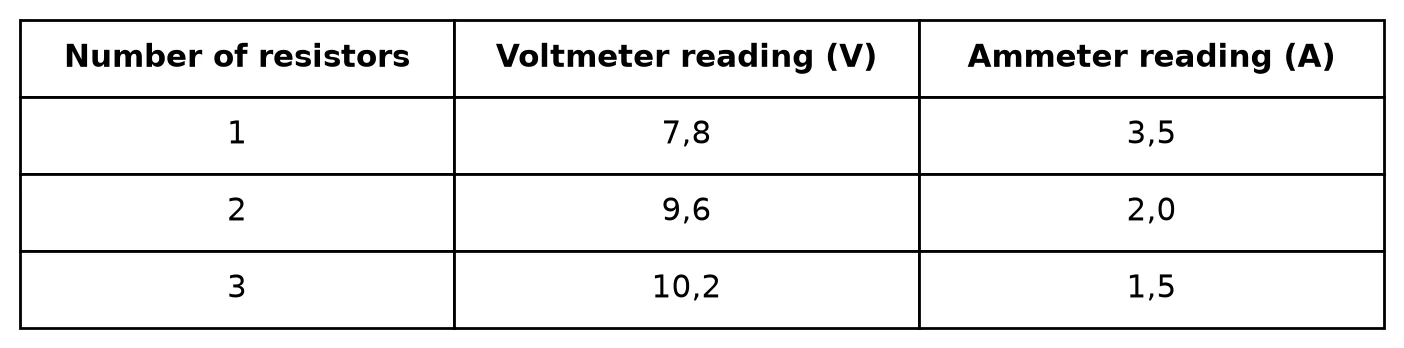 8.1 Sketch this circuit in your ANSWER BOOK. Show in your sketch where the learners connected the ammeter and the voltmeter.(2)
Show the memo (2 ticks)Memo
- ✓Ammeter in seriesThe ammeter is connected in series in the circuit (in the main line).
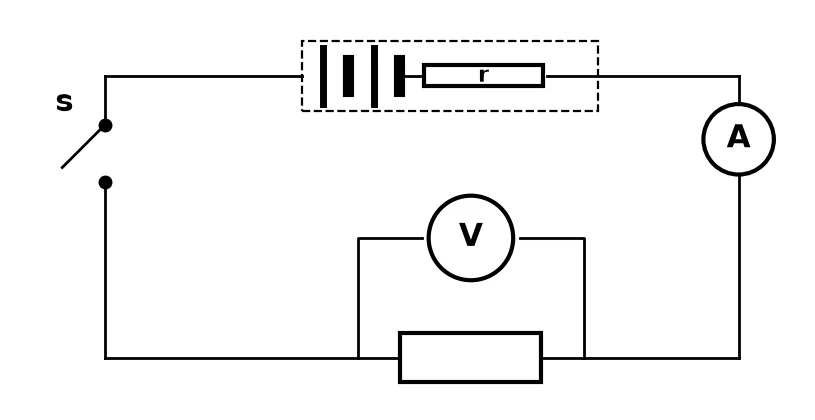
- ✓Voltmeter in parallelThe voltmeter is connected in parallel across the resistor(s) (or across the battery).
- ✓
7. Question 1.8 · September 2026 · Paper 1 · Provincial · 2 marks
Four options are provided as possible answers to the following questions. Choose the answer and write only the letter (A–D) next to the question numbers (1.1 to 1.10) in the ANSWER BOOK.1.8 The circuit diagram below shows four identical bulbs, 1, 2, 3, and 4, connected to a cell. The currents through bulbs 1, 2, 3, and 4 are , , , and , respectively.
Which ONE of the following expressions is correct for the current passing through light bulb 4?(2)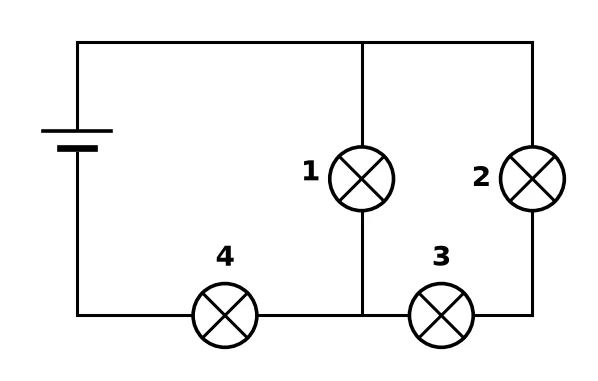
Show the memo (1 tick)Memo
- ✓Correct optionBulb 4 carries the total current. It splits between bulb 1 (resistance R) and the branch with bulbs 2 and 3 in series (resistance 2R). The parallel branches have the same potential difference, so the branch with half the resistance gets twice the current: , and .
Answer: D2 marks · Use series and parallel circuit rules
- ✓
8. Question 9.2 · September 2026 · Paper 1 · Provincial · 2 marks
Three resistors and a W electrical apparatus are connected to a V battery with an internal resistance r as shown in the diagram below. The ammeter A has a reading of A. Switch S is open.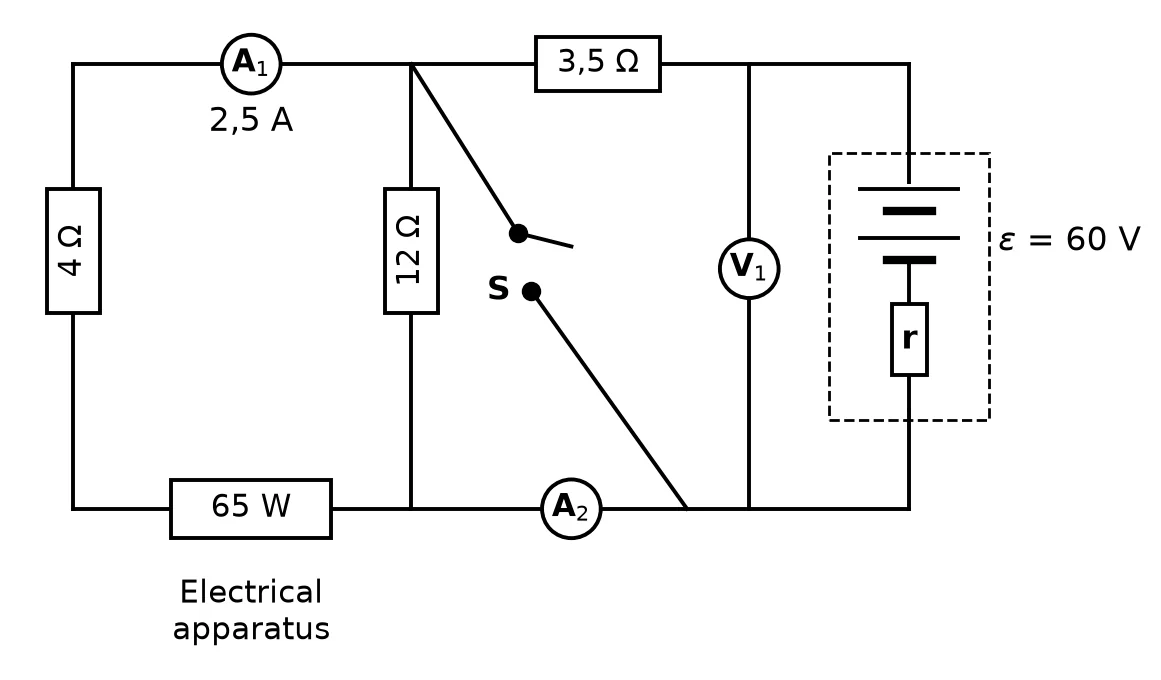 9.2 How does the reading on ammeter A compare to the reading on ammeter A? Choose from LARGER THAN, SMALLER THAN or THE SAME AS.
Explain the answer(2)Show the memo (2 ticks)Memo
- ✓ComparisonSMALLER THAN
- ✓ExplanationA is in a parallel connection, A is the total current.
- ✓
9. Question 1.9 · September 2026 · Paper 1 · Provincial · 2 marks
Four options are provided as possible answers to the following questions. Each question has only ONE correct answer. Choose the answer and write down ONLY the letter (A–D) next to the question number (1.1–1.10) in the ANSWER BOOK, e.g. 1.11 E.1.9 Four voltmeters, , , and , are connected in a circuit, as shown in the diagram below.
Which voltmeter(s) will have the same reading as voltmeter when the switch S is open?(2)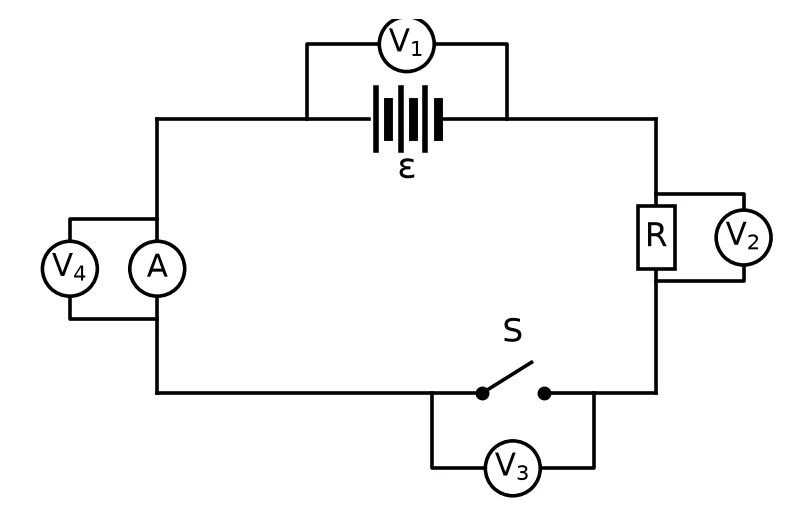
Show the memo (1 tick)Memo
- ✓Choose the correct optionWith S open there is no current in the circuit.
reads the emf of the battery (no current, so no lost volts).
: no current through R, so .
: across the ammeter, which has (almost) no resistance and no current, so it reads 0.
: across the open switch. The gap is the only place where the potential drops, so reads the full emf, the same as .
Answer: B2 marks · Use series and parallel circuit rules
- ✓
10. Question 1.9 · November 2025 · Paper 1 · Provincial · 2 marks
Various options are provided as answers to the following questions. Choose the answer and write only the letter (A–D) next to the question numbers (1.1 to 1.10) in your ANSWER BOOK, for example, 1.11 D.1.9 The battery in the circuit diagram below has a potential difference of V and negligible internal resistance. Two voltmeters, and , are connected to the circuit, as shown in the diagram below.
When the switch is open, the CORRECT readings on and will be as follows:(2)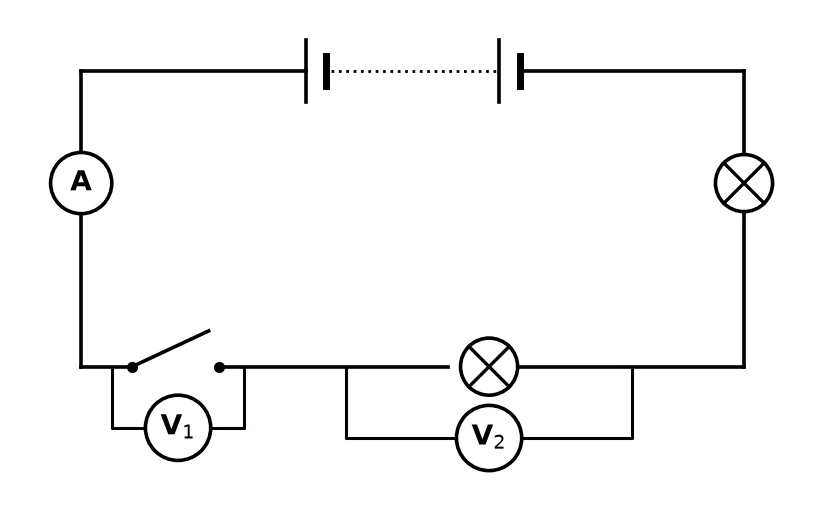
Show the memo (1 tick)Memo
- ✓Correct option CWith the switch open no current flows, so there is no potential difference across the bulb: V. is connected across the gap of the open switch, so it is joined to both battery terminals through the rest of the circuit and reads the full V.
Answer: C2 marks · Use series and parallel circuit rules
- ✓
Electric Circuits Grade 11 videos
Short lessons from South African teachers first. Videos load only when you tap play, to save your data.
Free on Android
Know exactly which skill is costing you marks.
Mark past papers tick by tick in the NavyBlue app. It remembers every mark you lose, shows you the skills to fix first, and picks your next questions.
Get NavyBlue free on Google Play
