Grade 10 Physical Sciences · Waves, Sound and Light
Use the wave equation
Use v = fλ or f = 1/T to find a wave's speed, frequency or wavelength (a 340 m/s sound wave at 170 Hz has λ = 2 m).
- past paper questions use it
- 17 past paper questions use it
- videos
- 4 videos
Learn it: use the wave equation
Pick one and watch it, then try the questions below. Videos load only when you tap play.
Now try it on a real exam question
No sign-up. Takes 3 minutes.
Question 9.4 · November 2024 · Paper 1 · National (DBE) · 2 marks
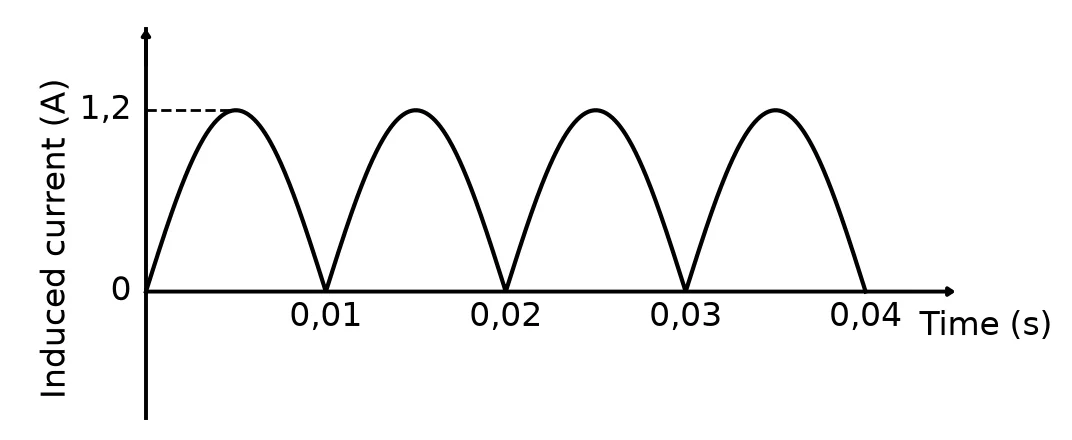
Work it out on paper first. Then mark yourself with the official memo, one tick at a time.
More past paper questions: use the wave equation
Work each one out first, then open the memo and check every tick.
3. Question 6.3.1 · November 2024 · Paper 1 · National (DBE) · 3 marks
A stationary listener, standing on the roadside, records the wavelength of the sound emitted by the siren of a police car travelling at a constant velocity.
In the wavelength-time graph below, NOT drawn to scale, is the wavelength of the sound recorded by the listener and is the wavelength of the sound emitted by the siren.
Take the speed of sound in air to be m·s.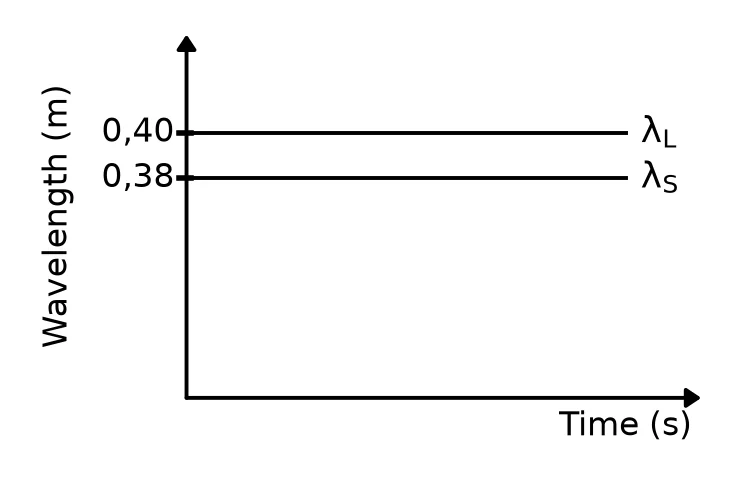 6.3 Calculate the:6.3.1 Frequency of the sound emitted by the siren(3)
Show the memo (3 ticks)Memo
- ✓Formula
1 mark · Use the wave equation
- ✓Substitution
1 mark · Use the wave equation
- ✓Answer Hz
1 mark · Use the wave equation
- ✓
4. Question 6.3 · May/June 2024 · Paper 1 · National (DBE) · 4 marks
A stationary listener records the frequency of the sound emitted by the siren of a police car. When the car which is travelling at a constant velocity of m·s, approaches the listener, the recorded frequency is Hz. The car passes the listener at time and then moves away from the listener. The recorded frequency now is Hz.
Ignore the effects of wind.6.3 Calculate the wavelength of the sound emitted by the police siren.(4)Show the memo (4 ticks)Memo
- ✓Substitution to find
OR
Hz1 mark · Use the Doppler equation
- ✓Formula
1 mark · Use the wave equation
- ✓Substitution
1 mark · Use the wave equation
- ✓Answer with unit m
1 mark · Use the wave equation
- ✓
5. Question 1.2 · November 2023 · Paper 1 · Provincial · 2 marks
1.2 If the velocity of the wave remains constant, the ... increases when the wavelength decreases.(2)Show the memo (1 tick)Memo
- ✓Use v = f lambda with constant v. If stays constant, and are inversely proportional: when decreases, increases. The period would decrease, and the speed is given as constant.
Answer: A2 marks · Use the wave equation
- ✓
6. Question 2.4.2 · November 2023 · Paper 1 · Provincial · 3 marks
The diagram below represents a transverse wave with the frequency of Hz moving from left to right.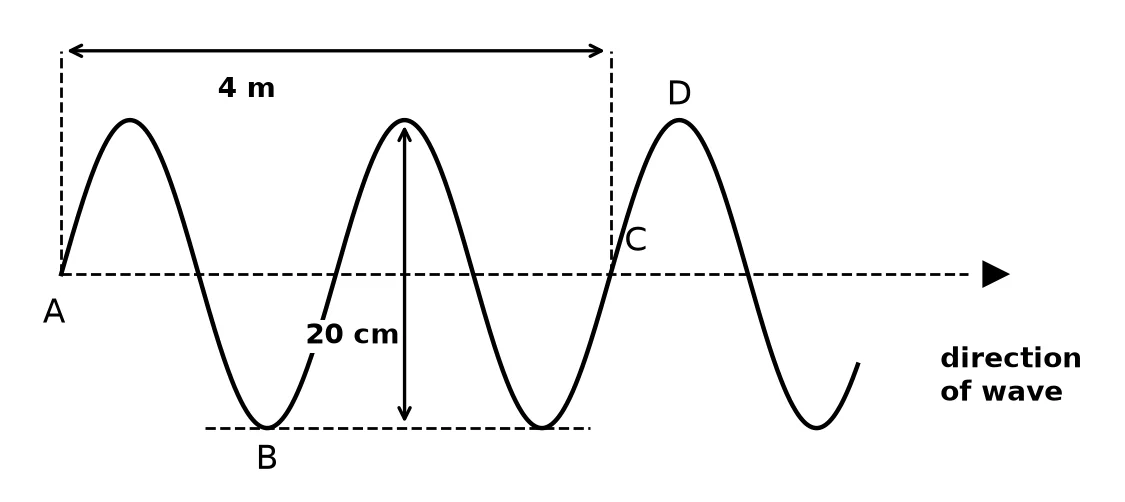 2.4 Calculate:2.4.2 The speed of the wave(3)
Show the memo (3 ticks)Memo
- ✓Formula
1 mark · Use the wave equation
- ✓Substitution
1 mark · Use the wave equation
- ✓Answer with unit m·s
1 mark · Use the wave equation
- ✓
Free on Android
Know exactly which skill is costing you marks.
Mark past papers tick by tick in the NavyBlue app. It remembers every mark you lose, shows you the skills to fix first, and picks your next questions.
Get NavyBlue free on Google Play
