Grade 10 Physical Sciences · Waves, Sound and Light · Relate pitch and loudness to waves
Pitch and Loudness Grade 10
Link pitch to frequency and loudness to amplitude, and explain how sound travels through different materials (a louder sound has a bigger amplitude).
- questions use it, all grades · 15 past paper, 21 practice
- 36 questions use it, all grades · 15 past paper, 21 practice
- videos
- 3 videos
Learn it: relate pitch and loudness to waves
Pick one and watch it, then try the questions below. Videos load only when you tap play.
Now try it on a real exam question
No sign-up. Takes 3 minutes.
Question 1.10 · November 2018 · Paper 1 · National (DBE) · 2 marks
Which COMBINATION is the CORRECT representation of the wave patterns with the same pitch?(2)
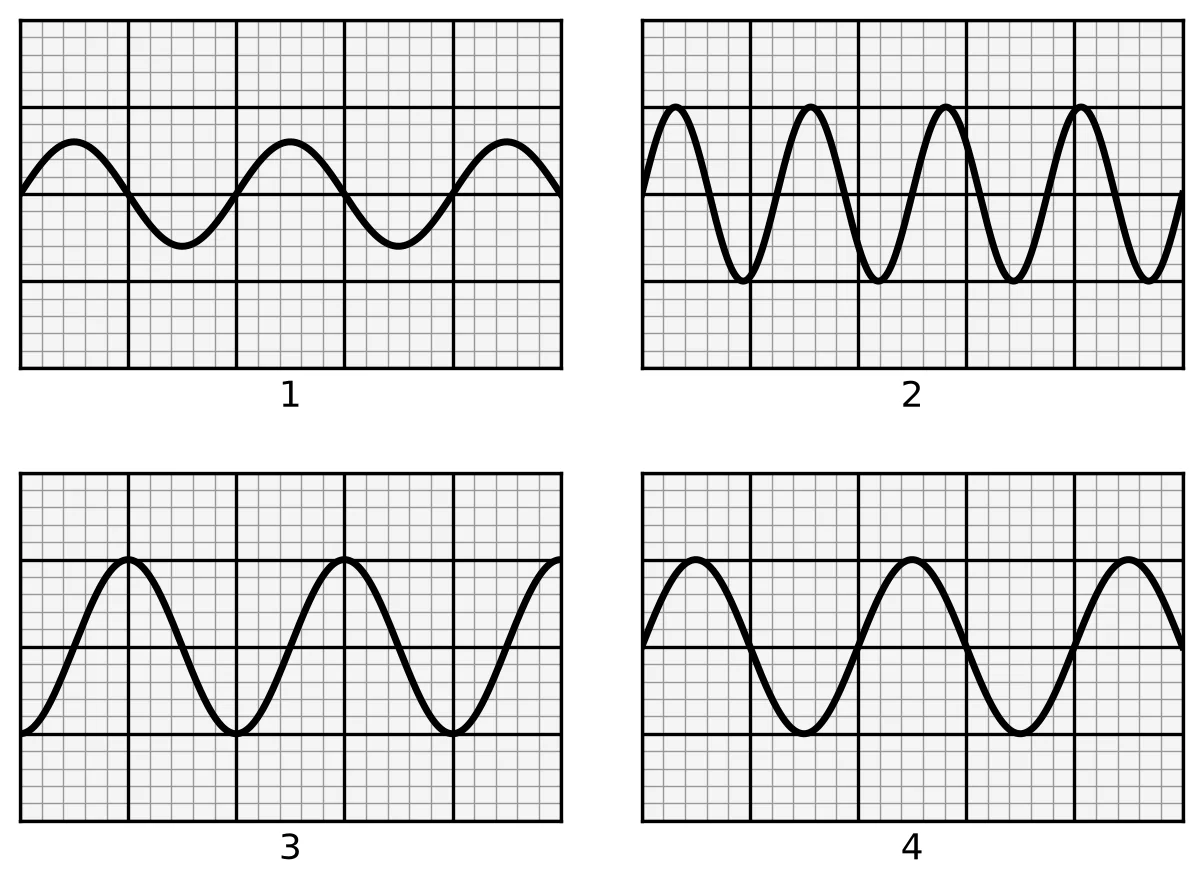
Work it out on paper first. Then mark yourself with the official memo, one tick at a time.
More questions: relate pitch and loudness to waves
Work each one out first, then open the memo and check every tick.
3. Question 1.6 · November 2017 · Paper 1 · National (DBE) · 2 marks
Various options are provided as possible answers to the following questions. Each question has only ONE correct answer. Choose the answer and write only the letter (A–D) next to the question number.1.6 The amplitude of a sound wave is increased without changing the frequency. How does this change affect the loudness and pitch of the sound?(2)Show the memo (2 ticks)Memo
- ✓Correct optionLoudness depends on amplitude, so a bigger amplitude gives a louder sound. Pitch depends on frequency, and the frequency did not change, so the pitch is unchanged.
Answer: C2 marks · Relate pitch and loudness to waves
- ✓
4. Question 1.2 · June 2024 · Paper 1 · Provincial · 2 marks
Four options are provided as possible answers to the following questions. Each question has only ONE correct answer. Choose the answer and write only the letter (A–D) next to the question number (1.1–1.5) in the ANSWER BOOK, for example 1.6 E.1.2 Which ONE of the following is CORRECT for sound waves?(2)Show the memo (2 ticks)Memo
- ✓Correct optionSound is a longitudinal wave: the particles of the medium vibrate parallel to the direction the wave moves (compressions and rarefactions).
A is wrong: sound travels fastest in solids and slowest in gases.
C is wrong: sound travels faster at higher temperatures.
D is wrong: sound needs a medium, so it cannot travel through a vacuum.
Answer: B2 marks · Relate pitch and loudness to waves
- ✓
5. Question 1.3 · June 2023 · Paper 1 · Provincial · 2 marks
Four options are provided as possible answers to the following questions. Each question has only ONE correct answer.1.3 The amplitude and frequency of a sound wave are both DECREASED. How do these changes affect the loudness and the pitch of the sound?(2)Show the memo (2 ticks)Memo
- ✓Correct optionLoudness depends on amplitude: smaller amplitude, softer sound (loudness decreased). Pitch depends on frequency: lower frequency, lower pitch (pitch lowered).
Answer: C2 marks · Relate pitch and loudness to waves
- ✓
6. Practice · Siyavula Grade 10 Physical Sciences · Ex 10.2 · 2 marks
What is the approximate range of audible frequencies for a healthy human?(2)Show the memo (2 ticks)Memo
- ✓Correct optionHumans hear from about Hz to about Hz ( kHz). Below this is infrasound and above it is ultrasound.
Answer: B2 marks · Relate pitch and loudness to waves
Question adapted from Siyavula Education (CC BY 3.0) · Solution by NavyBlue
- ✓
Free on Android
Know exactly which skill is costing you marks.
Mark past papers tick by tick in the NavyBlue app. It remembers every mark you lose, shows you the skills to fix first, and picks your next questions.
Get NavyBlue free on Google Play