Grade 10 Physical Sciences · Waves, Sound and Light · Apply superposition of pulses
Superposition of Pulses Grade 10
Add two pulses that meet to find the combined pulse, and say if the interference is constructive or destructive (two 2 cm crests make 4 cm).
- questions use it, all grades · 10 past paper, 17 practice
- 27 questions use it, all grades · 10 past paper, 17 practice
- videos
- 3 videos
Learn it: apply superposition of pulses
Pick one and watch it, then try the questions below. Videos load only when you tap play.
Now try it on a real exam question
No sign-up. Takes 3 minutes.
Question 1.7 · November 2019 · Paper 1 · National (DBE) · 2 marks
Work it out on paper first. Then mark yourself with the official memo, one tick at a time.
More questions: apply superposition of pulses
Work each one out first, then open the memo and check every tick.
3. Question 1.1 · June 2024 · Paper 1 · Provincial · 2 marks
Four options are provided as possible answers to the following questions. Each question has only ONE correct answer. Choose the answer and write only the letter (A–D) next to the question number (1.1–1.5) in the ANSWER BOOK, for example 1.6 E.1.1 Pulse A, moving to the right, with an amplitude of Y metres overlaps with Pulse B, moving to the left, with an amplitude of ½ Y metres, as shown in the diagram below.
Which of the following combinations will be CORRECT when the pulses meet at the same point in the medium?(2)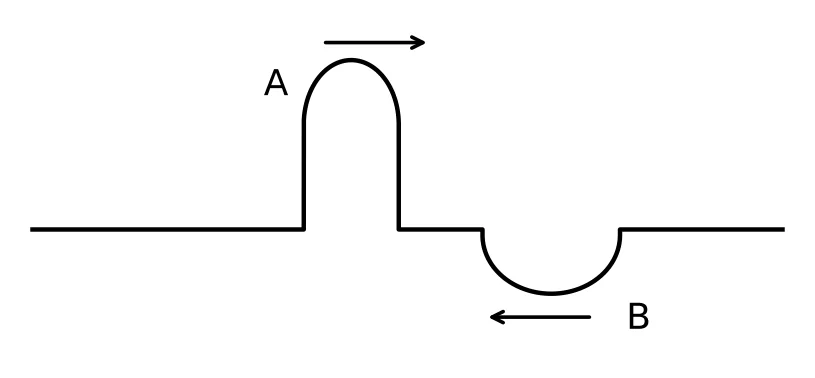
Show the memo (2 ticks)Memo
- ✓Correct optionPulse A is a crest (upwards) and pulse B is a trough (downwards), so when they meet they cancel partly: this is destructive interference.
The resultant amplitude is the difference of the two amplitudes: .
Answer: D2 marks · Apply superposition of pulses
- ✓
4. Question 2.4.2 · June 2024 · Paper 1 · Provincial · 2 marks
A snapshot of a transverse wave is given below, the wave has a frequency of Hz and is moving from left to right.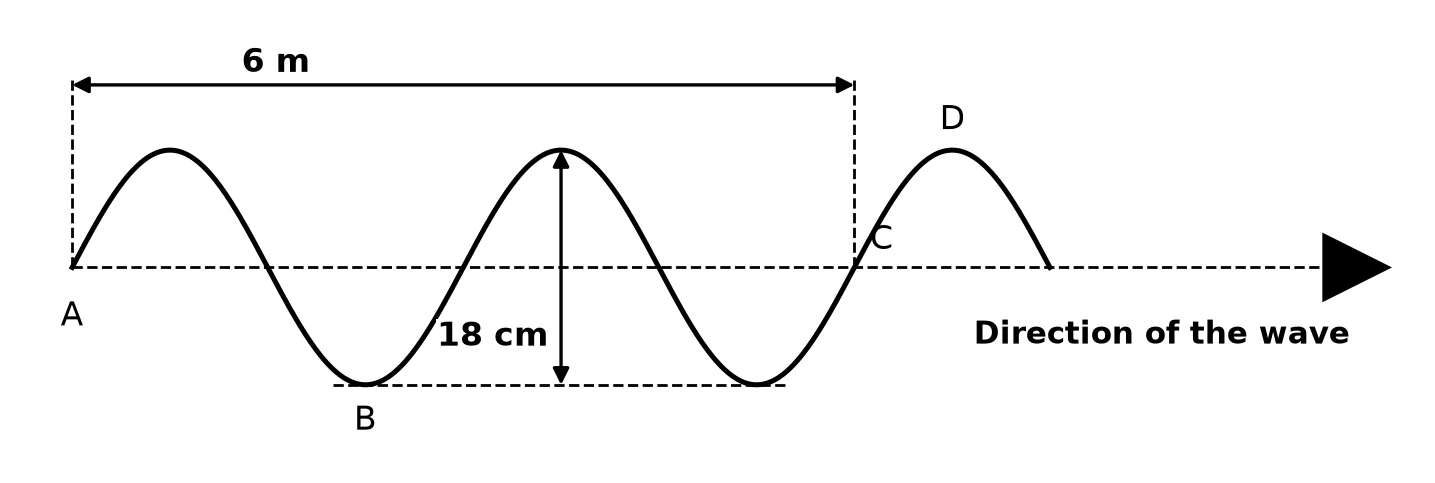 2.4 Look at this diagram of pulse D and pulse A (from a different transverse wave which is moving from right to left). The two pulses will meet at point X and the resultant amplitude will be m.
Answer the questions that follow.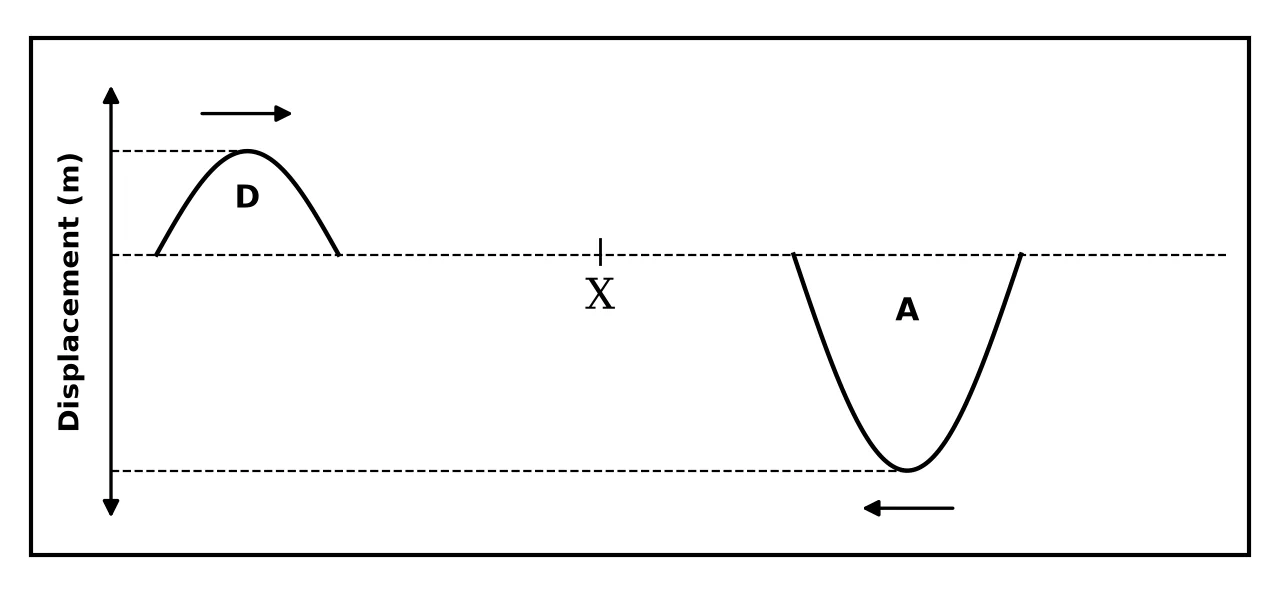 2.4.2 Draw a labelled diagram to show the resultant pulse when the two pulses meet at point X.(2)
Show the memo (2 ticks)Memo
- ✓TroughThe resultant pulse at X is a trough (below the rest position), because the trough of pulse A is much bigger than the crest of pulse D.
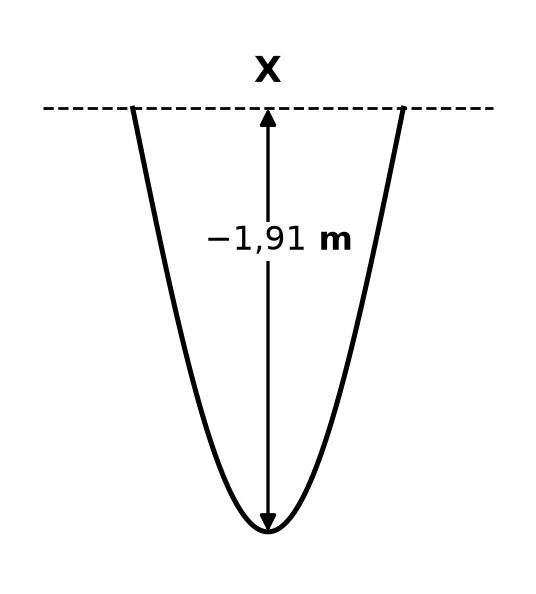
1 mark · Apply superposition of pulses
- ✓Correct amplitudeThe trough is labelled with an amplitude of m at X.
1 mark · Apply superposition of pulses
- ✓
5. Question 6.2 · June 2023 · Paper 1 · Provincial · 3 marks
Destructive interference takes place when two pulses meet and result in a smaller amplitude disturbance. The amplitude of the resulting pulse is the sum of the amplitudes of the two initial pulses, but the one amplitude will be a negative number.6.2 Use the theory of destructive interference to draw TWO pulses of different amplitudes meeting from different directions to demonstrate this theory.(3)Show the memo (3 ticks)Memo
- ✓First pulse with directionA large pulse above the rest position (crest) moving to the right.
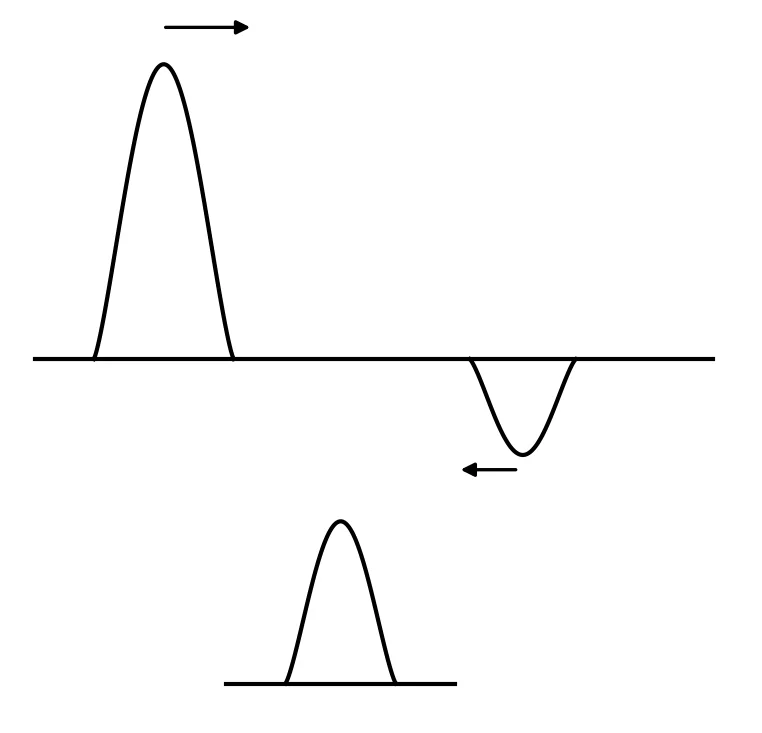
1 mark · Apply superposition of pulses
- ✓Second pulse with directionA smaller pulse below the rest position (trough) moving to the left, towards the first pulse.
1 mark · Apply superposition of pulses
- ✓Resulting pulseThe resulting pulse when they meet: a smaller pulse whose amplitude is the difference of the two amplitudes, on the side of the larger pulse.
1 mark · Apply superposition of pulses
- ✓
6. Practice · NavyBlue · 2 marks
Two pulses, A and B, travel towards each other along a rope at the same speed of . The diagram shows the rope at time . Each block on the grid is horizontally and vertically.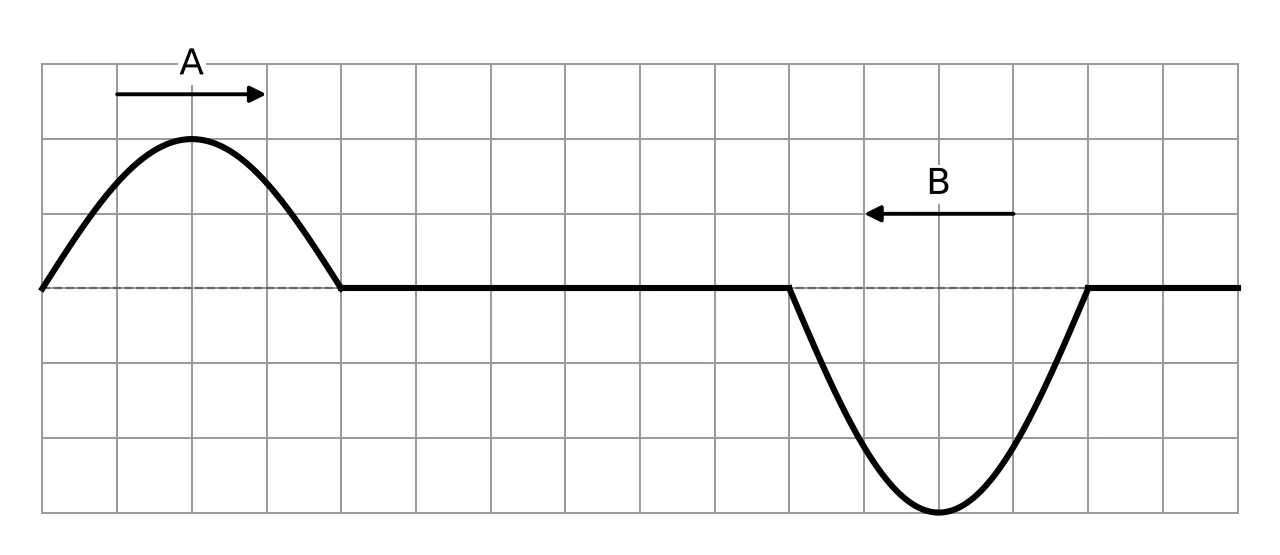 Calculate the displacement of the rope where the pulses completely overlap, and name the type of interference.(2)
Show the memo (2 ticks)Memo
- ✓Algebraic sum, that is below the rest position
1 mark · Apply superposition of pulses
- ✓TypeDestructive interference
1 mark · Apply superposition of pulses
- ✓
Free on Android
Know exactly which skill is costing you marks.
Mark past papers tick by tick in the NavyBlue app. It remembers every mark you lose, shows you the skills to fix first, and picks your next questions.
Get NavyBlue free on Google Play