Grade 12 Physical Sciences · Waves, Sound and Light
Use the Doppler equation
Use the Doppler formula to calculate the frequency a listener hears, or the speed of a moving source (a siren on a car moving at 30 m/s).
- past paper questions use it
- 11 past paper questions use it
- videos
- 4 videos
Learn it: use the doppler equation
Pick one and watch it, then try the questions below. Videos load only when you tap play.
Now try it on a real exam question
No sign-up. Takes 3 minutes.
Question 6.4 · November 2025 · Paper 1 · National (DBE) · 6 marks
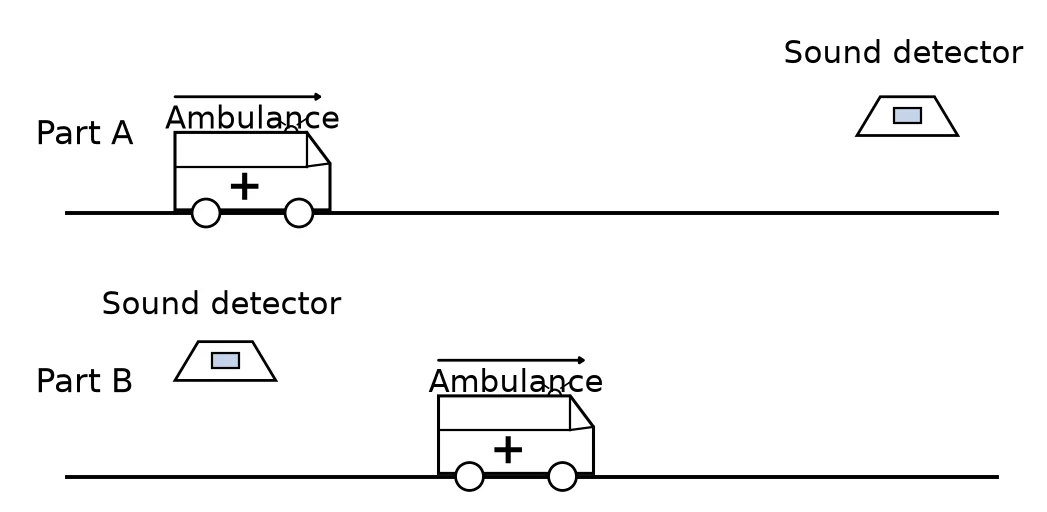
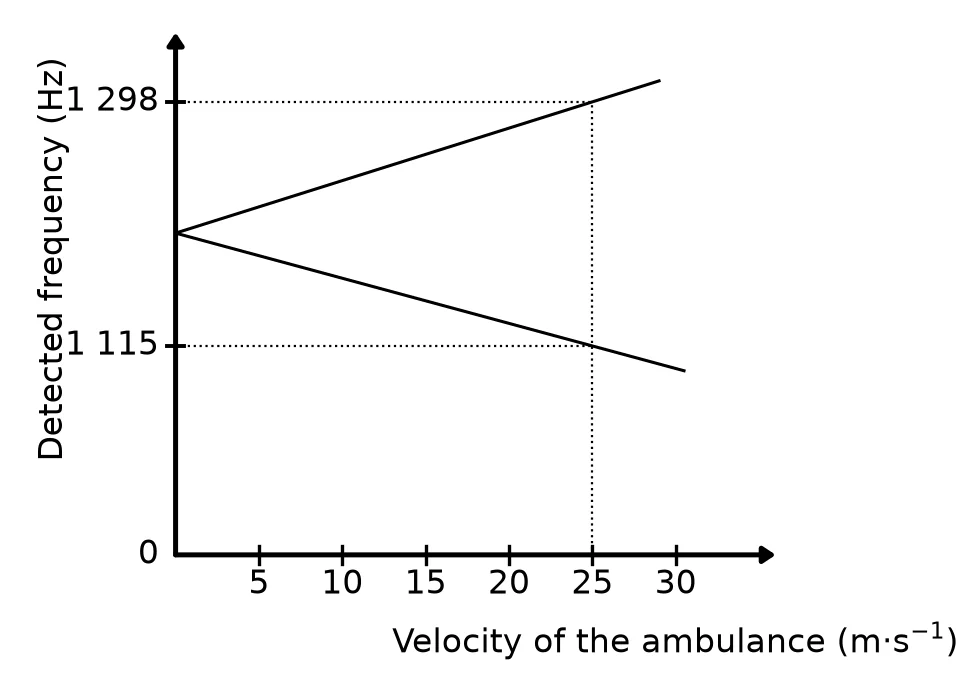
The siren of an ambulance produces sound with a constant frequency. The ambulance, with its siren on, moves towards a stationary sound detector (Part A) and away from the stationary sound detector (Part B) at constant velocities. The experiment is repeated for different velocities of the ambulance. The detected frequency is measured for EACH velocity. The results obtained are shown in the graph below.
Work it out on paper first. Then mark yourself with the official memo, one tick at a time.
More past paper questions: use the doppler equation
Work each one out first, then open the memo and check every tick.
3. Question 6.2 · May/June 2024 · Paper 1 · National (DBE) · 5 marks
A stationary listener records the frequency of the sound emitted by the siren of a police car. When the car which is travelling at a constant velocity of m·s, approaches the listener, the recorded frequency is Hz. The car passes the listener at time and then moves away from the listener. The recorded frequency now is Hz.
Ignore the effects of wind.6.2 Use the information given to calculate the speed of sound in air.(5)Show the memo (5 ticks)Memo
- ✓Formula
Any one: (towards) or (away)1 mark · Use the Doppler equation
- ✓Substitution: approaching
... equation 11 mark · Use the Doppler equation
- ✓Substitution: moving away
... equation 21 mark · Use the Doppler equation
- ✓Equating (equating to solve for v)
1 mark · Use the Doppler equation
- ✓Answer with unit m·s
1 mark · Use the Doppler equation
- ✓
4. Question 6.1.2 · May/June 2023 · Paper 1 · National (DBE) · 6 marks
6.1 A car moves at a constant velocity of m·s on a straight horizontal road TOWARDS a stationary device, which can both emit and detect sound waves.
The device emits sound waves with a frequency of Hz. These sound waves are reflected off the car and the reflected sound waves are then detected by the device, as shown in the diagram below.
Answer the questions that follow.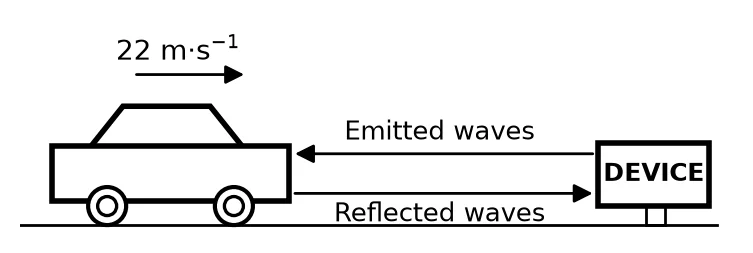 6.1.2 If the speed of sound in air is m·s, calculate the frequency of the reflected sound waves detected by the device.(6)
Show the memo (6 ticks)Memo
- ✓Formula
1 mark · Use the Doppler equation
- ✓Step 1: substitution of speeds (car as listener)
1 mark · Use the Doppler equation
- ✓Step 1: substitution of 24 000 Hz
Hz1 mark · Use the Doppler equation
- ✓Step 2: substitution of speeds (car as source)
1 mark · Use the Doppler equation
- ✓Step 2: substitution of 25 552,94 Hz
1 mark · Use the Doppler equation
- ✓Answer with unit Hz
1 mark · Use the Doppler equation
- ✓
5. Question 6.1.2 · November 2023 · Paper 1 · National (DBE) · 5 marks
6.1 An ambulance is moving away from a stationary listener with a constant velocity of m·s. The siren of the ambulance emits sound waves at a frequency of Hz. The listener detects the frequency of these sound waves to be Hz.
Ignore the effects of wind.
Answer the questions that follow.6.1.2 Use the given information to calculate the speed of sound in air.(5)Show the memo (5 ticks)Memo
- ✓Formula OR
1 mark · Use the Doppler equation
- ✓Substitution of the observed frequency
1 mark · Use the Doppler equation
- ✓Substitution of the velocities
1 mark · Use the Doppler equation
- ✓Substitution of the source frequency
1 mark · Use the Doppler equation
- ✓Answer with unit m·s
1 mark · Use the Doppler equation
- ✓
6. Question 6.5 · November 2022 · Paper 1 · National (DBE) · 2 marks
A learner investigates the relationship between the observed frequency and the frequency of sound waves emitted by a stationary source.
The learner moves towards the source at a constant velocity and records the observed frequency () for a given source frequency (). This process is repeated for different frequencies of the source, with the learner moving at the same constant velocity each time.
The graph below shows how the observed frequency changes as the frequency of sound waves emitted by the source changes.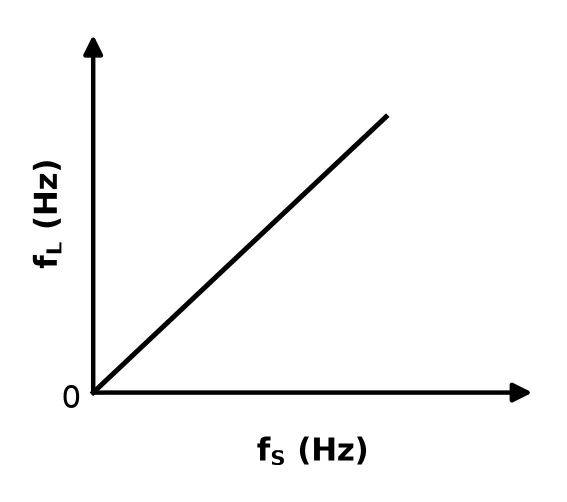 The investigation is now repeated with the learner moving at a HIGHER constant velocity towards the sound source.6.5 Copy the graph above in your ANSWER BOOK and label it as A. On the same set of axes, sketch the graph that will be obtained when the learner is moving at the HIGHER velocity. Label this graph as B.(2)
Show the memo (2 ticks)Memo
- ✓Straight line from the originGraph B is a straight line starting at the origin.
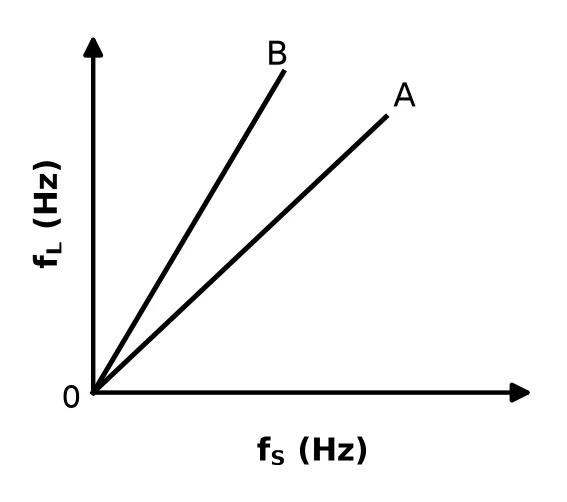
1 mark · Use the Doppler equation
- ✓Steeper gradientThe gradient of B is greater than the gradient of A.
1 mark · Use the Doppler equation
- ✓
Free on Android
Know exactly which skill is costing you marks.
Mark past papers tick by tick in the NavyBlue app. It remembers every mark you lose, shows you the skills to fix first, and picks your next questions.
Get NavyBlue free on Google Play
