Grade 12 Physical Sciences · Waves, Sound and Light
State and explain the Doppler effect
Explain why a sound's pitch seems higher as the source comes closer and lower as it moves away (an ambulance siren passing you).
- past paper questions use it
- 26 past paper questions use it
- videos
- 3 videos
Learn it: state and explain the doppler effect
Pick one and watch it, then try the questions below. Videos load only when you tap play.
Now try it on a real exam question
No sign-up. Takes 3 minutes.
Question 1.6 · November 2025 · Paper 1 · National (DBE) · 2 marks
Work it out on paper first. Then mark yourself with the official memo, one tick at a time.
More past paper questions: state and explain the doppler effect
Work each one out first, then open the memo and check every tick.
3. Question 1.6 · May/June 2025 · Paper 1 · National (DBE) · 2 marks
Various options are provided as possible answers to the following questions. Each question has only ONE correct answer. Choose the answer and write only the letter (A–D) next to the question numbers (1.1 to 1.10) in the ANSWER BOOK, e.g. 1.11 E.1.6 The absorption spectra of the same element surrounding both star A and star B are observed from Earth.
The spectral lines for star B are more red-shifted than those for star A.
How do the frequencies of the observed spectral lines and the speed of star B compare to that of star A?(2)Show the memo (1 tick)Memo
- ✓Correct optionRed shift means the observed lines move towards the red end of the spectrum: longer wavelength, LOWER frequency. A bigger red shift means the star is moving away from Earth FASTER (Doppler effect).
Answer: C2 marks · State and explain the Doppler effect
- ✓
4. Question 6.1 · May/June 2025 · Paper 1 · National (DBE) · 3 marks
A bat emits sound waves with a frequency as it flies at a constant speed towards a vertical cliff. The waves reflect off the cliff with the same frequency that they strike the cliff, and with a wavelength of m, as shown in the simplified diagram below.
Take the speed of sound in air to be m·s.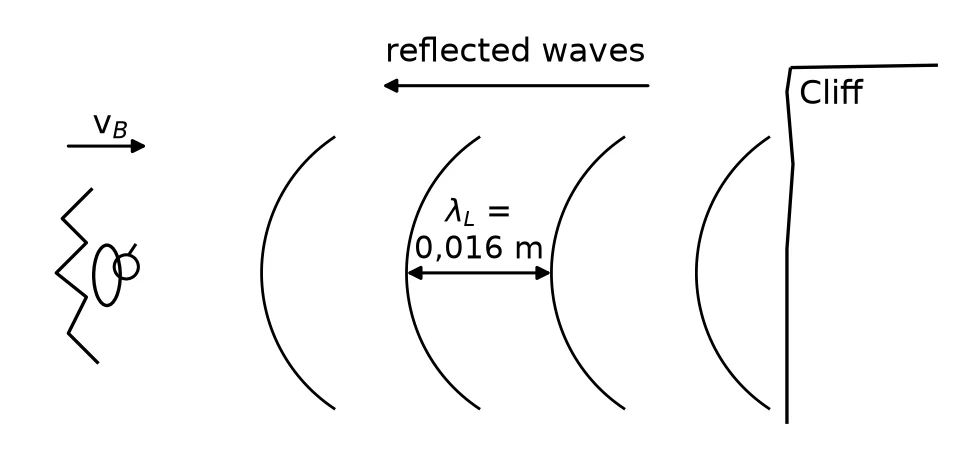 6.1 NAME and STATE the phenomenon that results in a change in frequency of the detected sound waves.(3)
Show the memo (2 ticks)Memo
- ✓NameDoppler effect
1 mark · State and explain the Doppler effect
- ✓StatementThe change in frequency (pitch) of the sound detected by a listener because the sound source and the listener have different velocities relative to the medium of sound propagation.
OR
A change in observed/detected frequency (pitch), as a result of the relative motion between a source and an observer (listener).2 marks · State and explain the Doppler effect
- ✓
5. Question 1.6 · May/June 2024 · Paper 1 · National (DBE) · 2 marks
Various options are provided as possible answers to the following questions. Each question has only ONE correct answer. Choose the answer and write only the letter (A–D) next to the question numbers (1.1 to 1.10).1.6 The spectrum of helium emitted from a star moving away from Earth is compared to the spectrum of helium found on Earth.
Which ONE of the following statements is CORRECT?
The observed spectral lines from the moving star will have a ...(2)Show the memo (1 tick)Memo
- ✓Choose the correct optionA source moving away from the observer gives a lower observed frequency (Doppler effect). Since and the speed of light is constant, a lower frequency means a longer wavelength: the lines are shifted towards red (red shift).
Answer: A2 marks · State and explain the Doppler effect
- ✓
6. Question 6.1 · May/June 2024 · Paper 1 · National (DBE) · 2 marks
A stationary listener records the frequency of the sound emitted by the siren of a police car. When the car which is travelling at a constant velocity of m·s, approaches the listener, the recorded frequency is Hz. The car passes the listener at time and then moves away from the listener. The recorded frequency now is Hz.
Ignore the effects of wind.6.1 State the Doppler effect in words.(2)Show the memo (1 tick)Memo
- ✓Statement of the Doppler effectIt is the (apparent) change in frequency/pitch of the sound (detected by a listener) because the sound source and the listener have different velocities relative to the medium of sound propagation.
OR
An (apparent) change in (observed/detected) frequency/pitch as a result of the relative motion between a source and an observer (listener).2 marks · State and explain the Doppler effect
- ✓
Free on Android
Know exactly which skill is costing you marks.
Mark past papers tick by tick in the NavyBlue app. It remembers every mark you lose, shows you the skills to fix first, and picks your next questions.
Get NavyBlue free on Google Play
