Grade 10 Physical Sciences · Matter and Materials
Write electron configurations
Write how electrons are arranged in energy levels, as s-p notation or an Aufbau diagram (sodium is 1s² 2s² 2p⁶ 3s¹).
- past paper questions use it
- 8 past paper questions use it
- videos
- 4 videos
Learn it: write electron configurations
Pick one and watch it, then try the questions below. Videos load only when you tap play.
Now try it on a real exam question
No sign-up. Takes 3 minutes.
Question 1.3 · November 2024 · Paper 2 · Provincial · 2 marks
Work it out on paper first. Then mark yourself with the official memo, one tick at a time.
More past paper questions: write electron configurations
Work each one out first, then open the memo and check every tick.
3. Question 1.5 · November 2023 · Paper 2 · Provincial · 2 marks
Four options are provided as possible answers to the following questions. Each question has only ONE correct answer. Choose the answer and write only the letter (A–D) next to the question numbers (1.1 to 1.9) in the ANSWER BOOK, e.g. 1.10 D.1.5 Which of the following represents the electron configuration of an alkaline-metal ion?(2)Show the memo (1 tick)Memo
- ✓Correct optionAlkali metals (group 1) lose one electron to form a ion. Lithium is , so is .
D () is a sodium ATOM, not an ion. B is beryllium (group 2) and C is fluorine.
Answer: A2 marks · Write electron configurations
- ✓
4. Question WE3 · Siyavula Grade 10 Physical Sciences, 4.6 Electronic configuration, Worked example 3 · 4 marks
WE3 Give the electron configuration for nitrogen (N) and draw an Aufbau diagram.(4)Show the memo (4 ticks)Memo
- ✓Number of electronsNitrogen has seven electrons.
1 mark · Write electron configurations
- ✓1s and 2sTwo electrons in the 1s orbital () and two in the 2s orbital (), leaving three electrons.
1 mark · Write electron configurations
- ✓2pThree electrons in the 2p orbitals: , one in each 2p orbital (Hund's rule).
1 mark · Write electron configurations
- ✓Answer with the Aufbau diagram shown.
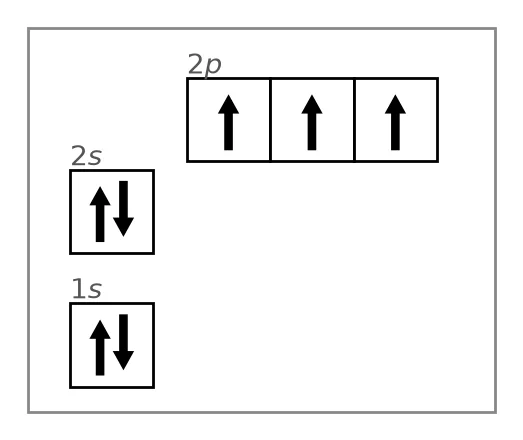
1 mark · Write electron configurations
- ✓
5. Question WE4 · Siyavula Grade 10 Physical Sciences, 4.6 Electronic configuration, Worked example 4 · 3 marks
WE4 Give the electron configuration for () and draw an Aufbau diagram.(3)Show the memo (3 ticks)Memo
- ✓Number of electronsOxygen has eight electrons. The oxygen anion has gained two electrons, so the total number of electrons is ten.
1 mark · Write electron configurations
- ✓Fill the orbitals, then , then six electrons in the 2p orbitals: .
1 mark · Write electron configurations
- ✓Answer with the Aufbau diagram shown.
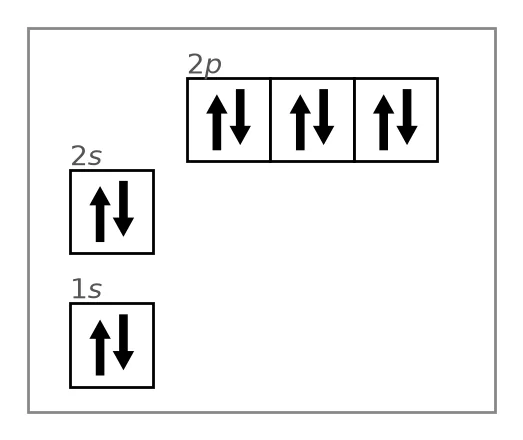
1 mark · Write electron configurations
- ✓
6. Question WE1 · Siyavula Grade 10 Physical Sciences, 6.3 Covalent bonding, Worked example 1 · 4 marks
WE1 How do hydrogen and chlorine atoms bond covalently in a molecule of hydrogen chloride?(4)Show the memo (4 ticks)Memo
- ✓Electron configurationsChlorine has 17 electrons: . Hydrogen has one electron: .
1 mark · Write electron configurations
- ✓Valence electronsChlorine has seven valence electrons, one of them unpaired. Hydrogen has one valence electron and it is unpaired.
1 mark · Draw Lewis diagrams
- ✓Bond formedEach atom needs one more electron to complete its outermost energy level, so one pair of electrons is shared between the two atoms: a single covalent bond is formed.
1 mark · Identify and compare chemical bonds
- ✓Lewis diagramH and Cl share one pair of electrons (one cross from H and one dot from Cl); chlorine keeps three lone pairs (see diagram).
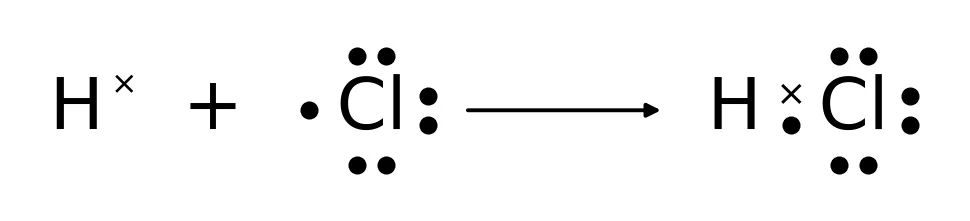
1 mark · Draw Lewis diagrams
- ✓
Free on Android
Know exactly which skill is costing you marks.
Mark past papers tick by tick in the NavyBlue app. It remembers every mark you lose, shows you the skills to fix first, and picks your next questions.
Get NavyBlue free on Google Play
