Grade 11 Physical Sciences · Mechanics
State Newton's laws and force terms
State Newton's three laws or the law of gravitation in full, or define terms like inertia, normal force, friction and weight.
- past paper questions use it
- 14 past paper questions use it
- videos
- 4 videos
Learn it: state newton's laws and force terms
Pick one and watch it, then try the questions below. Videos load only when you tap play.
Now try it on a real exam question
No sign-up. Takes 3 minutes.
Question 2.1 · November 2025 · Paper 1 · National (DBE) · 2 marks
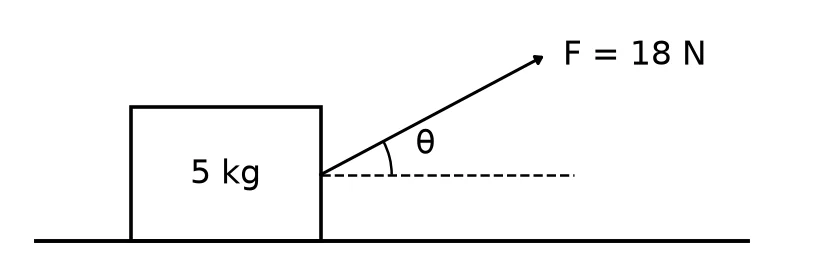
Work it out on paper first. Then mark yourself with the official memo, one tick at a time.
More past paper questions: state newton's laws and force terms
Work each one out first, then open the memo and check every tick.
3. Question 2.1 · May/June 2024 · Paper 1 · National (DBE) · 2 marks
Block A of mass kg is connected to block B of mass kg by a light inextensible string passing over a frictionless pulley. Block A is at rest on a rough horizontal table and block B hangs vertically, as shown in the diagram below.
A force F of magnitude N is applied on block A at an angle of to the horizontal, causing block A to accelerate TO THE LEFT from rest along the table.
The coefficient of kinetic friction between the surface of the table and block A is .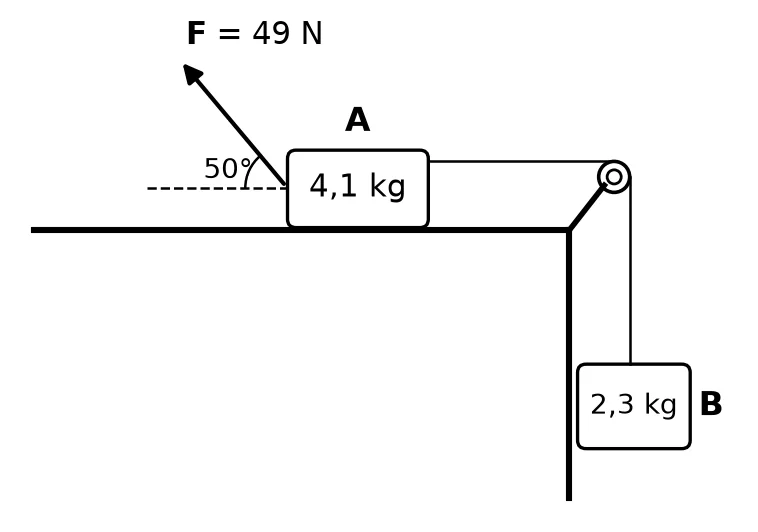 2.1 State Newton's Second Law of Motion in words.(2)
Show the memo (1 tick)Memo
- ✓Newton's Second Law in wordsWhen a resultant/net force acts on an object, the object will accelerate in the direction of the force. The acceleration is directly proportional to the resultant/net force and inversely proportional to the mass of the object.
OR
The resultant/net force acting on an object is equal to the rate of change of momentum of the object in the direction of the resultant/net force.2 marks · State Newton's laws and force terms
- ✓
4. Question 2.1 · November 2024 · Paper 1 · National (DBE) · 2 marks
In an experiment, a crate of mass kg, lying stationary on a rough horizontal table, is connected to a mass hanger by means of a light inextensible string passing over a frictionless pulley, as shown in the diagram below. Mass pieces are added to the mass hanger and the acceleration of the crate is measured. The experiment is repeated several times by adding different masses to increase the hanging mass each time.
Ignore the effects of air friction.
The results obtained were used to draw the sketch graph below.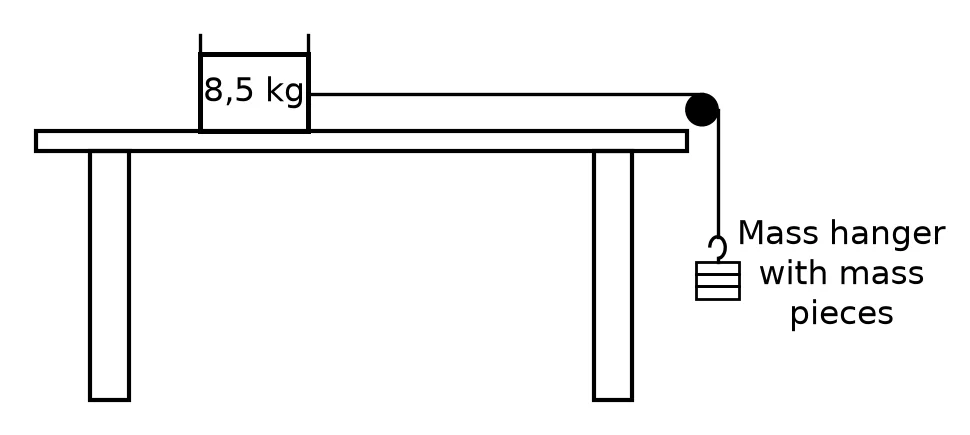
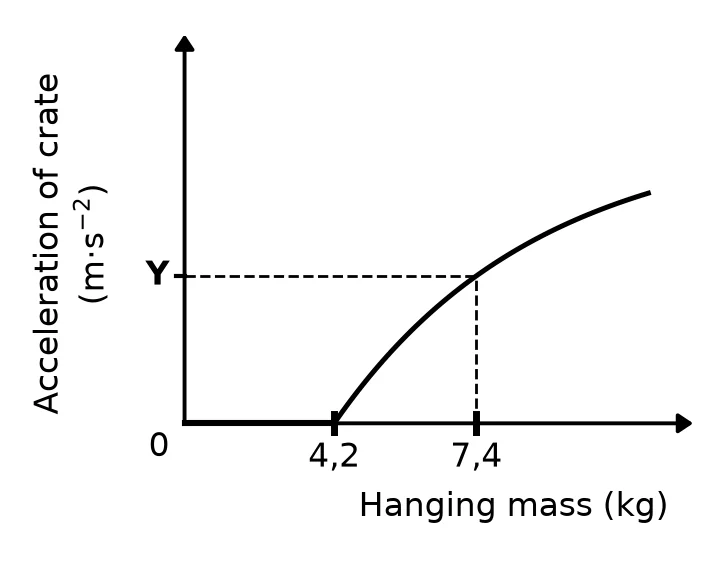 2.1 Define the term static friction.(2)
Show the memo (1 tick)Memo
- ✓Definition of static frictionThe force that opposes the tendency of motion of a stationary object relative/parallel to a surface.
2 marks · State Newton's laws and force terms
- ✓
5. Question 2.1 · November 2023 · Paper 1 · National (DBE) · 2 marks
Two blocks, , of mass kg, and , of mass kg, are connected by a light inextensible string. The blocks are held at rest on a plane which is inclined at an angle of with the horizontal.
A constant force, , acting parallel to the plane, is applied to block , as shown in the diagram below. The blocks now accelerate up the plane at m·s.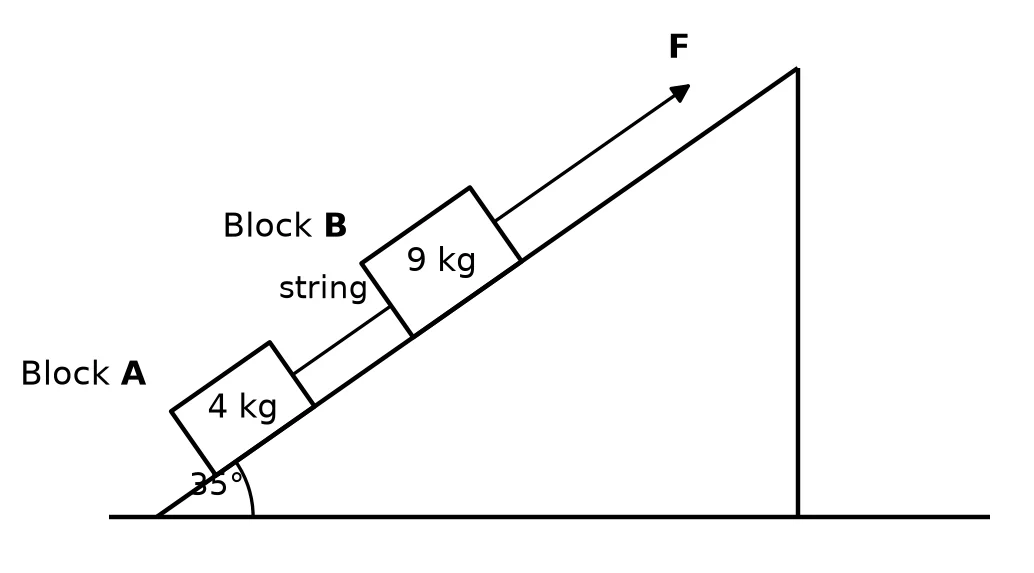 2.1 State Newton's Second Law of Motion in words.(2)
Show the memo (1 tick)Memo
- ✓Newton's Second LawWhen a resultant/net force acts on an object, the object will accelerate in the direction of the force. The acceleration is directly proportional to the resultant/net force and inversely proportional to the mass of the object.
OR
The resultant/net force acting on an object is equal to the rate of change of momentum of the object in the direction of the resultant/net force.2 marks · State Newton's laws and force terms
- ✓
6. Question 2.3 · May/June 2023 · Paper 1 · National (DBE) · 2 marks
Block A of mass m is connected to block B of mass kg by a light inextensible rope passing over a frictionless pulley. Block B is initially held at a height of m above the ground, while block A is initially stationary on the ground, as shown in the diagram below.
When block B is released, it moves vertically downwards and strikes the ground with a velocity of m·s.
Ignore the effects of friction.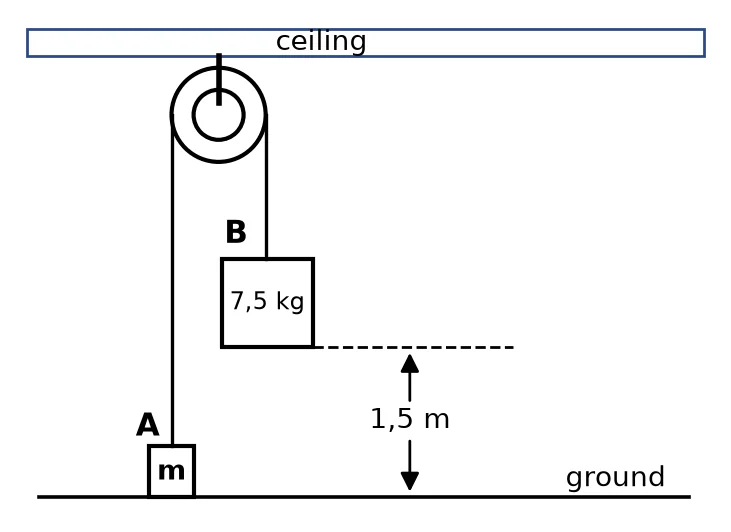 2.3 State Newton's Second Law of Motion in words.(2)
Show the memo (1 tick)Memo
- ✓Newton's Second LawWhen a resultant/net force acts on an object, the object will accelerate in the direction of the force with an acceleration that is directly proportional to the force and inversely proportional to the mass of the object.
OR
The resultant/net force acting on an object is equal to the rate of change of momentum of the object in the direction of the resultant/net force.2 marks · State Newton's laws and force terms
- ✓
Free on Android
Know exactly which skill is costing you marks.
Mark past papers tick by tick in the NavyBlue app. It remembers every mark you lose, shows you the skills to fix first, and picks your next questions.
Get NavyBlue free on Google Play
