Grade 11 Physical Sciences · Matter and Materials · Paper 2 (Chemistry)
Intermolecular Forces Grade 11
Real Intermolecular Forces past paper questions and answers from 2022 to 2026, with each memo split into the ticks examiners give. Try one, mark yourself, and see exactly which skill cost you marks.
- past paper questions
- 146 past paper questions
- skills
- 7 skills
- videos
- 7 videos
Try a Intermolecular Forces exam question
No sign-up. Takes 3 minutes.
Question 3.1 · November 2024 · Paper 2 · National (DBE) · 2 marks
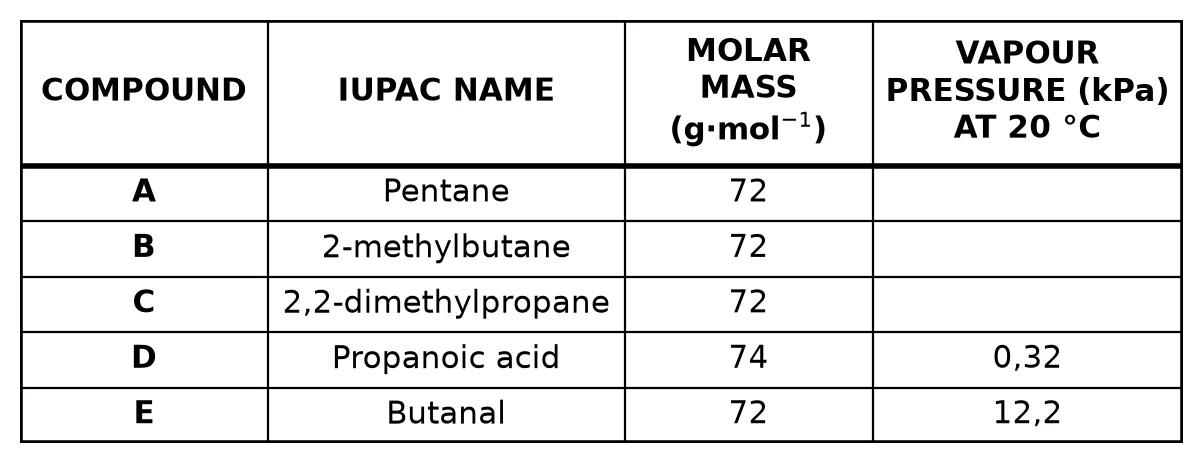
Work it out on paper first. Then mark yourself with the official memo, one tick at a time.
Intermolecular Forces skills
Each skill is one thing a memo gives a tick for. Tap one for its own questions, notes and videos.
- Define bonding and intermolecular termsGive the exact meaning of bonding words like covalent bond, ionic bond, lone pair, electronegativity and bond energy.62 past paper questions · 4 videos
- Identify the intermolecular forcesName the type of force between molecules, such as London forces, dipole-dipole forces or hydrogen bonds (water has hydrogen bonds).25 past paper questions · 3 videos
- Explain properties using intermolecular forcesExplain differences in boiling point, vapour pressure or solubility using the strength of forces between molecules (water boils higher than methane).42 past paper questions · 3 videos
- Explain organic boiling point trendsExplain why organic compounds have different boiling points using chain length, branching or functional group (longer chains boil at higher temperatures).56 past paper questions · 4 videos
- Identify variables in an investigationName the independent, dependent and controlled variables in an experiment (in a test of temperature on reaction rate, temperature is independent).50 past paper questions · 3 videos
- Write investigative question or conclusionWrite an investigative question, hypothesis or conclusion that links two variables (How does the length of a wire affect its resistance?).38 past paper questions · 3 videos
- Read a graph of resultsRead values from a graph or table of results, or calculate a gradient (finding resistance from the gradient of a V-I graph).38 past paper questions · 3 videos
More Intermolecular Forces Grade 11 questions and answers
Try each one on paper before you open the memo.
4. Question 3.1 · May/June 2023 · Paper 2 · National (DBE) · 2 marks
Learners investigate the boiling points of the four organic compounds given below.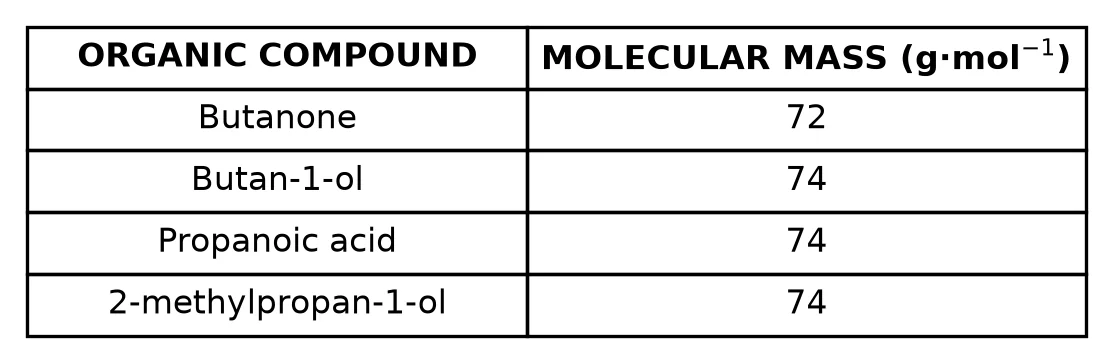 3.1 Define the term boiling point.(2)
Show the memo (1 tick)Memo
- ✓Definition of boiling pointThe temperature at which the vapour pressure (of a compound) equals atmospheric pressure.
2 marks · Define bonding and intermolecular terms
- ✓
5. Question 3.2.1 · November 2022 · Paper 2 · National (DBE) · 2 marks
3.2 The table below shows the results obtained from an experiment to determine the vapour pressure of different STRAIGHT CHAIN primary alcohols at K.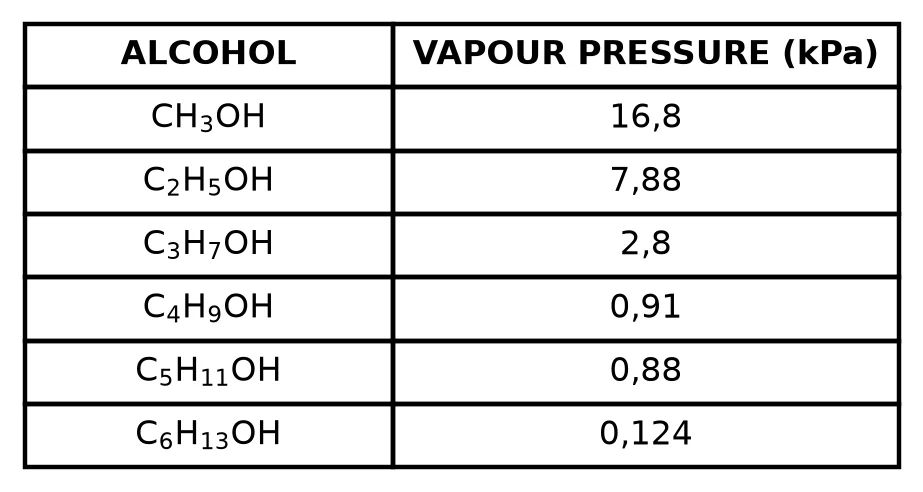 3.2.1 Define the term vapour pressure.(2)
Show the memo (1 tick)Memo
- ✓Definition of vapour pressureThe pressure exerted by a vapour at equilibrium with its liquid in a closed system.
2 marks · Define bonding and intermolecular terms
- ✓
6. Question 3.1 · May/June 2022 · Paper 2 · National (DBE) · 2 marks
Learners investigate factors that influence the boiling points of organic compounds. The boiling points of some organic compounds obtained are shown in the table below.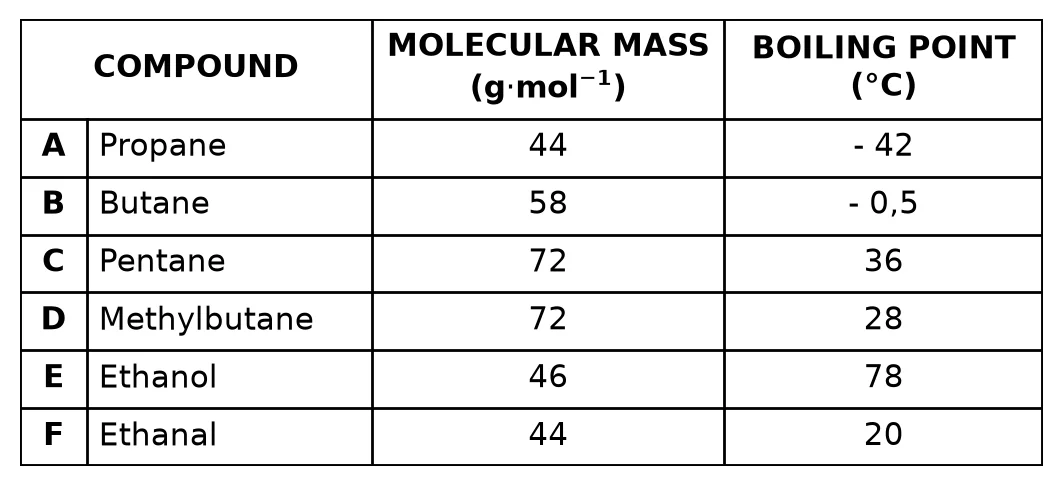 3.1 Define the term boiling point.(2)
Show the memo (1 tick)Memo
- ✓Definition of boiling pointThe temperature at which the vapour pressure of a substance equals atmospheric/external pressure.
2 marks · Define bonding and intermolecular terms
- ✓
7. Question 3.1 · September 2026 · Paper 2 · Provincial · 2 marks
Three compounds are used to investigate one of the factors that affect the boiling point of organic compounds.
The table below shows the results obtained.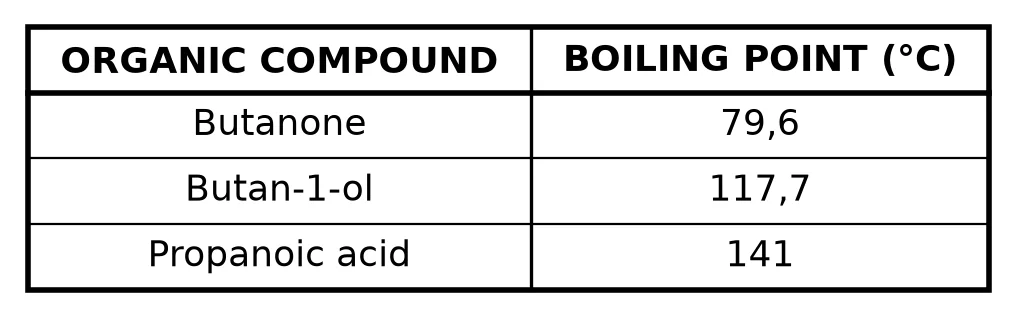 3.1 Define the term boiling point.(2)
Show the memo (1 tick)Memo
- ✓Definition of boiling pointThe temperature at which the vapour pressure of a substance equals the atmospheric pressure.
2 marks · Define bonding and intermolecular terms
- ✓
8. Question 1.3 · September 2026 · Paper 2 · Provincial · 2 marks
Four options are provided as possible answers to the following questions. Each question has only ONE correct answer. Choose the answer and write only the letter (A–D).1.3 Hexyl octanoate is added to water. This ester is insoluble in water because ...(2)Show the memo (1 tick)Memo
- ✓Explain why a large ester does not dissolve in waterHexyl octanoate has a long carbon chain (14 C atoms), so London forces dominate between its molecules. Water molecules are held by hydrogen bonds. The ester cannot form hydrogen bonds with water strongly enough to break into the water structure, so it does not dissolve.
A is wrong: esters have London forces as well as dipole-dipole forces. B is wrong: esters are covalent, there are no ionic forces. C is not a chemical reason.
Answer: D
- ✓
9. Question 3.1 · September 2026 · Paper 2 · Provincial · 2 marks
The boiling points of organic compounds at a specific pressure are compared.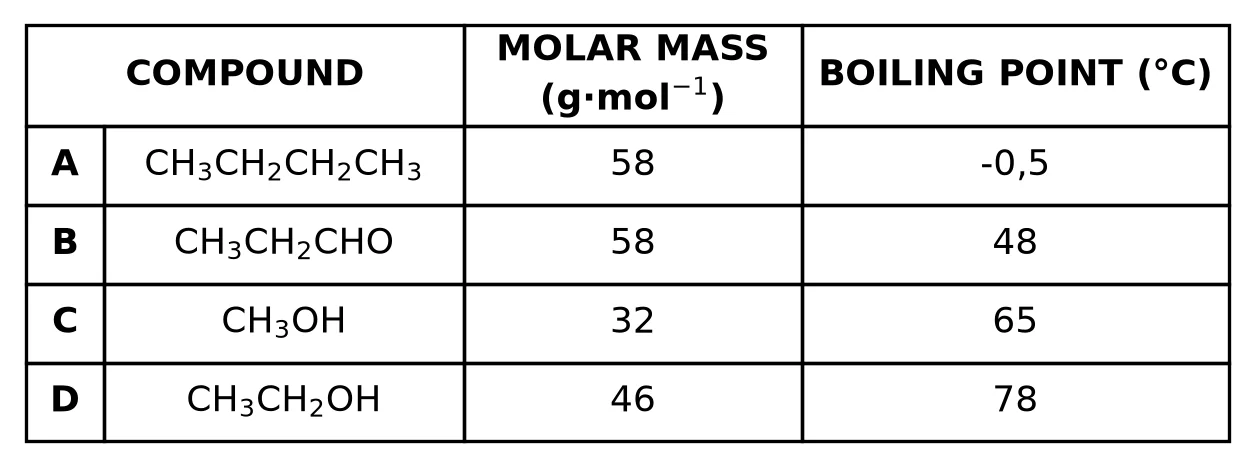 3.1 Define the term vapour pressure.(2)
Show the memo (1 tick)Memo
- ✓Definition of vapour pressureThe pressure exerted by vapour at equilibrium with its liquid in a closed system.
2 marks · Define bonding and intermolecular terms
- ✓
10. Question 3.1 · September 2026 · Paper 2 · Provincial · 2 marks
The physical properties of four organic compounds shown in the table below are compared.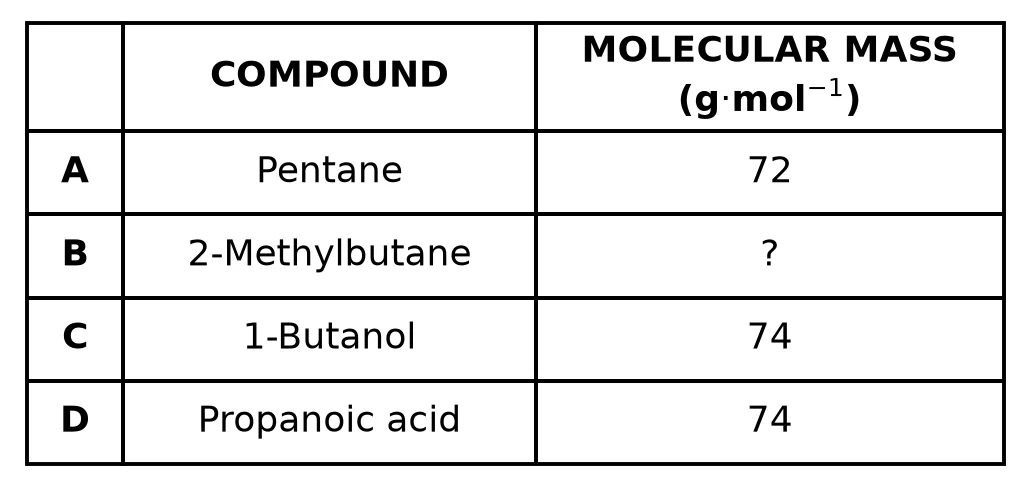 3.1 Define the term *boiling point*.(2)
Show the memo (1 tick)Memo
- ✓Definition of boiling pointThe temperature at which the vapour pressure of a substance equals atmospheric pressure.
2 marks · Define bonding and intermolecular terms
- ✓
Intermolecular Forces Grade 11 videos
Short lessons from South African teachers first. Videos load only when you tap play, to save your data.
Free on Android
Know exactly which skill is costing you marks.
Mark past papers tick by tick in the NavyBlue app. It remembers every mark you lose, shows you the skills to fix first, and picks your next questions.
Get NavyBlue free on Google Play
