Grade 11 Physical Sciences · Matter and Materials · Paper 2 (Chemistry)
Ideal Gas Laws Grade 11
Real Ideal Gas Laws past paper questions from 2018 to 2025 and practice questions, with each memo split into the ticks examiners give. Try one, mark yourself, and see exactly which skill cost you marks.
- questions · 85 past paper, 256 practice
- 341 questions · 85 past paper, 256 practice
- skills
- 9 skills
- videos
- 9 videos
Try an Ideal Gas Laws exam question
No sign-up. Takes 3 minutes.
Question 1.7 · November 2019 · Paper 2 · National (DBE) · 2 marks
The new pressure in the balloon is ...(2)
Work it out on paper first. Then mark yourself with the official memo, one tick at a time.
Ideal Gas Laws skills
Each skill is one thing a memo gives a tick for. Tap one for its own questions, notes and videos.
- State and explain the gas lawsState the gas laws, like Boyle's law, and explain gas behaviour with moving particles (squeezing a gas makes particles hit the walls more often).48 questions (34 past paper) · 4 videos
- Calculate with the gas equationsCalculate pressure, volume or temperature of a gas using $\frac{p_1V_1}{T_1} = \frac{p_2V_2}{T_2}$ or $pV = nRT$, with temperature in kelvin.40 questions (21 past paper) · 3 videos
- Convert unitsChange values into the units a formula needs ($500\ \text{g} \rightarrow 0{,}5\ \text{kg}$, $25\ ^{\circ}\text{C} \rightarrow 298\ \text{K}$, $72\ \text{km/h} \rightarrow 20\ \text{m/s}$).34 questions (1 past paper) · 3 videos
- Identify variables in an investigationName the independent, dependent and controlled variables in an experiment (in a test of temperature on reaction rate, temperature is independent).55 questions (21 past paper) · 3 videos
- Write investigative question or conclusionWrite an investigative question, hypothesis or conclusion that links two variables (How does the length of a wire affect its resistance?).65 questions (18 past paper) · 3 videos
- Describe and evaluate an experimentName apparatus, describe or explain the steps of a method, give safety precautions, and name sources of error and how to reduce them (repeat readings and work out an average).35 questions (2 past paper) · 3 videos
- Plot a graph from dataPlot results on a graph with labelled axes, units and a good scale, and draw the line or curve of best fit.38 questions (7 past paper) · 3 videos
- Read a graph of resultsRead values from a graph or table of results, or calculate a gradient (finding resistance from the gradient of a V-I graph).50 questions (16 past paper) · 3 videos
- Plan an investigationPlan an experiment to test a given hypothesis: list the apparatus, write the steps, say which variables you keep constant and how you will repeat readings.32 practice questions · 3 videos
More Ideal Gas Laws Grade 11 questions and answers
Try each one on paper before you open the memo.
4. Question 4.2 · November 2018 · Paper 2 · National (DBE) · 2 marks
A certain amount of gas is sealed in a container of which the volume can change. The relationship between the pressure and volume of the gas at °C is investigated. The results of the experiment are given in the table below.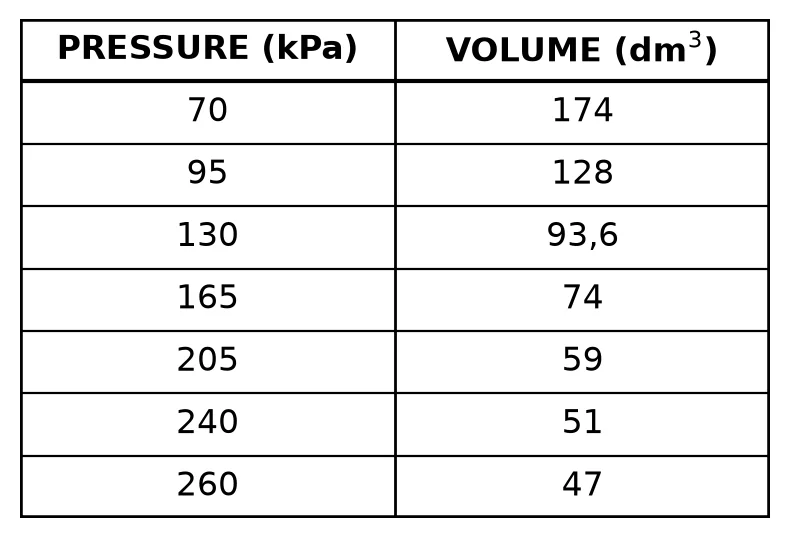 4.2 Write down a hypothesis for the investigation.(2)
Show the memo (2 ticks)Memo
- ✓Variables stated correctlyDependent variable: volume; independent variable: pressure.
Example: If the pressure of an enclosed gas increases, the volume will decrease at constant temperature. - ✓Relationship statedThe pressure of an enclosed gas is inversely proportional to the volume it occupies if the temperature is kept constant.
- ✓
5. Question 1.4 · November 2025 · Paper 2 · Provincial · 2 marks
Various options are provided as possible answers to the following questions. Choose the answer and write only the letter (A–D) next to the question numbers (1.1 to 1.10) in the ANSWER BOOK, for example 1.11 E.1.4 The diagram below shows a gas syringe containing a certain gas. When the plunger is at position A the volume occupied by the gas is X and exerts a pressure P. When the plunger moves to position B the volume occupied by the gas is X.
What is the DIFFERENCE in pressure exerted by the gas between points A and B?(2)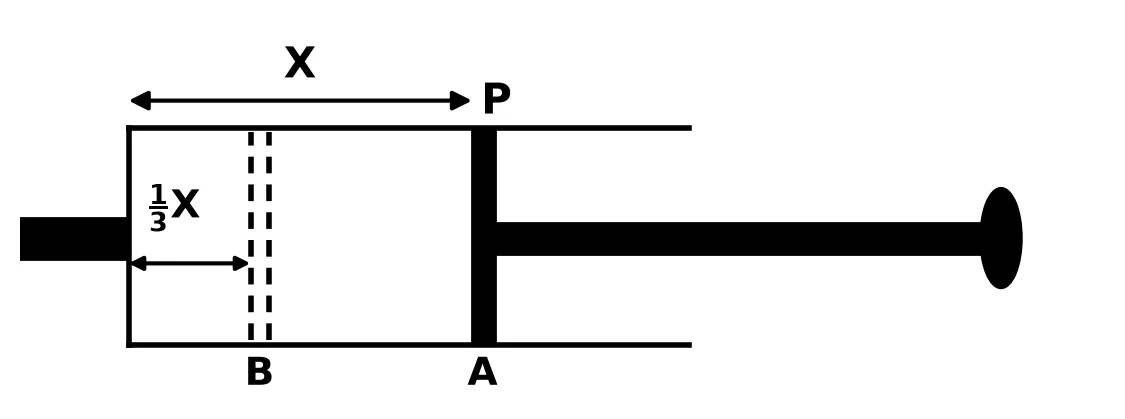
Show the memo (2 ticks)Memo
- ✓Choose the correct optionBoyle's law (constant temperature and amount of gas):
, so .
Difference in pressure .
Answer: D2 marks · Calculate with the gas equations
- ✓
6. Question 4.2.1 · November 2025 · Paper 2 · Provincial · 2 marks
A group of learners investigated the relationship between the pressure and volume of a certain gas. The graph of the pressure versus inverse of volume was obtained from the data in the investigation.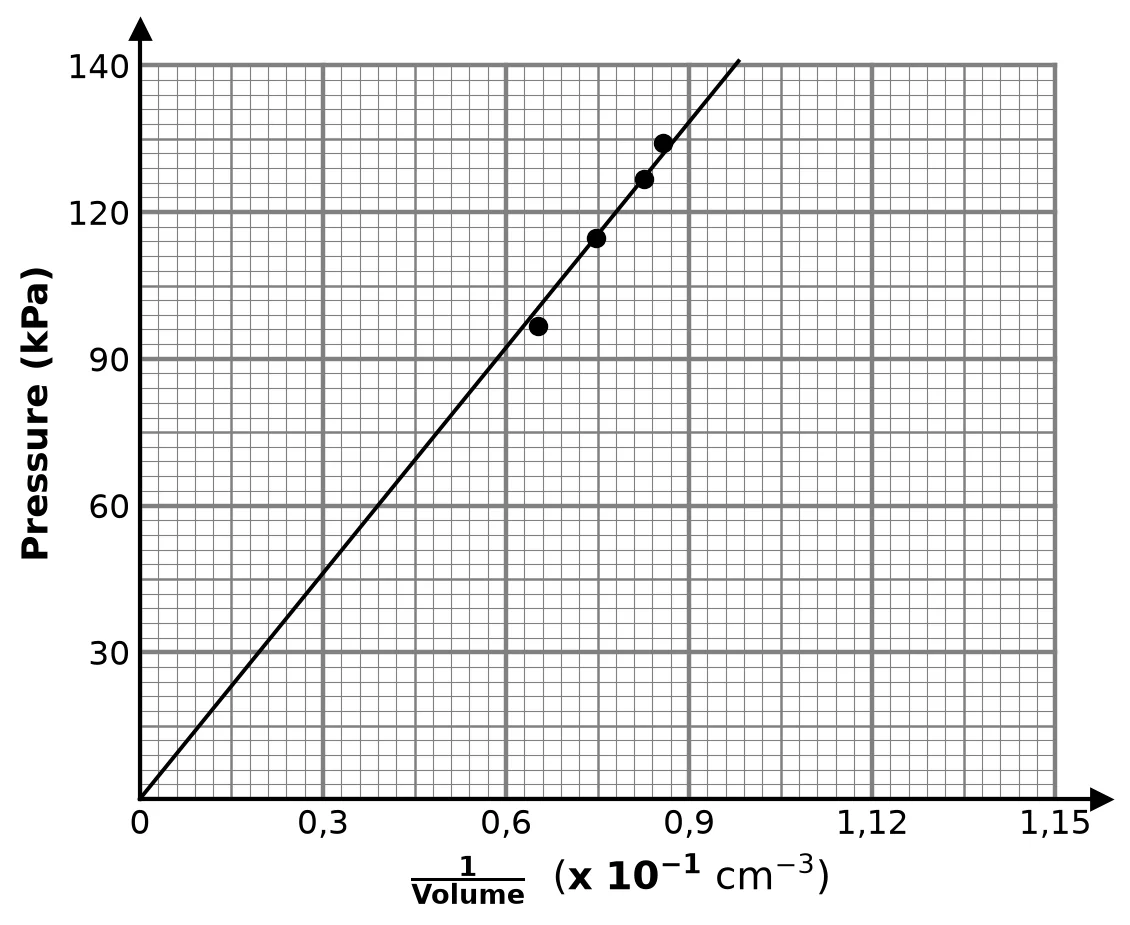 4.2 From the investigation write down:4.2.1 An investigative question for this investigation(2)
Show the memo (2 ticks)Memo
- ✓Variables statedHow does the pressure of a gas affect the volume?
OR
What is the relationship between pressure and volume of the gas? - ✓Question about the relationshipThe question asks how the pressure and the volume are related (it ends with a question mark).
- ✓
7. Question 1.3 · November 2024 · Paper 2 · Provincial · 2 marks
1.3 Which ONE of the following is NOT a property of the ideal gas?(2)Show the memo (2 ticks)Memo
- ✓Properties of an ideal gasIn an ideal gas the molecules themselves have negligible volume compared with the volume of the container, there are no intermolecular forces and collisions are elastic. So the statement that the gas volume EQUALS the total volume of the molecules is not true of an ideal gas.
Answer: C2 marks · State and explain the gas laws
- ✓
8. Question 3.2 · November 2024 · Paper 2 · Provincial · 2 marks
Learners investigated the boiling points of the compounds listed in the table below.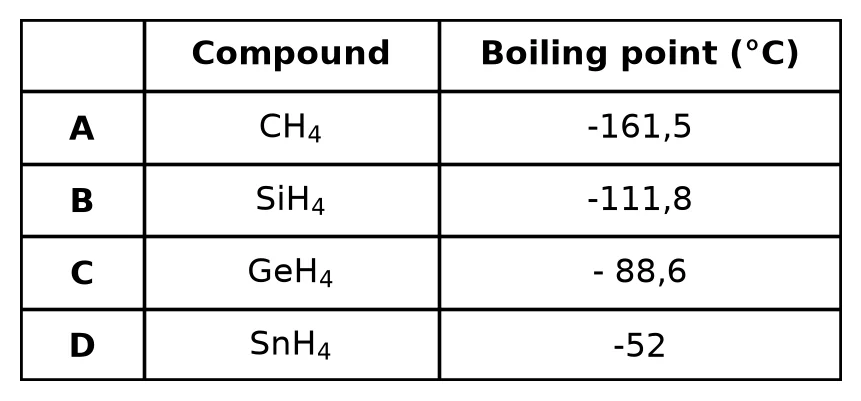 3.2 Is this a fair investigation? Write only YES or NO.
Give a reason for the answer.(2)Show the memo (2 ticks)Memo
- ✓Fair test: YESYES
- ✓ReasonOnly one independent variable / All variables are controlled except molecular mass.
- ✓
9. Question 1.7 · November 2024 · Paper 2 · Provincial · 2 marks
1.7 A fixed amount of gas occupies a volume V exerts a pressure P at a constant temperature. If the volume is doubled, the new pressure of the gas will be ...(2)Show the memo (2 ticks)Memo
- ✓Correct optionBoyle's law:
Answer: B2 marks · Calculate with the gas equations
- ✓
10. Question 3.2.1 · November 2024 · Paper 2 · Provincial · 2 marks
During an investigation, the MELTING POINTS of the hydrogen halides were determined. The results of the investigation are shown in the graph below.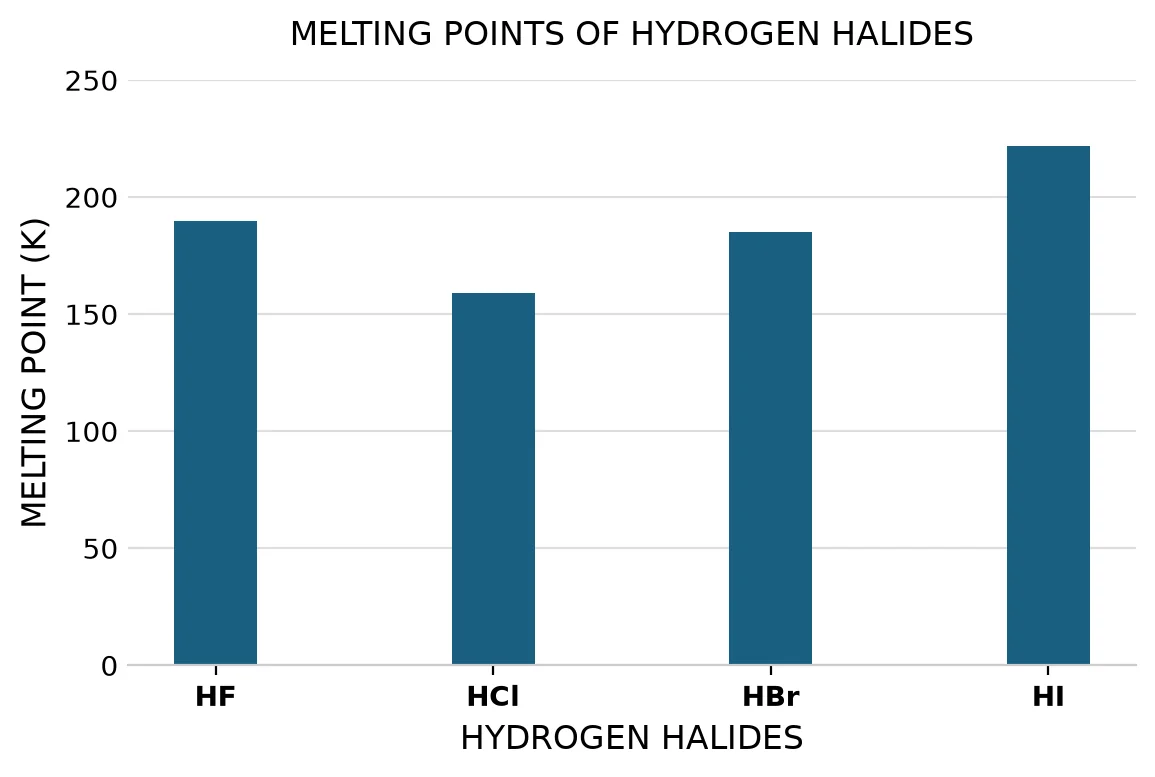 3.2 The melting points of HBr and are compared.3.2.1 What is the relationship between strength of the intermolecular forces and melting point?(2)
Show the memo (2 ticks)Memo
- ✓RelationshipThe stronger the intermolecular forces the higher the melting point.
- ✓
Ideal Gas Laws Grade 11 videos
Short lessons from South African teachers first. Videos load only when you tap play, to save your data.
Free on Android
Know exactly which skill is costing you marks.
Mark past papers tick by tick in the NavyBlue app. It remembers every mark you lose, shows you the skills to fix first, and picks your next questions.
Get NavyBlue free on Google Play