Grade 10 Physical Sciences · Matter and Materials · Explain periodic trends
Periodic Trends Grade 10
Describe and explain how properties like atomic radius or ionisation energy change across a period or down a group (atoms get bigger down a group).
- questions use it, all grades · 17 past paper, 20 practice
- 37 questions use it, all grades · 17 past paper, 20 practice
- videos
- 4 videos
Learn it: explain periodic trends
Pick one and watch it, then try the questions below. Videos load only when you tap play.
Now try it on a real exam question
No sign-up. Takes 3 minutes.
Question 4.4 · November 2018 · Paper 2 · National (DBE) · 4 marks
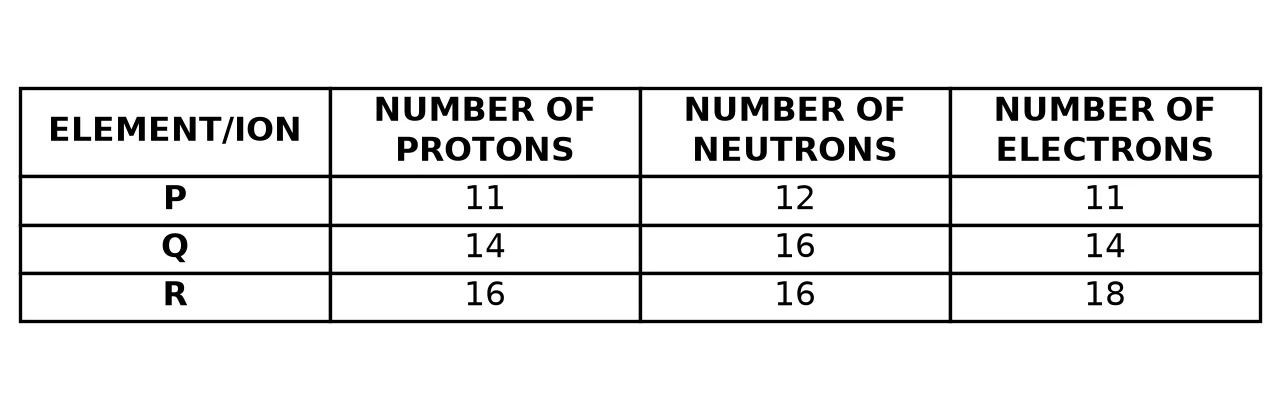
Work it out on paper first. Then mark yourself with the official memo, one tick at a time.
More past paper questions: explain periodic trends
Work each one out first, then open the memo and check every tick.
3. Question 4.2.2 · November 2019 · Paper 2 · National (DBE) · 2 marks
A section of the periodic table is shown below. Imaginary symbols are used to represent some of the elements.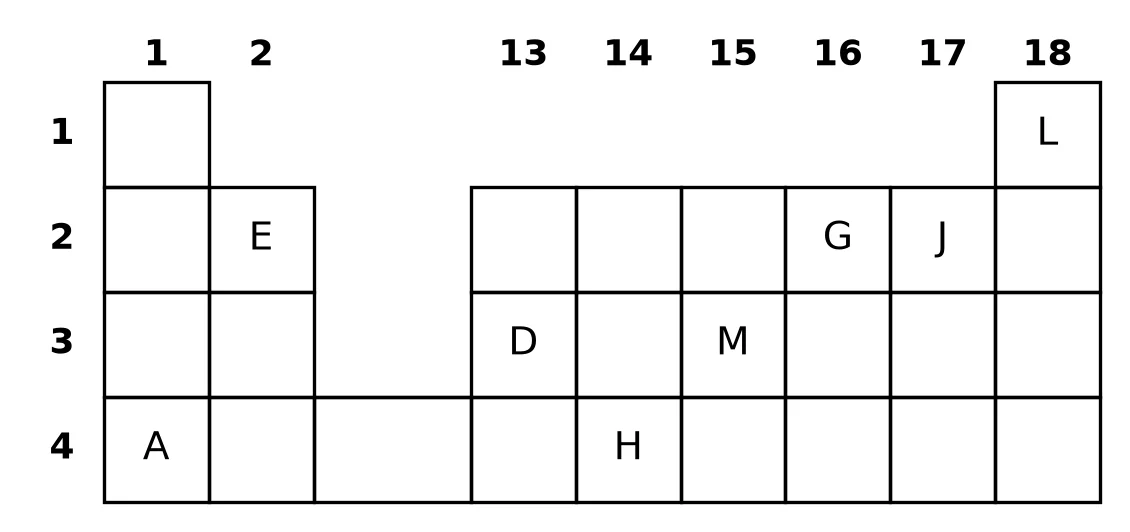 4.2 The first ionisation energy of element A is kJ·mol.
Answer the questions that follow.4.2.2 The first ionisation energy of element A can be represented by the following incomplete equation:
kJ·mol
Copy the equation above into the ANSWER BOOK and complete it.(2)Show the memo (2 ticks)Memo
- ✓Gaseous positive ion kJ·mol
1 mark · Explain periodic trends
- ✓Electron
1 mark · Explain periodic trends
- ✓
4. Question 3.5.1 · June 2024 · Paper 2 · Provincial · 3 marks
Chlorine is a non-metallic element with an atomic number of and can exist as isotopes.3.5 Use the information in the table to:3.5.1 Explain why the first ionisation energy of Lithium is so much lower compared to that of Fluorine.(3)Show the memo (3 ticks)Memo
- ✓Lithium: one valence electronLithium is a metal that has an electron in the second energy level (1 valence electron). Its first energy level is full.
1 mark · Explain periodic trends
- ✓Fluorine: seven valence electronsFluorine has 7 electrons in its 2nd energy level (7 valence electrons).
1 mark · Explain periodic trends
- ✓Li donates, F gainsLithium will rather donate and Fluorine will rather gain an electron.
Therefore the difference in first ionisation energies.1 mark · Explain periodic trends
- ✓
5. Question 4.4 · November 2023 · Paper 2 · Provincial · 2 marks
Strontium is best known for the brilliant reds it produces from its salts in fireworks and flares.
Strontium is an element on the Periodic Table in period 5 group 2.
The four isotopes of strontium have isotopic mass numbers of , , and and relative abundance of , , and respectively.4.4 Compare the atomic radius of strontium and magnesium.(2)Show the memo (2 ticks)Memo
- ✓TrendAtomic radius decreases across the period and increases down the group.
1 mark · Explain periodic trends
- ✓ComparisonStrontium's atomic radius is bigger than that of Magnesium.
1 mark · Explain periodic trends
- ✓
6. Question 1.7 · November 2021 · Paper 2 · Provincial · 2 marks
Four options are provided as possible answers to the following questions. Each question has only ONE correct answer.1.7 Which graph represents atomic radius, , versus atomic number, , for the elements of period 2?(2)Show the memo (2 ticks)Memo
- ✓Correct optionAcross a period the number of protons increases while the electrons are added to the same energy level. The greater nuclear charge pulls the electrons closer, so the atomic radius DECREASES as increases. Graph B shows a steady decrease.
Answer: B2 marks · Explain periodic trends
- ✓
Free on Android
Know exactly which skill is costing you marks.
Mark past papers tick by tick in the NavyBlue app. It remembers every mark you lose, shows you the skills to fix first, and picks your next questions.
Get NavyBlue free on Google Play