Grade 11 Physical Sciences · Mechanics · Paper 1 (Physics)
Newton's Laws Applications Grade 11
Real Newton's Laws Applications past paper questions and answers from 2023 to 2025, with each memo split into the ticks examiners give. Try one, mark yourself, and see exactly which skill cost you marks.
- past paper questions
- 168 past paper questions
- skills
- 7 skills
- videos
- 7 videos
Try a Newton's Laws Applications exam question
No sign-up. Takes 3 minutes.
Question 1.1 · November 2025 · Paper 1 · National (DBE) · 2 marks
Work it out on paper first. Then mark yourself with the official memo, one tick at a time.
Newton's Laws Applications skills
Each skill is one thing a memo gives a tick for. Tap one for its own questions, notes and videos.
- Use the equations of motionChoose and use an equation of motion to find an unknown, such as v_f = v_i + aΔt for a car speeding up from rest.31 past paper questions · 4 videos
- Resolve a vector into componentsSplit a force at an angle into horizontal and vertical parts, for example F cos θ and F sin θ, or mg sin θ along a slope.20 past paper questions · 4 videos
- Draw a closed vector diagramDraw forces head-to-tail to form a closed triangle, showing that forces acting on an object in equilibrium add up to zero.8 past paper questions · 3 videos
- Calculate and explain frictional forceCalculate friction using f = μN with the correct normal force, on flat ground or a slope (μ = 0,3 and N = 100 N gives 30 N).54 past paper questions · 4 videos
- Apply Newton's second lawUse F_net = ma to link the net force on an object to its mass and acceleration (a 2 kg box pushed with 10 N speeds up at 5 m/s²).31 past paper questions · 4 videos
- Solve problems with connected bodiesUse F_net = ma for each of two or more joined objects to find their acceleration or the tension in the string (two blocks pulled by a rope).29 past paper questions · 3 videos
- Explain using Newton's lawsExplain everyday events in words using Newton's laws, for example why a seatbelt stops a passenger from moving forward when a car brakes.45 past paper questions · 3 videos
More Newton's Laws Applications Grade 11 questions and answers
Try each one on paper before you open the memo.
4. Question 2.3.1 · November 2025 · Paper 1 · National (DBE) · 2 marks
A block of mass kg is at rest on a rough horizontal surface. When a constant force F of magnitude N acts on the block at an angle to the horizontal, the block experiences maximum static friction. See the diagram below.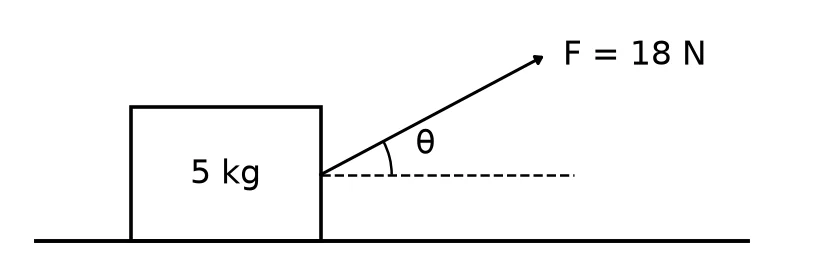 2.3 The horizontal component of force F is N.
Calculate:2.3.1 (2)Show the memo (2 ticks)Memo
- ✓Substitution
1 mark · Resolve a vector into components
- ✓Answer
1 mark · Resolve a vector into components
- ✓
5. Question 1.1 · November 2024 · Paper 1 · National (DBE) · 2 marks
1.1 Several forces are acting on a moving object.
Which ONE of the following statements is CORRECT when these forces are in equilibrium?(2)Show the memo (1 tick)Memo
- ✓Correct optionForces in equilibrium have a resultant (net) force of zero. By Newton's second law, , so . A moving object with zero acceleration keeps moving at constant velocity (Newton's first law).
A and D need a non-zero acceleration, and C needs the speed to change, which also needs a net force.
Answer: B2 marks · Explain using Newton's laws
- ✓
6. Question 2.3.1 · November 2024 · Paper 1 · National (DBE) · 4 marks
In an experiment, a crate of mass kg, lying stationary on a rough horizontal table, is connected to a mass hanger by means of a light inextensible string passing over a frictionless pulley, as shown in the diagram below. Mass pieces are added to the mass hanger and the acceleration of the crate is measured. The experiment is repeated several times by adding different masses to increase the hanging mass each time.
Ignore the effects of air friction.
The results obtained were used to draw the sketch graph below.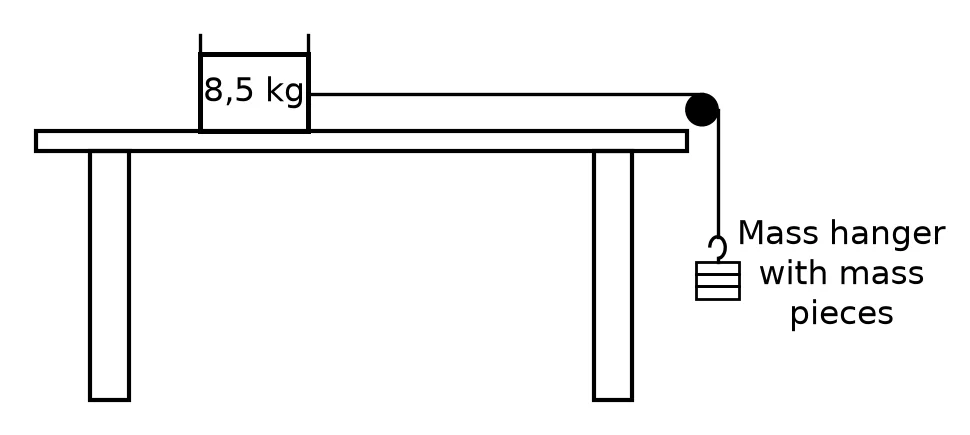
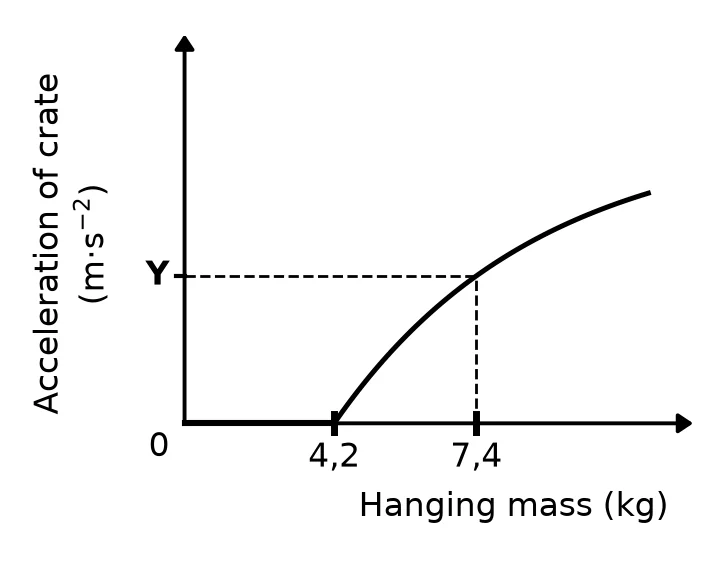 2.3 Calculate the:2.3.1 Coefficient of static friction ()(4)
Show the memo (4 ticks)Memo
- ✓Tension from the hanging massFor the hanging mass:
N1 mark · Solve problems with connected bodies
- ✓Forces on the crate (any one)For the crate:
(Any one of: / / / / / / )1 mark · Solve problems with connected bodies
- ✓Substitution into
- ✓Answer
- ✓
7. Question 1.1 · May/June 2024 · Paper 1 · National (DBE) · 2 marks
Various options are provided as possible answers to the following questions. Each question has only ONE correct answer. Choose the answer and write only the letter (A–D) next to the question numbers (1.1 to 1.10).1.1 A book rests on a table. Which ONE of the following forces will form an action-reaction pair with the weight of the book?(2)Show the memo (1 tick)Memo
- ✓Choose the correct optionThe weight of the book is the force of the Earth on the book. Its Newton III partner is the same type of force with the two objects swapped: the force of the book on the Earth (equal in size, opposite in direction).
The force of the table on the book (D) is the normal force. It also balances the weight, but it acts on the same object (the book) and is a different type of force, so it is not the action-reaction partner.
Answer: B2 marks · Explain using Newton's laws
- ✓
8. Question 2.3.1 · May/June 2024 · Paper 1 · National (DBE) · 3 marks
Block A of mass kg is connected to block B of mass kg by a light inextensible string passing over a frictionless pulley. Block A is at rest on a rough horizontal table and block B hangs vertically, as shown in the diagram below.
A force F of magnitude N is applied on block A at an angle of to the horizontal, causing block A to accelerate TO THE LEFT from rest along the table.
The coefficient of kinetic friction between the surface of the table and block A is .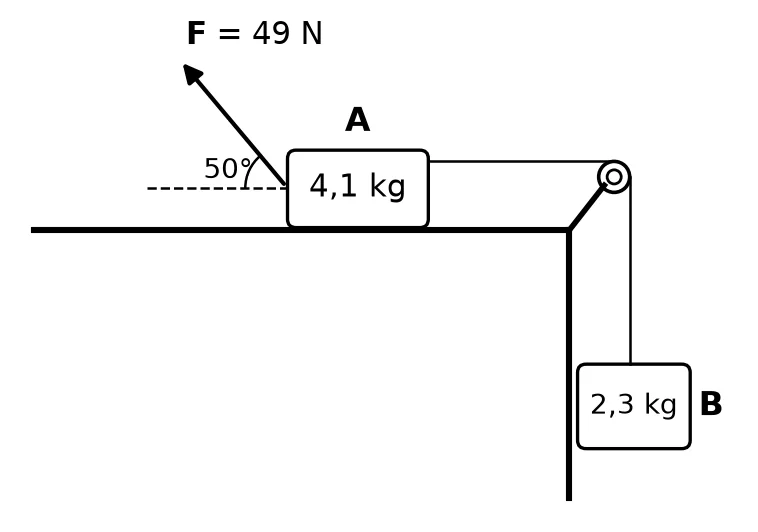 2.3 Calculate the magnitude of the:2.3.1 Kinetic frictional force exerted on block A(3)
Show the memo (3 ticks)Memo
- ✓Formula
Any one: or - ✓Substitution
- ✓Answer with unit N
- ✓
9. Question 1.1 · November 2023 · Paper 1 · National (DBE) · 2 marks
Various options are provided as possible answers to the following questions. Each question has only ONE correct answer.1.1 A constant net force is applied to a block. Which ONE of the following statements is CORRECT?
The block will move with a ...(2)Show the memo (1 tick)Memo
- ✓Correct optionBy Newton's second law , so . If and stay constant, the acceleration is constant. A constant velocity (A) would need zero net force.
Answer: B2 marks · Explain using Newton's laws
- ✓
10. Question 2.3.1 · November 2023 · Paper 1 · National (DBE) · 4 marks
Two blocks, , of mass kg, and , of mass kg, are connected by a light inextensible string. The blocks are held at rest on a plane which is inclined at an angle of with the horizontal.
A constant force, , acting parallel to the plane, is applied to block , as shown in the diagram below. The blocks now accelerate up the plane at m·s.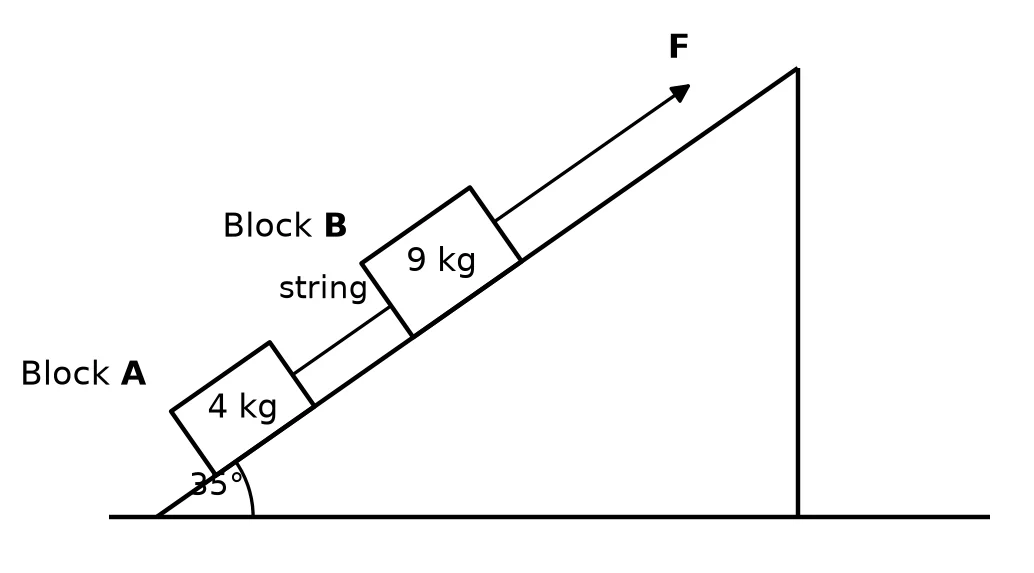 2.3 Calculate the magnitude of:2.3.1 The tension in the string(4)
Show the memo (4 ticks)Memo
- ✓Formula (any one)For block A, up the incline as positive:
1 mark · Solve problems with connected bodies
- ✓Substitution of the forces
1 mark · Solve problems with connected bodies
- ✓Substitution of ma
1 mark · Solve problems with connected bodies
- ✓Answer with unit N
1 mark · Solve problems with connected bodies
- ✓
Newton's Laws Applications Grade 11 videos
Short lessons from South African teachers first. Videos load only when you tap play, to save your data.
Free on Android
Know exactly which skill is costing you marks.
Mark past papers tick by tick in the NavyBlue app. It remembers every mark you lose, shows you the skills to fix first, and picks your next questions.
Get NavyBlue free on Google Play
