Grade 11 Physical Sciences · Mechanics · Paper 1 (Physics)
Forces Grade 11
Real Forces past paper questions and answers from 2022 to 2025, with each memo split into the ticks examiners give. Try one, mark yourself, and see exactly which skill cost you marks.
- past paper questions
- 108 past paper questions
- skills
- 3 skills
- videos
- 3 videos
Try a Forces exam question
No sign-up. Takes 3 minutes.
Question 2.1 · November 2025 · Paper 1 · National (DBE) · 2 marks
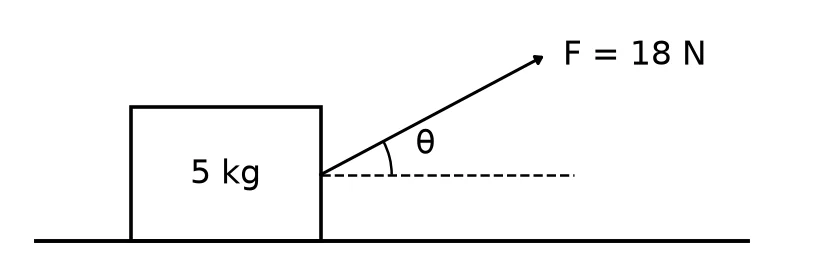
Work it out on paper first. Then mark yourself with the official memo, one tick at a time.
Forces skills
Each skill is one thing a memo gives a tick for. Tap one for its own questions, notes and videos.
- State Newton's laws and force termsState Newton's three laws or the law of gravitation in full, or define terms like inertia, normal force, friction and weight.43 past paper questions · 4 videos
- Calculate weightCalculate weight from mass using w = mg (a 50 kg learner weighs 490 N), and tell mass in kg apart from weight in N.14 past paper questions · 3 videos
- Calculate and explain frictional forceCalculate friction using f = μN with the correct normal force, on flat ground or a slope (μ = 0,3 and N = 100 N gives 30 N).54 past paper questions · 4 videos
More Forces Grade 11 questions and answers
Try each one on paper before you open the memo.
4. Question 7.2.3 · May/June 2025 · Paper 1 · National (DBE) · 5 marks
7.2 Sphere S is attached to the ceiling at point P by a light inextensible string. When sphere R, on an insulated stand, is brought close to sphere S they repel and sphere S comes to rest with the horizontal distance between the centres of the spheres equal to m.
Sphere R is directly below point P. The string makes an angle θ with the vertical, as shown in the diagram below.
Answer the questions that follow.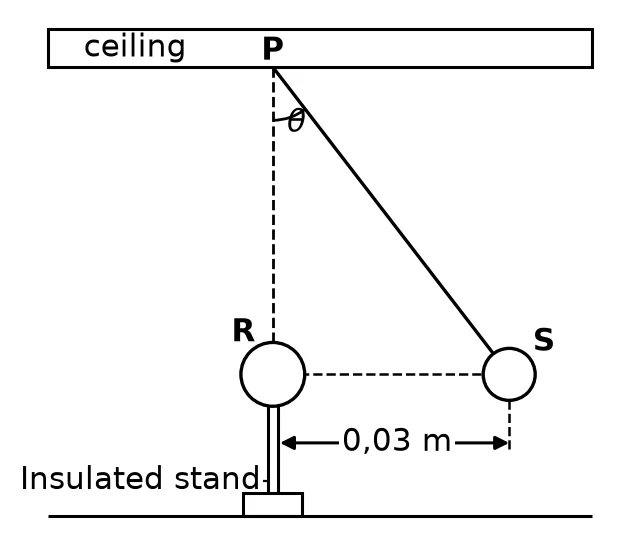 Sphere R has a charge of nC. Sphere S has a charge nC and a mass of g.7.2.3 Calculate angle θ.(5)
Show the memo (5 ticks)Memo
- ✓Formula
1 mark · Apply Coulomb's law
- ✓Substitution
N1 mark · Apply Coulomb's law
- ✓Weight of S N
1 mark · Calculate weight
- ✓Trig ratio
- ✓Answer
- ✓
5. Question 2.1 · May/June 2024 · Paper 1 · National (DBE) · 2 marks
Block A of mass kg is connected to block B of mass kg by a light inextensible string passing over a frictionless pulley. Block A is at rest on a rough horizontal table and block B hangs vertically, as shown in the diagram below.
A force F of magnitude N is applied on block A at an angle of to the horizontal, causing block A to accelerate TO THE LEFT from rest along the table.
The coefficient of kinetic friction between the surface of the table and block A is .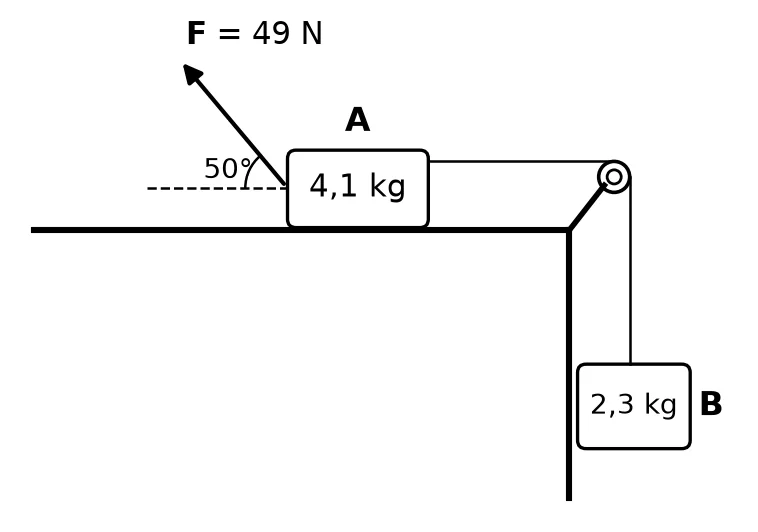 2.1 State Newton's Second Law of Motion in words.(2)
Show the memo (1 tick)Memo
- ✓Newton's Second Law in wordsWhen a resultant/net force acts on an object, the object will accelerate in the direction of the force. The acceleration is directly proportional to the resultant/net force and inversely proportional to the mass of the object.
OR
The resultant/net force acting on an object is equal to the rate of change of momentum of the object in the direction of the resultant/net force.2 marks · State Newton's laws and force terms
- ✓
6. Question 1.2 · November 2023 · Paper 1 · National (DBE) · 2 marks
Various options are provided as possible answers to the following questions. Each question has only ONE correct answer.1.2 A crate of mass m is stationary on a plane inclined at an angle with the horizontal, as shown below.
Which ONE of the following statements regarding the magnitude of the frictional force acting on the crate is CORRECT?
The magnitude of the frictional force acting on the crate is ...(2)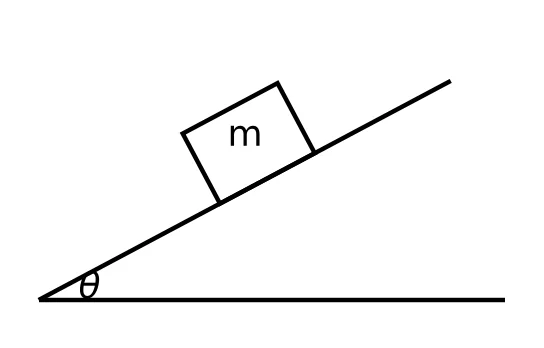
Show the memo (1 tick)Memo
- ✓Correct optionThe crate is at rest, so the net force along the plane is zero. The only forces along the plane are static friction (up the plane) and the parallel component of the weight, (down the plane). So . Friction cannot be larger (B), because then the crate would accelerate up the plane.
Answer: A2 marks · Calculate and explain frictional force
- ✓
7. Question 2.1 · November 2023 · Paper 1 · National (DBE) · 2 marks
Two blocks, , of mass kg, and , of mass kg, are connected by a light inextensible string. The blocks are held at rest on a plane which is inclined at an angle of with the horizontal.
A constant force, , acting parallel to the plane, is applied to block , as shown in the diagram below. The blocks now accelerate up the plane at m·s.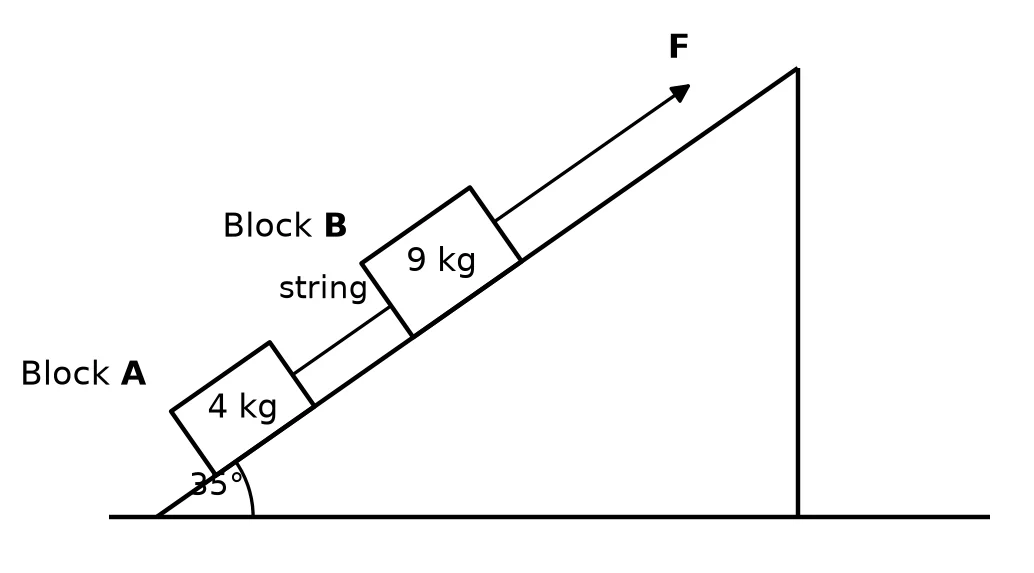 2.1 State Newton's Second Law of Motion in words.(2)
Show the memo (1 tick)Memo
- ✓Newton's Second LawWhen a resultant/net force acts on an object, the object will accelerate in the direction of the force. The acceleration is directly proportional to the resultant/net force and inversely proportional to the mass of the object.
OR
The resultant/net force acting on an object is equal to the rate of change of momentum of the object in the direction of the resultant/net force.2 marks · State Newton's laws and force terms
- ✓
8. Question 1.1 · May/June 2023 · Paper 1 · National (DBE) · 2 marks
Various options are provided as possible answers to the following questions. Each question has only ONE correct answer.1.1 Which ONE of the following quantities is the tendency of an object to resist a change to its state of motion?(2)Show the memo (1 tick)Memo
- ✓Correct optionInertia is defined as the property (tendency) of an object to resist any change in its state of motion. Impulse is the product of net force and contact time, momentum is mass times velocity and acceleration is the rate of change of velocity: none of these is a tendency to resist change.
Answer: A2 marks · State Newton's laws and force terms
- ✓
9. Question 2.3 · May/June 2023 · Paper 1 · National (DBE) · 2 marks
Block A of mass m is connected to block B of mass kg by a light inextensible rope passing over a frictionless pulley. Block B is initially held at a height of m above the ground, while block A is initially stationary on the ground, as shown in the diagram below.
When block B is released, it moves vertically downwards and strikes the ground with a velocity of m·s.
Ignore the effects of friction.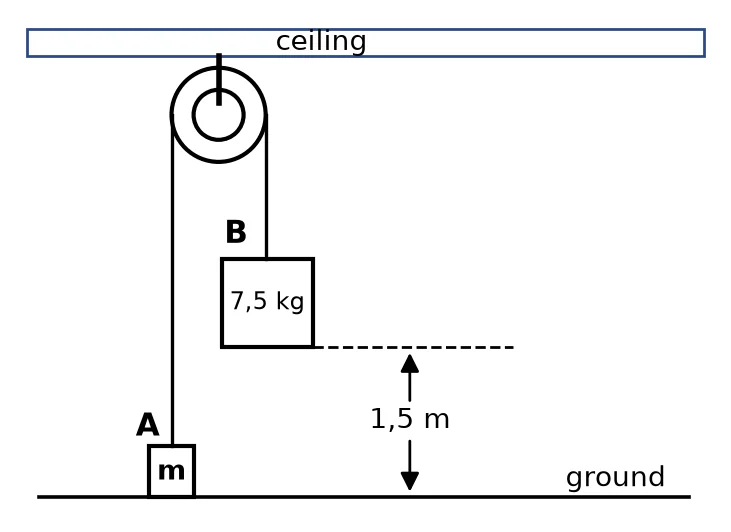 2.3 State Newton's Second Law of Motion in words.(2)
Show the memo (1 tick)Memo
- ✓Newton's Second LawWhen a resultant/net force acts on an object, the object will accelerate in the direction of the force with an acceleration that is directly proportional to the force and inversely proportional to the mass of the object.
OR
The resultant/net force acting on an object is equal to the rate of change of momentum of the object in the direction of the resultant/net force.2 marks · State Newton's laws and force terms
- ✓
10. Question 2.1 · November 2022 · Paper 1 · National (DBE) · 2 marks
Crate P of mass kg is connected to another crate, Q, of mass kg by a light inextensible string. The two crates are placed on a rough horizontal surface. A constant force F of magnitude N, acting at angle to the horizontal, is applied on crate Q, as shown in the diagram below.
The crates accelerate at m·s to the right.
Crate P experiences a constant frictional force of N and crate Q experiences a constant frictional force of N.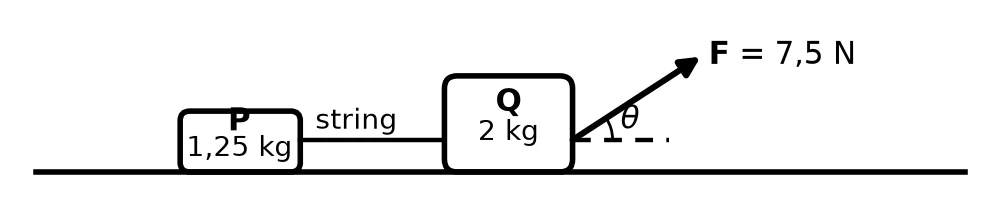 2.1 State Newton's Second Law of Motion in words.(2)
Show the memo (1 tick)Memo
- ✓Newton's second lawWhen a resultant/net force acts on an object, the object will accelerate in the direction of the force. The acceleration is directly proportional to the resultant/net force and inversely proportional to the mass of the object.
OR
The resultant/net force acting on an object is equal to the rate of change of momentum of the object. (2 or 0)2 marks · State Newton's laws and force terms
- ✓
Forces Grade 11 videos
Short lessons from South African teachers first. Videos load only when you tap play, to save your data.
Free on Android
Know exactly which skill is costing you marks.
Mark past papers tick by tick in the NavyBlue app. It remembers every mark you lose, shows you the skills to fix first, and picks your next questions.
Get NavyBlue free on Google Play
