Grade 10 Physical Sciences · Electricity and Magnetism · Paper 1 (Physics)
Electrostatics Grade 10
Real Electrostatics past paper questions and answers from 2017 to 2025, with each memo split into the ticks examiners give. Try one, mark yourself, and see exactly which skill cost you marks.
- past paper questions
- 69 past paper questions
- skills
- 3 skills
- videos
- 3 videos
Try a Electrostatics exam question
No sign-up. Takes 3 minutes.
Question 1.7 · November 2023 · Paper 1 · National (DBE) · 2 marks
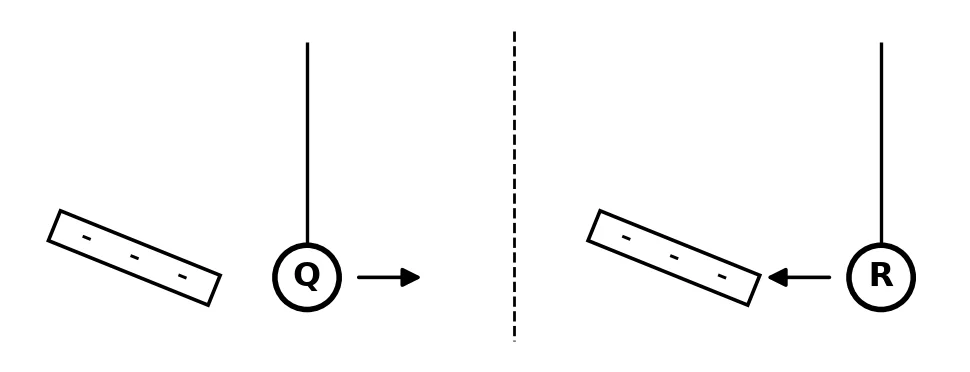
Q and R are small spheres suspended by light insulated strings.
When a negatively charged rod is brought close to sphere Q, sphere Q is repelled. When the negatively charged rod is brought close to sphere R, sphere R is attracted.
Which ONE of the combinations below can be possible for the nature of the charges on spheres Q and R?(2)
Work it out on paper first. Then mark yourself with the official memo, one tick at a time.
Electrostatics skills
Each skill is one thing a memo gives a tick for. Tap one for its own questions, notes and videos.
- Explain charging and polarisationExplain how objects become charged by gaining or losing electrons, and why a charged rod attracts small pieces of paper.29 past paper questions · 3 videos
- State electrostatics laws and definitionsState Coulomb's law, conservation of charge or charge quantisation in full, or define an electric field.37 past paper questions · 3 videos
- Calculate shared charge and electrons transferredFind the charge on identical spheres after they touch using Q = (Q₁ + Q₂)/2, or count electrons moved with n = Q/e.52 past paper questions · 4 videos
More Electrostatics Grade 10 questions and answers
Try each one on paper before you open the memo.
4. Question 10.1 · November 2018 · Paper 1 · National (DBE) · 3 marks
Two identical insulated spheres, X and Y, suspended by threads from a ceiling, are held at a small distance apart, as shown in the diagram below.
Sphere X carries a charge of C, while sphere Y has an excess of electrons.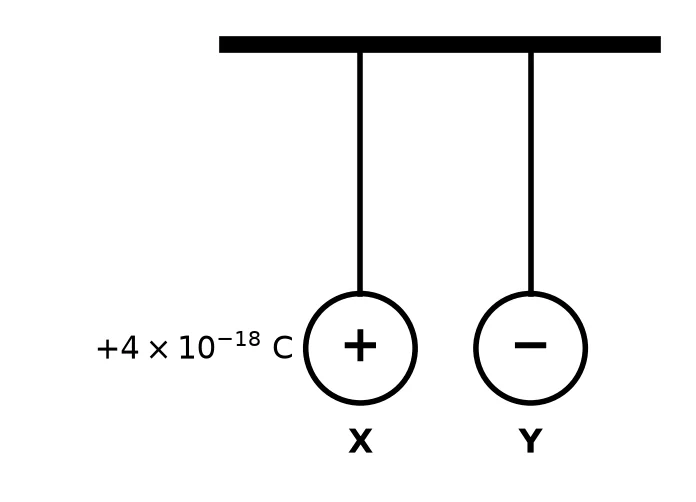 10.1 Calculate the magnitude of the charge on sphere Y.(3)
Show the memo (3 ticks)Memo
- ✓Formula or
- ✓Substitution
Accept: - ✓Answer with unit C
- ✓
5. Question 1.9 · November 2017 · Paper 1 · National (DBE) · 2 marks
Various options are provided as possible answers to the following questions. Each question has only ONE correct answer. Choose the answer and write only the letter (A–D) next to the question number.1.9 Two identical spheres, X and Y, on insulated stands, carry charges of μC and μC respectively. The spheres are brought into contact with each other and returned to their original positions. The charge on EACH sphere after contact is ...(2)Show the memo (1 tick)Memo
- ✓Correct option μC on each sphere.
Answer: D
- ✓
6. Question 10.1 · November 2017 · Paper 1 · National (DBE) · 2 marks
A neutral plastic ruler becomes charged when it is rubbed with a woollen cloth. After rubbing, the ruler has a charge of C.10.1 Distinguish between a neutral object and a charged object.(2)Show the memo (2 ticks)Memo
- ✓Neutral objectNeutral object: Has equal amount of both protons and electrons.
1 mark · Explain charging and polarisation
- ✓Charged objectCharged object: Has either gained or lost electrons.
1 mark · Explain charging and polarisation
- ✓
7. Question 7.2 · September 2025 · Paper 1 · Provincial · 2 marks
The diagram below shows a metal sphere A on an insulated stand in a vacuum. electrons are REMOVED from the sphere. Point P is cm away from sphere A.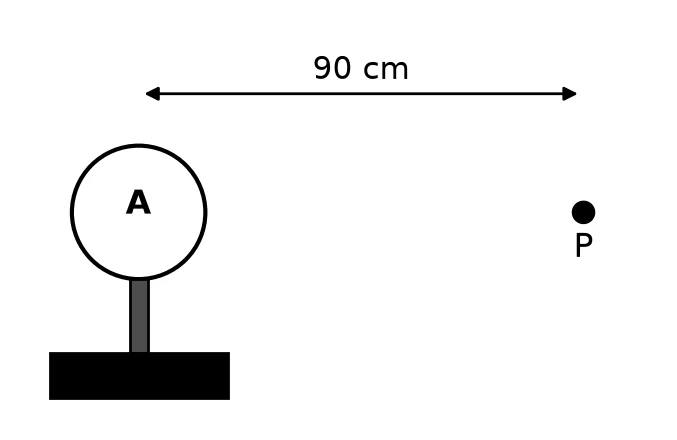 7.2 Explain why sphere A is placed on an insulated stand.(2)
Show the memo (1 tick)Memo
- ✓Reason for the insulated standTo ensure that charges do not leak to the ground.
2 marks · Explain charging and polarisation
- ✓
8. Question 1.4 · June 2024 · Paper 1 · Provincial · 2 marks
Four options are provided as possible answers to the following questions. Each question has only ONE correct answer.1.4 A glass rod becomes positively charged after being rubbed by a silk cloth. The glass rod becomes positively charged because ...(2)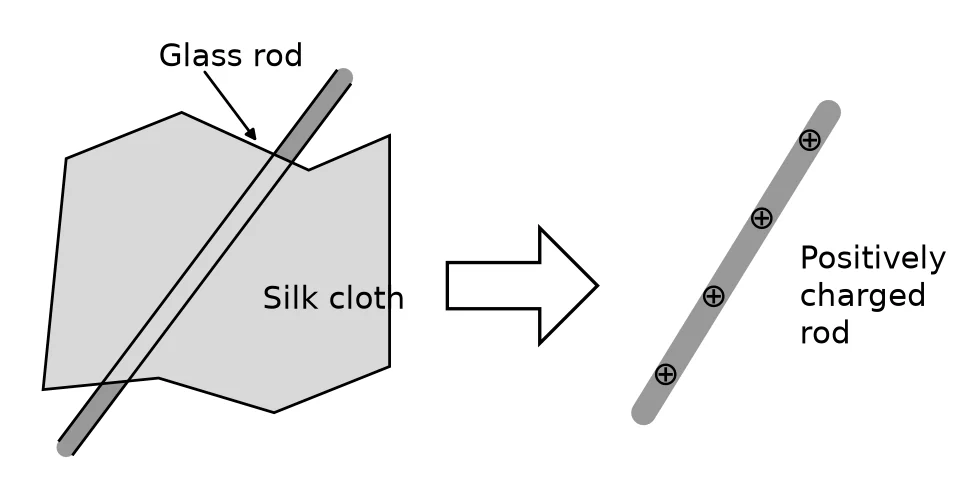
Show the memo (1 tick)Memo
- ✓Charging by friction: electrons moveWhen objects are rubbed together only electrons move; protons are fixed in the nuclei. The rod ends up positive, so it has lost electrons (to the silk).
Answer: C2 marks · Explain charging and polarisation
- ✓
9. Question 1.4 · June 2024 · Paper 1 · Provincial · 2 marks
Four options are provided as possible answers to the following questions. Each question has only ONE correct answer. Choose the answer and write only the letter (A–D) next to the question number (1.1–1.5) in the ANSWER BOOK, for example 1.6 E.1.4 Which ONE of the following will result in an object becoming positively charged?(2)Show the memo (1 tick)Memo
- ✓Correct optionOnly electrons move when objects are charged; protons stay in the nuclei. An object that loses electrons has more protons than electrons, so it becomes positive.
Answer: B2 marks · Explain charging and polarisation
- ✓
10. Question 1.6 · June 2024 · Paper 1 · Provincial · 2 marks
1.6 Consider two point charges, Q1 and Q2, placed a distance apart in a vacuum. If the force between the charges is repulsive, which of the following statements is true?(2)
Show the memo (1 tick)Memo
- ✓Like charges repelLike charges repel and unlike charges attract. A repulsive force means both charges have the same sign (both positive or both negative).
Answer: A2 marks · Explain charging and polarisation
- ✓
Electrostatics Grade 10 videos
Short lessons from South African teachers first. Videos load only when you tap play, to save your data.
Free on Android
Know exactly which skill is costing you marks.
Mark past papers tick by tick in the NavyBlue app. It remembers every mark you lose, shows you the skills to fix first, and picks your next questions.
Get NavyBlue free on Google Play
