Grade 12 Physical Sciences · Electricity and Magnetism · Explain the motor effect
Motor Effect Grade 12
Find the direction of the force on a current-carrying wire in a magnetic field, and so which way a motor coil turns.
- questions use it, all grades · 6 past paper, 13 practice
- 19 questions use it, all grades · 6 past paper, 13 practice
- videos
- 3 videos
Learn it: explain the motor effect
Pick one and watch it, then try the questions below. Videos load only when you tap play.
Now try it on a real exam question
No sign-up. Takes 3 minutes.
Question 1.9 · November 2024 · Paper 1 · National (DBE) · 2 marks
Which ONE of the following statements is CORRECT while the motor is in operation?
The coil and the ...(2)
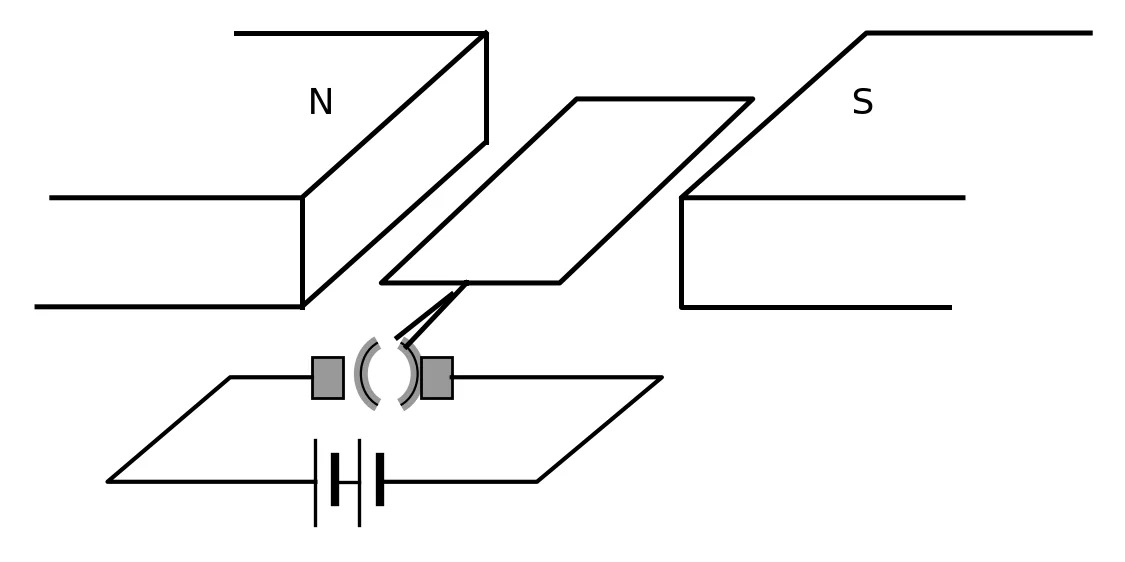
Work it out on paper first. Then mark yourself with the official memo, one tick at a time.
More questions: explain the motor effect
Work each one out first, then open the memo and check every tick.
3. Question 9.1.4 · November 2023 · Paper 1 · National (DBE) · 2 marks
9.1 A simplified diagram of a DC electric motor is shown below.
Answer the questions that follow.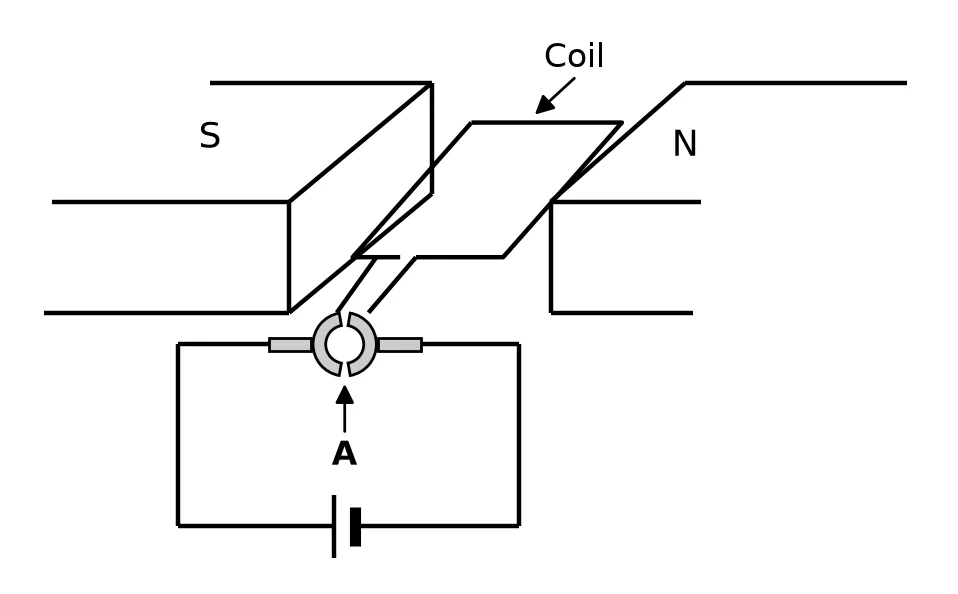 9.1.4 State TWO changes that can be made to the motor for the coil to rotate faster.(2)
Show the memo (2 ticks)Memo
- ✓First changeAny one of: increase the strength of the magnetic field (e.g. use stronger magnets / bring magnets closer / use curved magnets); increase the current (use a battery with higher potential difference / more cells in series / increase emf); increase the area of the coil; increase the number of turns in the coil.
1 mark · Explain the motor effect
- ✓Second changeA different one from the list: stronger magnetic field; larger current; larger coil area; more turns in the coil.
1 mark · Explain the motor effect
- ✓
4. Question 1.8 · September 2026 · Paper 1 · Provincial · 2 marks
Various options are provided as possible answers to the following questions. Each question has only ONE correct answer. Choose the answer and write only the letter (A–D) next to the question numbers in the ANSWER BOOK.1.8 Fleming's Left hand rule is used to determine the direction of ...(2)Show the memo (2 ticks)Memo
- ✓Correct option DThe left-hand (motor) rule gives the direction of the FORCE on a current-carrying conductor in a magnetic field: first finger = field, second finger = current, thumb = force (motion).
Answer: D2 marks · Explain the motor effect
- ✓
5. Practice · NavyBlue · 2 marks
In a DC motor, the two sides of the coil that are parallel to the magnetic field experience no magnetic force. Explain why.(2)Show the memo (2 ticks)Memo
- ✓Parallel currentIn those sides the current is parallel (or antiparallel) to the magnetic field.
1 mark · Explain the motor effect
- ✓No forceA conductor experiences a magnetic force only when its current has a component perpendicular to the field, so the force on these sides is zero.
1 mark · Explain the motor effect
- ✓
6. Practice · NavyBlue · 2 marks
A light, loose piece of copper wire hangs vertically between the poles of a strong horseshoe magnet, with the magnetic field horizontal and at right angles to the wire. The ends of the wire are connected to a battery and a switch.Describe what happens to the wire when the switch is closed. Explain why.(2)Show the memo (2 ticks)Memo
- ✓ObservationThe wire is pushed sideways (it jumps out of or into the gap), at right angles to both the field and the wire.
1 mark · Explain the motor effect
- ✓ReasonA current-carrying conductor in a magnetic field experiences a force (the motor effect).
1 mark · Explain the motor effect
- ✓
Free on Android
Know exactly which skill is costing you marks.
Mark past papers tick by tick in the NavyBlue app. It remembers every mark you lose, shows you the skills to fix first, and picks your next questions.
Get NavyBlue free on Google Play