Grade 10 Physical Sciences · Chemical Change · Paper 2 (Chemistry)
Physical and Chemical Change Grade 10
Real Physical and Chemical Change past paper questions and answers from 2018 to 2024, with each memo split into the ticks examiners give. Try one, mark yourself, and see exactly which skill cost you marks.
- past paper questions
- 40 past paper questions
- skills
- 3 skills
- videos
- 3 videos
Try a Physical and Chemical Change exam question
No sign-up. Takes 3 minutes.
Question 1.4 · November 2019 · Paper 2 · National (DBE) · 2 marks
Work it out on paper first. Then mark yourself with the official memo, one tick at a time.
Physical and Chemical Change skills
Each skill is one thing a memo gives a tick for. Tap one for its own questions, notes and videos.
- Describe physical and chemical changeDecide whether a change is physical or chemical and give a reason (melting ice is physical, burning paper is chemical).17 past paper questions · 2 videos
- Use conservation of massShow that the total mass or number of atoms is the same before and after a reaction (no atoms are lost or gained).21 past paper questions · 2 videos
- Define stoichiometry terms and lawsGive the exact meaning of words like mole, molar mass, concentration and limiting reagent, or state a law in full.33 past paper questions · 3 videos
More Physical and Chemical Change Grade 10 questions and answers
Try each one on paper before you open the memo.
4. Question 5.1 · November 2018 · Paper 2 · National (DBE) · 2 marks
Study the physical and chemical processes below and answer the questions that follow.
X:
Y:
Z: Iron + Oxygen Iron(III) oxide5.1 Define the term physical change.(2)Show the memo (1 tick)Memo
- ✓Definition of physical changeA change in which no new substances are formed.
OR
A change in which energy changes are small in relation to chemical changes.
OR
A change in which mass, number of atoms and molecules are being conserved.2 marks · Describe physical and chemical change
- ✓
5. Question 1.6 · November 2024 · Paper 2 · Provincial · 2 marks
1.6 If g of reactant A reacts completely with g of reactant B, which ONE of the following statements is CORRECT?(2)Show the memo (1 tick)Memo
- ✓Correct optionBy the law of conservation of mass, the total mass of the products equals the total mass of the reactants that reacted: g.
Answer: A2 marks · Use conservation of mass
- ✓
6. Question 6.1.1 · November 2024 · Paper 2 · Provincial · 2 marks
6.1 Classify the following as a PHYSICAL or CHEMICAL change.6.1.1 Iron metal is melted. Explain your answer.(2)Show the memo (2 ticks)Memo
- ✓ClassificationPhysical
- ✓ExplanationA phase/state change takes place; the chemical composition of the metal remains the same.
- ✓
7. Question 1.4 · June 2024 · Paper 2 · Provincial · 2 marks
Various options are provided as possible answers to the following questions. Each question has only ONE correct answer. Choose the answer and write only the letter (A–D) next to the question numbers (1.1 to 1.5) in the ANSWER BOOK, e.g. 1.6 C.1.4 Which ONE of the following is correct regarding a PHYSICAL CHANGE of a substance?
(i) No new substances are formed.
(ii) Intermolecular forces are broken.
(iii) Energy changes are large.
(iv) Number of atoms are conserved.(2)Show the memo (1 tick)Memo
- ✓Correct option(i) TRUE: in a physical change no new substances form.
(ii) TRUE: only the forces between molecules are overcome (e.g. melting, boiling).
(iii) FALSE: energy changes in a physical change are small; large energy changes belong to chemical changes.
(iv) TRUE: atoms are not rearranged, so their number is conserved.
Answer: A2 marks · Describe physical and chemical change
- ✓
8. Question 4.7 · June 2024 · Paper 2 · Provincial · 5 marks
Chlorine gas can be prepared in the laboratory by allowing concentrated hydrochloric acid to react with manganese dioxide. Manganese (II) chloride and water also forms from the reaction.4.7 Use the law of conservation of mass to show that mass is conserved in the reaction above.(5)Show the memo (5 ticks)Memo
- ✓Mass of KCl
1 mark · Use conservation of mass
- ✓Mass of H2SO4
1 mark · Use conservation of mass
- ✓Mass of KHSO4
1 mark · Use conservation of mass
- ✓Mass of HCl
1 mark · Use conservation of mass
- ✓Totals equal
1 mark · Use conservation of mass
- ✓
9. Question 1.6 · November 2023 · Paper 2 · Provincial · 2 marks
Four options are provided as possible answers to the following questions. Each question has only ONE correct answer. Choose the answer and write only the letter (A–D) next to the question numbers (1.1 to 1.9) in the ANSWER BOOK, e.g. 1.10 D.1.6 Which of the following equations represents a chemical change?(2)Show the memo (1 tick)Memo
- ✓Correct optionIn a chemical change new substances form: water is decomposed into hydrogen and oxygen, so bonds inside the molecules break. A and D are phase changes (the same substance in another state) and C is dissolving, which are physical changes.
Answer: B2 marks · Describe physical and chemical change
- ✓
10. Question 2.4.1 · November 2023 · Paper 2 · Provincial · 2 marks
Use the table of substances below to answer the following questions.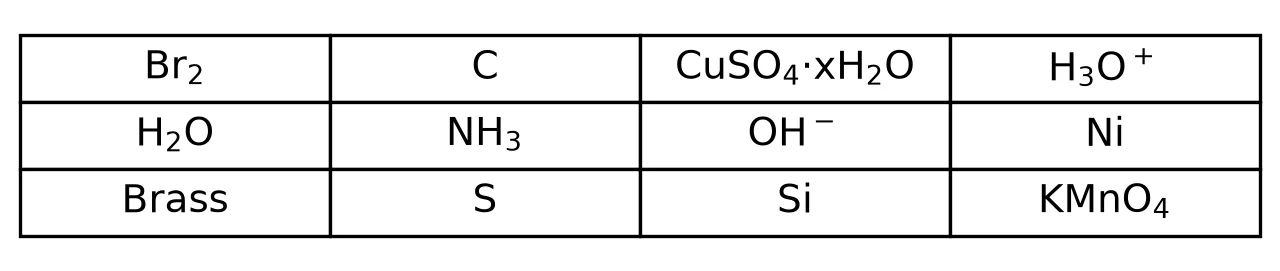 2.4 The experimental setup below is used to dry g hydrated blue copper(II) sulphate crystals, , to form g anhydrous salt.
Answer the questions that follow.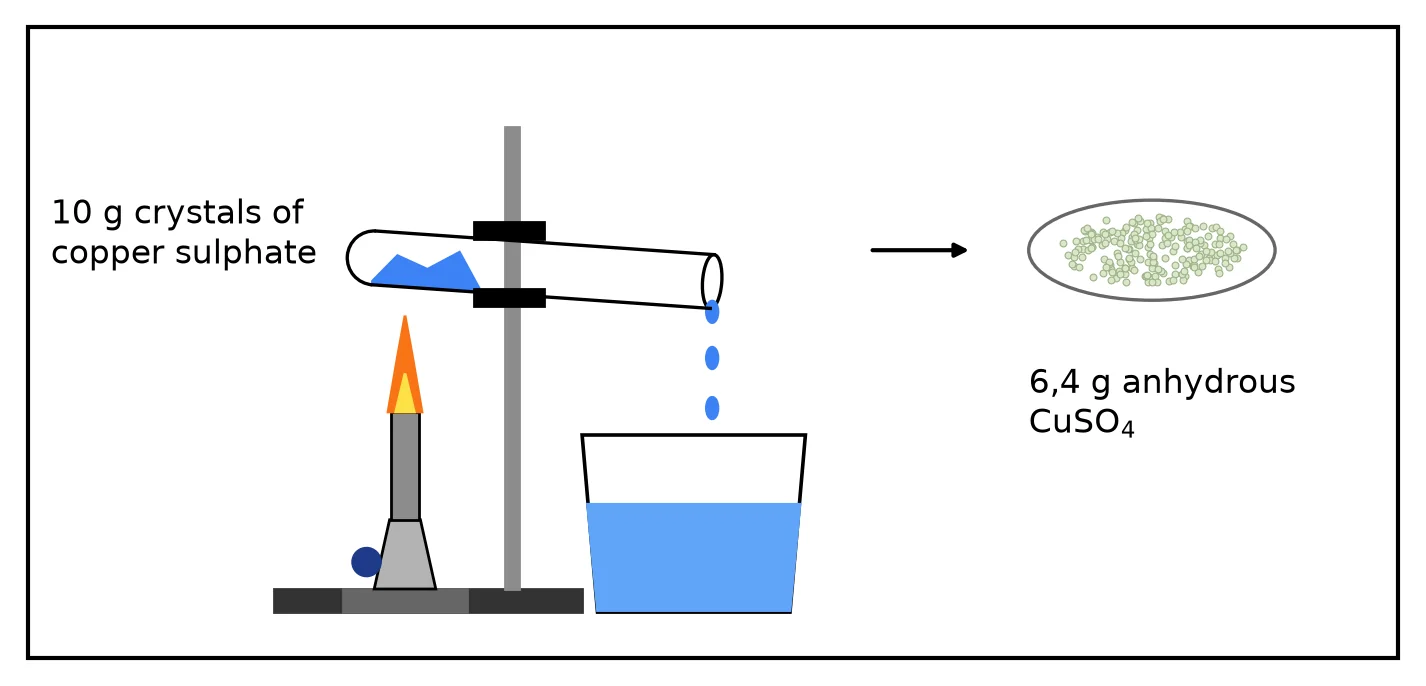 2.4.1 Define term anhydrous.(2)
Show the memo (1 tick)Memo
- ✓Definition of anhydrousFree of water.
2 marks · Define stoichiometry terms and laws
- ✓
Physical and Chemical Change Grade 10 videos
Short lessons from South African teachers first. Videos load only when you tap play, to save your data.
Free on Android
Know exactly which skill is costing you marks.
Mark past papers tick by tick in the NavyBlue app. It remembers every mark you lose, shows you the skills to fix first, and picks your next questions.
Get NavyBlue free on Google Play
